In 1973, at Belmont Park in New York, a horse named Secretariat crossed the finish line of the Belmont Stakes with a 31-length lead over the second-place horse. The race lasted 2 minutes and 24 seconds — a record that has stood unbroken for more than fifty years. Secretariat was not just a champion; he was the most perfect expression ever produced of a breed that humanity spent three centuries building toward a single objective: maximum speed.
The Thoroughbred is the fastest horse in the world at middle distances, and the animal whose deliberate, scientific development shaped modern horse racing and equestrian sport. The history of the Thoroughbred is the history of how genetics, ambition, and money combine to produce something extraordinary.
Building a Biological Machine: The Three Foundation Sires
The modern Thoroughbred has a surprisingly well-documented origin. The breed descends from three stallions imported to England between 1689 and 1724, crossed with English native mares — often called “Royal Mares.” These three stallions are considered the universal foundation sires of the breed:
Byerley Turk (arrived England 1689): a stallion captured at the Siege of Buda, likely of Arabian or Turkish origin, whom Captain Robert Byerley rode in battle before putting him to stud.
Darley Arabian (1704): imported from Syria by British consul Thomas Darley, this desert-bred Arabian is the founder of the most important male line in the Thoroughbred — approximately 95% of today’s Thoroughbreds trace their male line back to him.
Godolphin Arabian (1724): of uncertain origin (likely Arabian or Barb), reportedly found in a neglected state in Paris before becoming one of the most influential stallions in equine history.
These three stallions, crossed systematically with British mares over decades, produced progressively faster descendants. The process was what we would today call intensive artificial selection — only the fastest horses reproduced.
Maximum Speed: What Makes the Thoroughbred the Fastest
An elite Thoroughbred can reach speeds between 40 and 44 mph at full gallop. Secretariat was reportedly clocked at 44 mph during the Belmont Stakes — and that speed is not simply faster than other breeds. It is sustained, at full gallop, over distances of three-quarters of a mile to a mile and a half. The Quarter Horse may be faster in the first 440 yards; beyond that, the Thoroughbred is faster than any other horse on earth.
The biological mechanisms behind this speed are multiple and synergistic. The Thoroughbred has the largest average heart of any equine breed — a typical Thoroughbred’s heart weighs 8 to 11 pounds; that of common horses, 7 to 9 pounds. Secretariat’s heart, revealed after his death in 1989, reportedly weighed approximately 22 pounds — nearly three times the average. A larger heart means greater capacity to pump oxygenated blood to the muscles per beat.
Thoroughbred lungs are proportionally larger with greater gas exchange capacity. The muscular architecture favors fast-twitch fibers. The legs are long and light, maximizing stride length. Every aspect of the biology was shaped by three centuries of relentless selection for one variable: speed.
The Triple Crown: The Greatest Title in Equestrian Sport
Thoroughbred racing organizes itself around a central concept: the Triple Crown. In the United States, it is the sequence of three races for three-year-olds — the Kentucky Derby (Churchill Downs, Louisville), the Preakness Stakes (Pimlico, Baltimore), and the Belmont Stakes (Belmont Park, New York). Winning all three in the same season is considered the greatest individual achievement in equestrian sport.
Only thirteen horses have captured the American Triple Crown since the format was established. The rarity is part of what makes the title so valuable: the races are run only five and six weeks apart, requiring a three-year-old — still developing physically — to maintain peak performance under different conditions over six intense weeks.
England has its own Classic races: the Two Thousand Guineas, One Thousand Guineas, Epsom Derby, Oaks, and St. Leger. France has the Prix de l’Arc de Triomphe at Longchamp. Ireland, Japan, the UAE — the Thoroughbred is a genuinely global phenomenon.
The Economics of the Sport: A Multi-Billion Dollar Market
Thoroughbred racing moves tens of billions of dollars per year in legalized wagering worldwide. Japan has the world’s largest horse betting market, with annual volume exceeding $25 billion. The United Arab Emirates invests hundreds of millions in breeders, facilities, and prize money.
The Dubai World Cup, run at the Meydan Racecourse, carries the world’s largest individual horse race prize: $12 million. The Japan Cup in Tokyo offers more than $3 million. The Kentucky Derby, with all its American cultural weight, offers $3 million.
But it is in the breeding market where truly stratospheric values appear. A successful Thoroughbred racing stallion can be worth tens of millions of dollars as a sire. Coolmore Stud in Ireland and Darley, the breeding operation of the Al Maktoum family of the UAE, are business empires built on Thoroughbred genetics.
The Thoroughbred Beyond Racing: Its Role in Olympic Sport
The Thoroughbred’s impact on equestrian sport goes far beyond the racetrack. During the 20th century, Thoroughbred blood was the primary tool for improving European sport horses. The Hanoverian, the KWPN, the Selle Français — all the great Warmblood breeds that dominate Olympic equestrian sport today carry significant proportions of Thoroughbred blood in their pedigrees.
The process was deliberate: European Warmbloods had the structure and temperament for work but lacked elevation, elasticity, and athleticism. The Thoroughbred added exactly those qualities. The “blood infusion” with Thoroughbreds transformed European sport horses throughout the 1960s to 1990s.
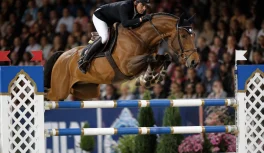
Today, horses with 25-50% Thoroughbred blood are common at the highest levels of eventing (cross-country) and show jumping — where the Thoroughbred’s bravery, elasticity, and cardiovascular capacity are direct advantages.
Temperament: Intelligent, Sensitive, Intense
The Thoroughbred has a temperament reputation that is simultaneously its trademark and its challenge. The breed is described as “hot-blooded” — sensitive, reactive, high-energy, and with a low tolerance for boredom. These are not horses for beginning riders or those who prefer casual, leisurely riding.
In experienced hands, the Thoroughbred is an extraordinary partner — responsive, intelligent, with a capacity to learn and connect with its rider that few animals match. The same horse with an inconsistent or heavy-handed rider can become unpredictable and difficult.
Off-the-Track Thoroughbreds (OTTBs) — former racehorses retrained for riding — have become a growing niche. With patience and appropriate rehabilitation, many OTTBs become excellent sport horses and leisure horses. Specialized programs in multiple countries work on transitioning these horses to a second career away from the track.
The Health Controversy: The Price of Extreme Specialization
Extreme selection for speed has consequences. The Thoroughbred is the most fracture-prone equine breed in competition — a problem directly related to the structural pressure that high-speed galloping imposes on bones and tendons that have been progressively refined by selection.
Injury rates in high-level racing are significantly higher than in other equestrian disciplines, and debates about animal welfare in Thoroughbred racing have become more prominent over the last two decades. Reforms in track surfaces, workload management for young horses, and veterinary protocols are partial responses to a deeper structural critique of the breeding model.
The Thoroughbred is also more prone to gastric ulcers than most breeds — estimates suggest 60-90% of horses in active racing training have some degree of ulcers, a consequence of the stress of intense training and high-concentrate diets.
These health questions do not diminish the magnitude of what the Thoroughbred represents — but they are part of an honest portrait of a breed built for extremes.
The speed Secretariat demonstrated in 1973 remains the ultimate symbol of what human genetic selection can produce in an animal. No other breed has come close to that record. None likely will. The Thoroughbred was built to be the fastest — and for more than three centuries, it is.