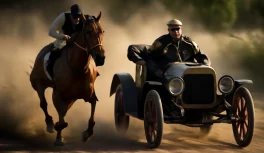
When most people think of horse racing, they picture Thoroughbreds running long distances over famous tracks. But there is a discipline that puts all of that in perspective — and its star is the Quarter Horse. In less than 25 seconds, these horses reach speeds that no other breed can match over short distances. It is the equestrian sprint taken to the extreme.
And the best part: you do not need to be an expert to appreciate it. All you need to know is that when the gates open, what happens in the next 402 meters is pure nature in motion.
What Is Quarter Horse Racing?
Quarter Horse racing is a straight-line race of exactly 402 meters — one quarter of an American mile, as the breed’s name itself indicates. There are no turns, no positioning strategy along the track, no distance running. There is only a start, a straight, and a finish line.
What decides the result is the explosion off the start and the ability to maintain peak acceleration for the few seconds the race lasts. Most high-level Quarter Horse races are decided in 21 to 24 seconds. For comparison: the world’s fastest human runs 100 meters in under 10 seconds. The Quarter Horse covers 402 meters in comparable time.
This places it among the fastest animals on earth in short sprints — with speeds that can exceed 70 km/h (43 mph) in the best individuals.
How Did This Race Originate?
Quarter Horse racing has colonial roots. In the 17th and 18th centuries, American colonists improvised straight tracks on main village streets — literally between one tavern and the next — and placed bets on weekends. The quarter-mile format was the preference because it fit within available space and produced fast, exciting results.
The horses that performed best in these races were selected over decades. The result is what we know today as the Quarter Horse: an animal shaped by selection pressure to be exactly this — a perfect sprinter.
Formalization came in 1940 with the founding of the AQHA, which began regulating both animal registration and competitions. Today, Quarter Horse racing is organized with the same standards as major Thoroughbred events — professional tracks, specialist jockeys, handicaps, and multimillion-dollar purses.
How Does the Competition Work?
The Start
Quarter Horse races start from starting gates (stalls) — metal structures that hold the horses positioned in a straight line before the race begins. When the start is given, all gates open simultaneously and the horses burst forward.
That moment — the first 50 to 100 meters — is decisive. A horse that breaks poorly from the gate rarely recovers the lost ground over such a short distance.
Speed Classification
Quarter Horse racing horses are classified according to their performance using the AQHA Speed Index (SI), which runs from 0 to 100. The index is calculated based on race time relative to the best time recorded for that distance. A horse with SI 100 is considered perfect for the race.
In practice:
- SI above 90: elite horse, competitive at national and international level
- SI between 80 and 89: high level, excellent for breeding
- SI below 70: outside the competitive racing circuit
The Most Important Races
In Brazil, the ABQM organizes a Quarter Horse racing calendar with events throughout the year, concentrated mainly in São Paulo, Paraná, and Mato Grosso do Sul states.
In the United States, the All American Futurity, run at Ruidoso Downs (New Mexico), is considered the richest race in the world in terms of prize money per distance — surpassing major Thoroughbred events in proportional prize value.
What Makes the Quarter Horse So Fast?
The Quarter Horse’s speed is no accident. It is the result of a specific physical construction:
- Wide and muscular hindquarters: generate the propulsion that launches the horse forward at the start
- Well-angled hind limbs: allow an extremely powerful push-off
- Compact and low body: reduces air resistance and keeps the center of gravity stable
- Predominantly fast-twitch muscle fiber: unlike endurance breeds, the Quarter Horse has a high proportion of muscle fibers oriented toward immediate explosive power
It is literally a horse built to accelerate — and centuries of selection performed that work with surgical precision.
Quarter Horse Racing in Brazil: A Growing Market
In Brazil, Quarter Horse racing drives a significant market — spanning auctions of high-SI horses, breeding services, specialized training, and equine tourism tied to events.
Racing is particularly strong in states such as São Paulo, Mato Grosso do Sul, Goiás, and Paraná, where agribusiness tradition meets a platform for high-performance sport.
For breeders, a sire’s Speed Index is one of the most valued criteria when selecting a stallion — a high-SI animal theoretically produces offspring with greater potential for racing and speed events in general.
Is Quarter Horse Racing Worth Watching?
Even someone who has never watched a horse race is impressed when they see a Quarter Horse in action. The race lasts less than 25 seconds — but in those 25 seconds, something happens that no camera fully captures: a living creature reaching the absolute limit of what its biology permits.
For horse enthusiasts, it is an experience that is hard to forget. For breeders, it is real-time genetics education. And for those who have never seen it, it is a good reason to find the next Quarter Horse racing event in your area.