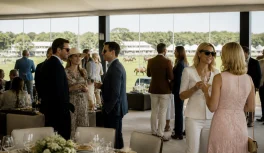
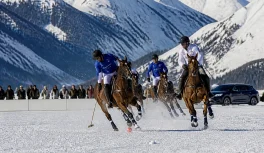
There is a mental image that most people cannot form spontaneously: Fernando Alonso holding a polo mallet 300 meters from the goal post, on a horse at full gallop, adjusting trajectory at the last second to score. The image seems unlikely until you discover that it is absolutely real — and that Alonso is far from the only Formula 1 driver who does this regularly.
The connection between Formula 1 drivers and polo is deeper than any lifestyle magazine piece suggests. For the athletes who live it, it is not an occasional hobby or a personal branding exercise — it is a natural extension of who they are and what they need to maintain the level of excellence that Formula 1 demands.
Why F1 Drivers and Polo Is a Combination That Makes Sense
To understand why so many F1 drivers gravitate toward polo, you first need to understand what polo demands of those who practice it.
Polo is, among all equestrian sports, the one that most closely resembles motorsport in terms of simultaneous cognitive and physical demand. A high-level polo player must control an animal weighing more than 1,000 pounds moving at over 30 mph, assess the positions of seven other players and horses around them, calculate attack and defense angles in real time, and execute a stroke of millimeter precision — all simultaneously, in cycles that repeat dozens of times per game.
For a Formula 1 driver who does exactly this with a car on a track where inputs follow at hundreds of miles per hour, polo is not an entirely foreign challenge. It is a different challenge, but one that activates similar skills: rapid reading of a dynamic environment, control of body and mind under pressure, instant decision-making with real physical consequences.
Fernando Alonso: The Most Well-Known Case
Fernando Alonso is probably the Formula 1 driver most associated with polo on the contemporary grid. The two-time champion from Asturias began practicing the equestrian sport years ago and developed his involvement with seriousness — not as a curious beginner, but with the dedication that characterizes his approach to any challenge.
Alonso found in polo something that other recreational sports do not offer: the presence of genuine risk. At a stage of his career when motorsport — having become safe enough to be widely practiced without fear of fatal consequences — might for some athletes lose part of its edge, polo restores a dimension of physical unpredictability that activates mental circuits which a modern cockpit tends to muffle.
Alonso also found in polo a way to stay competitive during periods away from the grid. During the years he spent partially away from F1, polo was a consistent part of his athletic maintenance — a sport that demands high-level physical conditioning, sharp peripheral vision, and the analytical agility that kept him among the finest drivers of his generation.
Carlos Sainz Jr.: The Saddle as Counterpoint to the Cockpit
Carlos Sainz Jr., son of the legendary Carlos Sainz and one of the most complete drivers on the current grid, has documented appearances at polo fields during his off-season periods. For Sainz, as for Alonso, polo seems to function as a recalibrator: an environment where high-performance skills are tested in a format completely different from motorsport.
There is one aspect of polo that no simulator or gym session can replicate: the animal variable. A polo horse has its own personality, responds in ways that cannot be fully predicted, tires in patterns that vary with each horse and each game. For a driver accustomed to a car that responds in a highly predictable way to its inputs — especially in an era of constant telemetry and fine-tuning — polo reintroduces the uncontrollable variable that is, at its core, the essence of high-risk sport.
Rubens Barrichello and the Brazilian Polo Connection
In Brazil, where polo has stronger roots than most Brazilians realize, the connection between motorsport and equestrian sport is even more natural. Rubens Barrichello, the Brazilian driver with the most Formula 1 starts in history at the time of his retirement, practiced polo throughout his career.
For Barrichello, polo was not merely exercise — it was part of a family and social culture that connected motorsport to the world of the Brazilian countryside, where horses and speed are not opposing worlds but faces of the same tradition. The Brazilian cowboy, the gaucho from the Pampas, the Pantanal horseman — all inhabit a universe where the horse and velocity coexist in a way that elite motorsport simply recognized and embraced.
Polo as High-Performance Physical Training
Beyond the cognitive and mental aspects, polo offers physical benefits that directly complement an F1 driver’s preparation.
Polo is a high-aerobic endurance sport. A complete game of eight chukkers — the playing periods of polo — involves roughly two hours of intense activity with intervals. Throughout that time, the player maintains an active posture on the horse, absorbing constant impacts, rotating the torso to strike, engaging the core to stabilize balance, and applying leg pressure to control the animal. It is comprehensive functional training that no gym session replicates with the same fidelity.
For a Formula 1 driver whose body must withstand G-forces of up to 5G through corners and maintain fine muscular control during two-hour races in temperatures that can exceed 120°F inside the cockpit, polo offers a conditioning complement that goes far beyond conventional gym training.
The Language Both Sports Share
There is a language that F1 drivers who play polo quickly discover: both sports speak in very similar ways about the same things.
The “line” in polo — the trajectory a player traces across the field to attack or defend — has a direct equivalent in the racing line a driver negotiates through a corner. The “setup” of a polo horse — how it is prepared, warmed up, the choice of mallet for each type of field — echoes the technical setup of a race car. The communication between player and animal parallels the communication between driver and engineer. Even the need to “feel” the field — to sense where the turf is more worn, where the ground gives — has an equivalent in the asphalt feel that the best drivers cultivate as a sixth sense.
This shared language is not coincidence. It is the result of two sports that, at their core, are about the same challenge: making a complex system — car or horse — perform at the absolute limit of its capability, under precise human control, in conditions that change every second.
Polo as a Mirror of What F1 Demands from Its Athletes
In the end, the reason so many Formula 1 drivers play polo is not difficult to understand: the best drivers are, above all, high-performance athletes who need challenges that bring out the best in them.
Polo, with its unpredictable horses, its physical intensity, and its demand for rapid decision-making in a dynamic environment, offers exactly that kind of challenge. And for the aces of the wheel who have discovered the saddle, the reverse movement — from polo back to the cockpit — confirms that the two sports are not opposites. They are variations on the same theme: the human being at the limit, in pursuit of the performance that separates the good from the exceptional.