The canter looks simple from the outside: the horse moves forward, covers ground, carries a rider. But underneath that apparent simplicity is a powerful chain of coordinated movement — hindquarters driving, a back that transmits and absorbs, and that brief suspended instant when all four feet leave the ground at once. Understanding canter biomechanics changes how you ride, because it explains why a canter becomes round and light, why it sometimes turns into a flat, rushing scramble, and why some horses break to trot when their bodies simply can’t maintain the gait.
The Three-Beat Canter — and Why the Suspension Matters
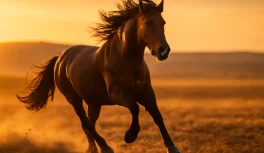
In the working canter, the footfall sequence occurs in three beats followed by a moment of suspension — a brief window in which no hoof touches the ground. This moment is the real quality test of the canter: it only exists cleanly when the horse’s body is organized enough to achieve “lift” and return to the ground without collapsing onto the forehand.
When the suspension is light and consistent, the canter feels effortless. When it disappears — replaced by a flat, shuffling rhythm — it usually means the body isn’t coordinating the way it needs to.
The Hindquarters: Engine and Brake at Once
If the canter were a vehicle, the hindquarters would be both motor and brakes. They perform two functions that seem contradictory but are completely interdependent:
1. Propulsion (driving forward) This is the energy that creates forward movement, power, and the upward component of the gait.
2. Load-bearing (carrying weight and balancing) The hindquarters must also receive a portion of the horse’s weight — especially when the rider wants a more collected, controlled canter.
When the Hindquarters Don’t Engage
The result is predictable: the horse tries to manage the canter by rushing — throwing weight onto the forehand. The rider feels:
- a heavy, pulling contact,
- a flat, hurried canter,
- difficulty turning,
- messy transitions in and out of the gait.
When the Hindquarters Engage Well
The opposite: the horse feels lighter in front without bracing, the rhythm holds, adjustments between short and long canter become possible without a fight, and the suspension becomes cleaner and more comfortable to sit.
The Back: The Bridge That Turns Power into Movement
The back connects the engine (hindquarters) to the steering (forehand). In the canter, it must be mobile and elastic, because it:
- transmits the energy generated behind,
- absorbs ground impact,
- allows the horse to stay organized without stiffening.
A Free Back = a Round Canter
When the back works correctly, the horse:
- maintains a softer, more consistent contact,
- uses the neck naturally as a balancing aid,
- appears to “swing” through the movement with visible ease.
A Blocked Back = a Hard or Rushing Canter
When the back locks, the horse loses the bridge — and compensates in one of three ways:
- rushing (to avoid sitting and engaging behind),
- breaking to trot (not enough energy to sustain the gait without the back),
- going tense and high-headed (the body stiffens across the whole topline).
In practice, a great deal of “fighting” in the canter traces directly back to a back that won’t — or can’t — move freely.
The Neck and Head: The Body’s Built-In Balancing Pole
Horses use the head and neck as a counterbalance, and in the canter — with its moment of suspension — this function is especially important. The horse needs to find the right balance between stability and freedom of movement.
- Too much restriction in front (a hard, fixed hand): the horse may brace the back and lose the suspension.
- Too much release without organization: the horse may fall onto the forehand and accelerate.
The goal is a steady, elastic contact — enough to give the neck something to work against, without blocking the movement that makes the canter what it is.
The Suspension: The Moment That Reveals Everything
The suspension is the micro-instant in which the horse is airborne. It functions as a real-time quality indicator:
- Light, consistent suspension → a balanced canter with well-distributed energy.
- Suspension that’s barely there (feels more like a fast trot) → an unorganized canter, typically with too much weight on the forehand.
- Heavy, crashing suspension (feels like the horse is falling) → suggests lack of strength, fatigue, or significant imbalance.
You don’t need slow-motion video to feel this:
- A good canter feels like it lifts and floats.
- A poor canter feels like it plows and falls.
Why the Canter Changes So Much on a Curve
Turning in the canter asks more of the horse’s body:
- more control through the shoulder (forehand),
- more load on the inside hindquarter,
- body alignment maintained on the correct lead.
Without the strength or coordination to manage this, a turn exposes every weakness: wrong lead, disunited canter, rushing, line breaks. This is why so many productive canter-training sessions use large circles — they strengthen the underlying biomechanics without the compressive demands of tight turns.
What Biomechanics Explains (Things You Already Feel)
“Rushes when I ask for the canter”
Typically: the hindquarters aren’t loading; the horse compensates by throwing weight forward and running.
“Breaks back to trot”
Typically: insufficient strength or coordination to sustain the back-hindquarter connection required for the gait.
“Heavy on the hand”
Typically: blocked back + forehand loading + hindquarters pushing rather than carrying.
“Disunited canter or wrong lead”
Typically: asymmetry + imbalance + a turn that demands more than the horse’s current capacity delivers.
Biomechanics isn’t abstract theory. It’s an explanation for what you already feel when you ride.
How to Support Better Biomechanics (Without Overcomplicating It)
1. Short transitions (trot ↔ canter, and within the canter itself) These teach the horse to reorganize the body and bring the hindquarters underneath. They’re one of the most effective tools for improving engagement.
2. Large circles and simple lines Help the horse find balance and keep the back free without inducing tension.
3. Short sets of quality canter A few good strides build more biomechanical strength than extended periods of poor-quality canter.
4. Elastic contact and rider position A following hip and stable, soft hands allow the horse’s back to do its job. A bracing rider blocks the very movement they’re trying to encourage.
A Beautiful Canter Is a Body in Harmony
Once you understand what’s happening in the back, hindquarters, and suspension, the canter stops feeling like a mystery. You start to perceive what’s missing: more engagement behind, a freer topline, better organization so the suspension can emerge on its own. And — most usefully — you stop correcting only the symptom (the rushing, the breaking, the stiffness) and start helping the horse build the movement correctly from the ground up.
The most beautiful canter isn’t the fastest one. It’s the one that feels easy — because the whole body is working together.