Some battles would never have been won without them. Some thrones would never have been consolidated, some conquests would have been impossible, some races would have been forgotten before the dust settled. The famous horses of history are not supporting characters in the great dramas of civilization — in many decisive moments, they were the reason the outcome went one way and not the other. And some of them carry names that have outlasted empires.
What earns a horse a place in history? Sometimes it is raw courage on a battlefield that decided the fate of entire civilizations. Sometimes it is a speed so extraordinary it challenges what we thought biology could produce. Sometimes it is the documented intensity of a leader’s devotion to one specific animal — a devotion so well recorded that posterity simply could not ignore it. And sometimes — as in the most deliriously bizarre episode in Roman political history — it is a lunatic emperor’s determination to appoint his favorite horse to the Senate.
Each of these animals carries a story that reveals at least as much about the humans beside them as about the horses themselves.
Bucephalus: The Horse No One Could Ride
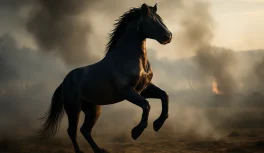
The most famous horse of the ancient world was considered unrideable. According to Plutarch, Bucephalus arrived at the Macedonian court when Alexander was twelve or thirteen years old — a massive black stallion that had thrown every rider who attempted him and was already being returned to the seller when the young prince asked for a chance.
What Alexander saw that the others had missed was simple: Bucephalus was terrified of his own shadow. The boy turned the horse to face the sun, mounted, and the animal — without the dark phantom on the ground beneath him — settled. His father, Philip II, reportedly wept and said: “My son, find a kingdom worthy of yourself — Macedonia is too small to contain you.”
For nearly two decades, Bucephalus carried Alexander through campaigns that stretched from Greece to what is now Pakistan. The horse died in 326 BCE at the Battle of the Hydaspes River, against the Indian king Porus — one of Alexander’s last great victories. He was more than 25 years old, a remarkable age for a warhorse. Alexander founded a city on the banks of that river and named it Bucephala in his honor.
What Actually Makes a Horse Famous?
The answer is almost never speed or beauty alone. Bucephalus was extraordinary because of what he and Alexander meant to each other — a partnership so thoroughly documented by ancient historians that it transcended military record and entered the personal mythology of the greatest conqueror of the ancient world. Marengo, the gray Arab who carried Napoleon through his most decisive campaigns, became famous less for any single battle than for an unlikely survival: after Waterloo, he was captured by the British, lived out his days in England, and died at 38 — with his hooves eventually put on display in a museum.
Copenhagen, the chestnut horse that carried the Duke of Wellington through Waterloo, was buried with full military honors at Stratfield Saye. His owner reportedly said: “I may have dined with kings, but the greatest honor of my life was riding Copenhagen at the Battle of Waterloo.”
The staying power of these animals in historical memory has a practical explanation: they were recorded by people who loved them and who held enough power that those records survived. It is a selection bias written into history — there were certainly other extraordinary horses, ridden by farmers and infantrymen with no one to write their stories down.
Horses That Turned Battles — and Battles That Turned the World
Why Were Warhorses So Decisive?
For more than three thousand years — from the first documented military use of horses around 2000 BCE to the First World War — the horse was the fastest and most versatile weapon on any battlefield. Well-deployed cavalry could decide the outcome of a battle in minutes, flanking enemy infantry or creating the panic that collapsed an entire defensive line.
The famous warhorses were those that stayed calm under cannon fire, amid the smell of blood and the chaos of open combat. That temperament was not accidental — it was bred across generations of careful selection and intensive training. The best warhorses were animals that trusted their riders completely, in the most extreme circumstances imaginable.
Comanche, the mixed-breed horse who survived the Battle of Little Bighorn in 1876 — where the U.S. 7th Cavalry Regiment was overwhelmed by Lakota and Cheyenne forces — was found gravely wounded two days after the massacre. He recovered, was declared the “second survivor” of the 7th Regiment, and was the only horse found alive on the battlefield. The U.S. Army retired him with honors and issued orders that he would never be ridden again.
The Horses That Ran Into Legend
What Made Secretariat More Than a Champion?
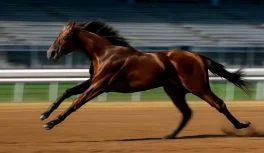
On June 3, 1973, at Belmont Park in New York, Secretariat covered a mile and a half (2,400 meters) in 2 minutes and 24 seconds — a time no horse had reached before and that, more than fifty years later, remains unmatched. The chestnut horse with the white blaze on his forehead won by 31 lengths, in a race where he did not merely outrun the field but left it behind entirely.
What transformed Secretariat from champion to myth was not the victory but the manner of it. After his death, reports famously estimated his heart at nearly 22 pounds — roughly three times the size of an average thoroughbred’s. A genetic anomaly that, according to those accounts, allowed him to pump far more oxygenated blood to his muscles with every stride.
Before Secretariat, there was Man o’ War — considered the greatest American racehorse of the 20th century before the 1970s. He won 20 of the 21 races he entered, in 1919 and 1920. The single loss was contested from the start — a race in which he was badly positioned at the gate. When he died in 1947, more than a thousand people attended his funeral.
Horses and Power: When Rulers Love Specific Animals
Throughout history, the bond between leaders and their horses was recorded with an intensity that goes far beyond the utilitarian. Frederick II of Prussia — Frederick the Great — loved his horse Condor with a devotion that reportedly unnerved his generals. Louis XIV of France built the stables at Versailles as one of the palace’s most elaborate structures, capable of housing 600 horses, with architectural details that rivaled the royal apartments themselves.
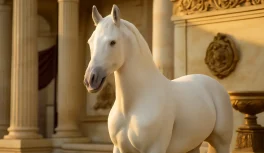
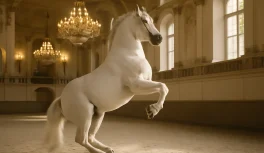
But nothing in recorded history comes close to the story of Incitatus, the white horse belonging to the Roman emperor Caligula. According to the historian Suetonius, Caligula did not merely love the animal — he intended to appoint him consul. The horse was reportedly given a marble stable, an ivory manger, jeweled collars, and a staff of dedicated servants. Whether the consulship was ever seriously intended remains debated by historians; some scholars argue it was a calculated provocation aimed at the Senate rather than a genuine plan. Either way, the episode has traveled two thousand years as the definitive symbol of power without limits.
Why These Animals Still Fascinate Us
There is something unsettling, and at the same time profoundly human, about the relationship between historical leaders and their horses. In animals that could not speak, that did not choose their riders, that had no way to understand the battles they were thrown into, we find a projection of the qualities we most admire: unconditional loyalty, courage in the face of danger, performance at the precise moment it matters most.
What Bucephalus was to Alexander, what Secretariat was to racing fans across a generation, what Marengo was to Napoleon — in every case, the animal became a mirror. In him, the humans around him saw not just a horse but a version of themselves they wished they could be.
That is why these names survive. Not simply because the horses were exceptional — but because the people who loved them needed them to be.