Numbers help, but they only go so far. A Shire horse that stands 18 hands and weighs 2,200 pounds is documented on paper — but the reality of standing next to one, feeling the ground vibrate slightly as it shifts weight, looking up to meet eyes the size of a fist, operates on a different register. The Shire’s physical characteristics are not merely measurements. They are the accumulated result of centuries of selection for a specific purpose, expressed in bone and muscle and hair.
Height: A Breed Built Upward
How tall is a Shire horse and how does it compare to other breeds?
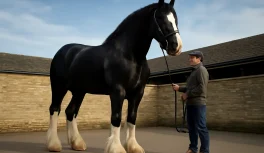
The Shire horse is, by any credible measure, the tallest horse breed in the world. Adult males (stallions and geldings) typically stand between 17 and 18 hands at the withers — the point at the top of the shoulder where a horse’s height is measured. Exceptional individuals have been recorded above 19 hands, and historical accounts describe animals reaching 19.2 hands, which translates to approximately 6 feet 6 inches at the withers alone.
To put this in context: a thoroughbred racehorse, already considered a large animal by most standards, typically stands between 15.2 and 16.2 hands. A Shire stands roughly a full hand taller on average — and because horse height is measured at the withers rather than the head, the actual head height of a large Shire, including the neck extended upward, can approach or exceed 7 feet.
How do male and female Shire horses differ in height and size?
Female Shires (mares) are typically somewhat smaller, with averages ranging from 16 to 17 hands, though large mares regularly exceed 17 hands.
Weight: The Mass Behind the Power
How much does a Shire horse weigh and what does that mass actually mean?
Shire height is impressive. Shire weight is extraordinary. Adult stallions commonly weigh between 1,800 and 2,200 pounds. Particularly large individuals have been documented at 2,600 pounds or more — well over a ton. To understand what this means in practical terms: a standard pickup truck weighs roughly 4,000 to 5,000 pounds. A large Shire represents nearly half that weight concentrated in a living, moving animal.
How did Shire horses use their body weight as part of their pulling mechanism?
This mass is not incidental — it is functional. A heavy draft horse uses its body weight as part of its pulling mechanism. When a Shire leans into a harness and drives forward with its hindquarters, its own mass contributes to the force applied to the load. Historical records from the early 20th century document pairs of Shires pulling loads exceeding 45 tons on smooth surfaces — a figure that challenges belief until you understand the physics of dead weight and rolling resistance.
Bone Structure and Conformation
What makes the Shire’s skeletal structure uniquely adapted for heavy work?
The Shire’s skeleton is built for compression and impact absorption. The cannon bones — the lower leg bones between the knee and the pastern — are substantially thicker in proportion to overall body size than in lighter breeds, providing resistance to the stress of pulling heavy loads on hard surfaces.
The hooves are notably large and round, designed to distribute the horse’s weight across a broader surface area. This matters particularly on soft or muddy ground, where a smaller, narrower hoof would sink and lose traction.
What does a Shire horse’s Roman-nosed head profile tell us about the breed?
The head is distinctively proportioned: wide and somewhat convex in profile (Roman-nosed in equestrian terminology), with large, widely spaced eyes and broad nostrils. The ears are large and alert. The overall expression is typically calm and attentive rather than nervous or reactive.
The neck is long, arched, and heavily muscled, connecting to shoulders with an angle that facilitates both collar fit for draft work and free movement at the walk. The back is relatively short and strong. The barrel — the horse’s midsection — is deep and wide, with well-sprung ribs that give the lungs and digestive organs ample room.
The Feathering: Form and Function
What is the biological origin of the Shire’s iconic leg feathering?
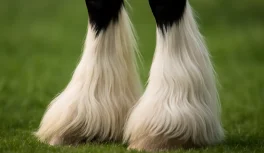
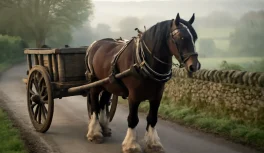
No physical feature is more immediately identified with the Shire than its feathering — the long, silky hair that grows from just below the knees and hocks, flowing down over the hooves. In well-kept animals, particularly dark-colored Shires with white feathering, the effect is visually remarkable: a massive, powerful animal moving with what appears to be flowing skirts of silk.
The feathering is not purely decorative. Its origin is functional — heavy horse breeds developed in cold, wet climates grew this additional hair as insulation and weather protection for the lower legs. The dense structure of the feathering prevents moisture and mud from reaching the skin directly, reducing the risk of bacterial skin infections common in animals kept in wet conditions.
How is feathering care and judging handled at Shire horse shows?
In competition animals, feathering care is extensive. Judges evaluate the quality, texture, and distribution of the feathering — preferring long, fine, silky hair over sparse, coarse, or unevenly distributed growth. Championship preparation involves washing, conditioning, drying, and sometimes braiding the feathering in decorative patterns.
Color Patterns
What coat colors appear in the Shire horse breed?
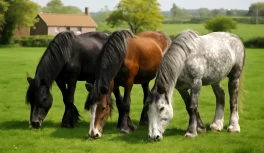
Shire horses occur in several color patterns, with black being historically the most common and highly valued in show contexts. Bay (brown body with black mane and tail), brown, gray, and roan (a mix of colored and white hairs) also appear regularly in the breed.
Why does the black Shire with white markings create such a striking visual impact?
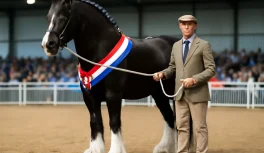
White markings on the face and legs are common and often striking — a black Shire with white stockings and white feathering presents one of the most visually dramatic appearances of any horse breed. The contrast between the solid dark body and the bright white leg markings, emphasized by the flowing feathering, creates the silhouette most associated with the breed in popular imagination.
A Body Built for Generations
What does the Shire’s physical form reveal about the environment that shaped it?
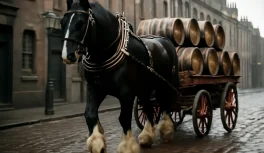
The physical characteristics of the modern Shire are not the result of any single breeder’s vision. They evolved over centuries of agricultural work in specific conditions — the clay soils of the English Midlands, the cobblestone streets of industrial cities, the damp cold of an English winter. Every proportional decision encoded in the Shire’s body — the depth of chest, the roundness of hoof, the texture of feathering — answered a real problem in the world that shaped it.