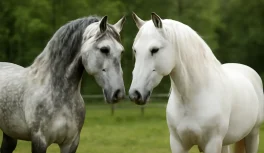
The Shire horse was not designed in a laboratory. It was shaped by centuries of necessity — by farmers who needed animals capable of pulling massive loads across clay-heavy Midlands soil, by merchants who needed reliable power to move goods through unpaved medieval roads, by a growing nation that needed a horse equal to its ambitions. Understanding where the Shire came from is understanding the story of pre-industrial England itself.
The Medieval Foundations
What medieval warhorses were the genetic predecessors of the modern Shire?
The horses that would eventually become the Shire trace their roots to the great war horses of medieval Europe. When William the Conqueror brought heavy Flemish stallions to England after 1066, he introduced a genetic line fundamentally different from the lighter native horses already on the island. These Flemish imports — bred in the Low Countries for pulling artillery and carrying armored knights — were large, heavily built, and extraordinarily strong.
When did the power of heavy horses first prove its agricultural value in England?
English landowners quickly recognized the agricultural potential in horses built for power rather than speed. The same physical attributes that made a horse carry 450 pounds of knight and armor also made it ideal for pulling heavy plows through the notoriously difficult clay soils of the English Midlands.
By the 13th and 14th centuries, a recognizable tradition of heavy horse breeding had established itself in the counties of Lincolnshire, Leicestershire, and Staffordshire — the geographic heart of what would become Shire horse country. These animals were not yet a formal breed, but they shared characteristics: extraordinary size, patient temperament, heavy bone structure, and an ability to sustain effort over long working days.
The Role of Flemish Bloodlines
How did Flemish and Dutch horses continue to refine the Shire after the Norman Conquest?
The Flemish connection did not end with the Norman conquest. Through the following centuries, English breeders repeatedly introduced Flemish and Dutch stallions to refresh and improve their heavy horse stock. The most influential of these later introductions occurred in the 17th century, when Dutch engineers brought skilled workers — and their heavy horses — to England to drain the fens of Lincolnshire and Cambridgeshire.
How did the 17th-century Dutch fen-drainage project shape the Shire’s genetics?
The Dutch engineers’ horses mixed with the local heavy stock, producing animals that combined the size and strength of Continental breeds with temperamental qualities selected over generations of English agricultural work. This cross became particularly influential in Lincolnshire, one of the counties most closely associated with the early development of the Shire.
The 18th Century: Foundation and Naming
Who was the Packington Blind Horse and why does his bloodline appear in every modern Shire?
The formal history of the Shire breed is typically dated to the 18th century, when systematic breeding and record-keeping began replacing the informal practices of previous generations. The most celebrated foundation sire of the modern Shire is the Packington Blind Horse, a black stallion that stood in Leicestershire from approximately 1755 to 1770.
The Packington Blind Horse was exceptional enough that his breeding services were sought by farmers across a wide area, and his descendants dominated the early development of the breed. His name appears in the genealogy of virtually every modern Shire horse.
Why was 1878 the defining year for the Shire’s official identity and name?
The breed acquired its current name in 1878, when Robert Bakewell’s work in systematic livestock improvement had raised awareness of selective breeding across England. The term “Shire” referred to the English Midland shires — the counties where the breed had its deepest roots and most enthusiastic supporters. In 1878, the Shire Horse Society was founded and the first stud book was published, giving the breed a formal identity and a mechanism for maintaining genetic records.
The Industrial Revolution: Peak Demand
How did the Industrial Revolution make Shire horses more valuable rather than obsolete?
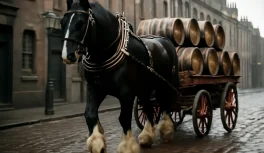
The Industrial Revolution, which accelerated through the late 18th and 19th centuries, did not replace the Shire horse — it made it more valuable than ever. Canal systems, railways, and expanding urban centers all created demand for animals capable of moving heavy loads over short distances. Canal boats needed horses to pull them along towpaths. Railway stations needed horses to distribute goods from depots to warehouses. Urban factories needed horses to receive raw materials and ship finished products.
How many Shire horses were working at the Victorian peak of the breed’s population?
The peak of the Shire horse population came in the late 19th and early 20th centuries. The 1901 census of England and Wales recorded more than a million working horses — the majority of them in the heavy draft category, with Shires accounting for a large proportion. Annual registrations with the Shire Horse Society reached into the thousands.
The 20th-Century Decline
What technologies replaced the Shire horse and how quickly did the transition happen?
The invention and proliferation of the internal combustion engine reversed the Shire’s fortunes with cruel speed. Tractors replaced agricultural horses beginning in the 1920s. Motor trucks replaced delivery horses in urban settings through the 1930s and 1940s. Two world wars consumed hundreds of thousands of horses. By the 1950s, a breed that had numbered more than a million animals had been reduced to fewer than a thousand registered individuals.
How did international enthusiasm help save a British breed from extinction?
The recovery came through the dedication of a small community of breeders who maintained the breed not for economic return but for historical and cultural reasons — and through the unexpected support of American and Australian enthusiasts who recognized in the Shire something worth preserving. Today’s global population of 3,000 to 5,000 animals is a shadow of the breed’s Victorian peak, but it represents a genuine survival story.
A Breed Rooted in Place
What does the Shire’s physical form tell us about the centuries of work that shaped it?
The Shire’s history is, ultimately, a history of a specific place — the English Midlands — and a specific moment — the centuries between medieval agriculture and industrial mechanization. The breed carries the accumulated work of hundreds of generations of farmers, farriers, and horsemen who shaped it for a purpose that no longer drives the world. What remains is an animal of extraordinary physical presence and characteristic gentleness, carrying its history without knowing it.