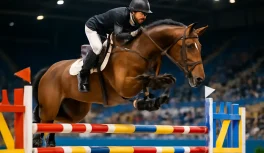
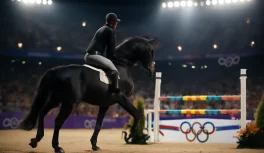
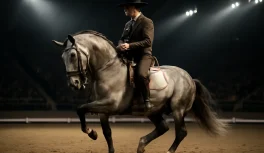
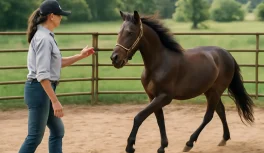
In the stands at the Paralympic Games, the audience watching Paralympic equestrian tends to fall quiet before any other sport. Not from indifference — quite the opposite. It is a silence of attention: the kind that comes when you realize what is happening in the arena goes beyond the score on the board.
Paralympic equestrian is a discipline of adapted dressage for athletes with physical and neurological disabilities. Formally established by the FEI in the 1990s and included in the Paralympic Games since Atlanta 1996, the sport reveals a dimension of equestrian that extends beyond conventional athletics: the horse’s capacity to respond to commands that don’t follow traditional patterns, to create safety for riders who depend on it in ways a conventional rider never would — and to transform, in ways science is still working to quantify, the experience of the people who ride.
How Does Paralympic Equestrian Work?
Paralympic equestrian is divided into grades — currently five, from Grade I to Grade V — corresponding to the level of physical or neurological impairment of the athlete. Grade I includes athletes with the most significant impairment; Grade V, those with the mildest.
Each grade has its own dressage tests, with movements calibrated to what the athlete can execute. Some grades permit modified aids — extended whips, voice commands, trunk movement as a substitute for leg aids. Judging takes into account not only technical execution, but the quality of the horse’s movement and the perceived harmony between athlete and animal.
In Grades I and II, highly trained dressage horses with exceptionally stable temperaments are essential: these athletes have little or no function in their lower limbs, and control is exercised primarily through the trunk, hands, and in some cases voice aids.
What Does a Paralympic Horse Need?
The selection of horses for Paralympic equestrian follows criteria that are different — and in many respects more demanding — than conventional dressage.
Ultra-stable temperament. A horse that reacts to unexpected stimuli with spooking or evasion is dangerous for a rider who cannot stabilize or correct the horse’s path in the same way a conventional rider can. The Paralympic horse must be naturally calm, consistent, and tolerant.
Responsiveness to non-conventional aids. The horse must learn to respond to commands given through the trunk, voice, and rein contacts very different from conventional riding. This requires not only training, but a specific kind of intelligence — the capacity to read each rider individually.
Connection with different athletes. In some Paralympic competition formats, particularly in preparatory contexts, horses are ridden by different athletes. The horse that thrives in this environment is one that doesn’t depend on a unique and specific communication with one human — but can adapt its responsiveness.
Quality of movement. Paralympic equestrian is dressage. Judges assess the horse’s movement with the same quality criteria as conventional dressage — rhythm, relaxation, impulsion, straightness. A horse with poor biomechanics will not score well, regardless of the athlete’s performance.
The Truth About Partnership in Paralympic Equestrian
Paralympic riders who have reached the elite level frequently describe the relationship with their horses with an intensity that goes beyond conventional athletic partnership.
Lee Pearson, the British rider with arthrogryposis — a condition affecting multiple limbs — who won ten Paralympic gold medals between Sydney 2000 and Tokyo 2020, described in multiple interviews how his horses learned to read his trunk position as a substitute for the leg aids he cannot give. “They know what I’m asking before I complete the movement,” Pearson said. “I’ve learned as much from them as I’ve taught them.”
Anabel Balkenhol, a German rider who competed at the Paralympic Games with severe arthritis, described the moment her horse — after months of work — began anticipating corrections before she asked for them. “He looks after me as actively as I look after him.”
These are not sentimental anecdotes. They describe a phenomenon that equine behavior researchers have been documenting: horses that spend enough time with Paralympic riders develop response patterns specific to each athlete, which can be more sophisticated than the response to a conventional rider precisely because the communication channel is more complex.
Paralympic Equestrian and Therapeutic Riding: Relationship and Distinction
It is common for discussion of Paralympic equestrian to blend with therapeutic riding — therapy assisted by horses. The relationship exists, but they are different things.
Therapeutic riding uses riding as a therapeutic intervention — with goals of physical, sensory, or psychological rehabilitation. Paralympic equestrian is competitive sport, focused on athletic performance within rules established by the FEI.
What they share is the growing evidence that horses have a particular capacity to respond to riders with special needs in ways that benefit them beyond physical movement. The transfer of body heat, the three-dimensional oscillation of the horse in motion, and the sensory feedback of riding have documented effects on muscle tone, balance, and coordination.
For many Paralympic athletes, equestrian began as therapy — and became sport when they discovered they could compete.
Names That Built the History of Paralympic Equestrian
Lee Pearson (Great Britain) is the most decorated athlete in the sport’s history — ten golds across five consecutive Paralympic Games, with different horses over two decades. His trajectory stands as a sustained study in adaptation and partnership.
Pepo Puch (Austria) won multiple medals at Athens and Beijing while riding with only one functional upper limb. His ability to control high-level horses under physical constraints that most trainers would have considered incompatible with elite performance transformed what the world understood as possible in equestrian sport.
Rodolpho Riskalla (Brazil) — diagnosed with Sjögren’s syndrome affecting mobility — represented his country at the Tokyo 2020 Games and won a silver medal in the Grade II individual event, putting Brazilian Paralympic equestrian on the international map.