Few animals have crossed so many cultural borders carrying the same symbolic weight. Horse symbolism across world cultures is one of the most consistent narratives in human history: from civilization to civilization, from continent to continent, the horse emerges as a symbol of freedom, power, nobility, and connection to the divine.
This consistency is not accidental. It speaks to a real relationship — the partnership between humans and horses that lasted millennia and shaped the course of history. And when a relationship runs that deep, that long, and that consequentially, it inevitably becomes symbol.
What Does the Horse Represent in Chinese Culture?
In China, the horse is one of the twelve animals of the zodiac and carries specific symbolism within the Taoist cosmological system. Associated with the Yang element — the active, solar, expansive energy — it represents movement, freedom, and vitality.
The horse in Chinese tradition is also associated with the speed of communication and success in endeavors. The expression mǎ dào chéng gōng (馬到成功), literally “where the horse arrives, success follows,” is one of the most popular wishes of good fortune in business and projects.
In classical Chinese art, the horse appears frequently in full gallop — not harnessed, not domesticated, not in service. The free horse was considered a sign of a state’s health: a prosperous country had horses that could run. A nation in decline had horses yoked to heavy labor with no light in their eyes.
Emperor Han Wudi (141–87 BCE) became so obsessed with the “celestial horses” of Central Asia — described in ancient texts as animals whose sweat ran with blood — that he launched military expeditions to find them. Not only for strategic utility: for symbolic meaning. Possessing the celestial horses was possessing the mandate of heaven.
How Did the Greeks Understand the Horse?
In ancient Greece, the horse was both an instrument of war and a symbol of civilization. The word hippos (horse) entered the names of gods, heroes, and cities — Hippodrome, Hippolyta, Philip (literally “lover of horses”).
The Greek Poseidon was the god of the seas, but also of horses — the link between the two domains reflected the Greek perception that horse and ocean shared something essential: untamable force, unpredictability, and the capacity to destroy and sustain in equal measure.
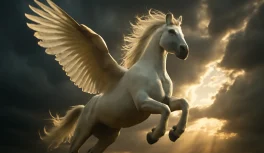
Pegasus, the winged horse, is one of the most enduring symbols of Greek mythology — and one of the most richly layered. Son of Poseidon and Medusa, he was born from the blood that sprang when Perseus cut off the monster’s head. The duality is inscribed in his origin: absolute beauty rising from violent death. Pegasus became a symbol of poetic inspiration — the Greeks believed that where he struck the ground with his hoof, the spring Hippocrene welled up, and from its waters poets drank to create.
The connection between the horse and intellectual creativity was not metaphorical for the Greeks — it was cosmological. The animal that carried gods and heroes also carried the muses.
The Horse in Celtic and Norse Traditions
The ancient Celtic cultures of Europe maintained a horse cult that permeated both religion and politics. The goddess Epona — whose name derives from the Celtic word for horse — was worshipped throughout Gaul and parts of Britain. She was depicted surrounded by horses, and her presence was associated with fertility, the protection of travelers, and the passage to the afterlife.
What makes Epona’s cult remarkable is that the Romans — normally resistant to adopting deities from conquered peoples — incorporated her into the Roman pantheon. She was the only Gaulish deity worshipped in Rome.
In Norse tradition, Odin had an eight-legged horse named Sleipnir — the fastest of all animals, capable of traveling between the nine worlds. The number eight was no accident: four legs in the world of the living, four in the world of the dead. Sleipnir was the vehicle of crossing, allowing the god to move between Midgard and Helheim.
The idea of the horse as a mediator between worlds — between life and death, between earth and sky — reappears in cultures separated by oceans and centuries, suggesting that this is not a matter of cultural transmission but something deeper: a shared perception about the nature of the animal.
The Horse Among Indigenous Peoples of the Americas
Although horses disappeared from the Americas at the end of the Pleistocene (roughly 10,000 years ago) and only returned with the Spanish in the sixteenth century, many Native American cultures developed a relationship with the animal that quickly took on spiritual dimensions.
The Lakota, Comanche, Apache, and other nations of the Great Plains did not merely use the horse strategically — they integrated it into their cosmologies. For the Lakota, the horse was šúŋkawakȟáŋ — literally “sacred dog” or “mysterious dog” — and possessing horses was possessing medicine, spiritual power.
Horse dances, songs of protection for animals before battles, burials alongside horses — all of this speaks to a relationship that transcended the utilitarian with remarkable speed. In less than a century, the horse went from an unknown animal to a central element of the cultural and spiritual identities of entire nations.
This suggests that when Indigenous cultures encountered the horse, they recognized in it something their traditions already described — the power animal, the carrier of vital force. The encounter was one of recognition, not discovery.
The Horse in Islam and the Middle East
In Islamic tradition, the horse is mentioned in the Quran as one of the animals created with specific purpose — to serve humanity, but also to remind people of the greatness of divine creation. The Prophet Muhammad had horses by name, and the tradition of furusiyya — the Arab equestrian art, combining cavalry, warfare, ethics, and spirituality — elevated the care of horses to a near-religious practice.
The Buraq — the creature that carried the Prophet on the Night Journey (Isra and Mi’raj) described in the Quran — is described as a creature with the body of a white mule, wings, and a human face. The choice of an equine creature for that crossing between the earthly and the divine is consistent with the global pattern: the horse as a vehicle of transcendence.
In pre-Islamic Arab culture, the genealogy of horses was preserved with the same care as human genealogy. A horse of pure lineage was both a proof of God and an instrument of survival. Separating the two dimensions — the utilitarian and the spiritual — was impossible because in ancient Arab tradition, they did not exist separately.
Why Is Horse Symbolism So Universal?
The question that all these cultures pose, taken together, is this: why the horse? Why not the lion, which is more powerful? Why not the elephant, which is larger? Why not the eagle, which can fly?
The answer lies in partnership. The horse is the animal that humans rode — that carried bodies, not merely cargo. That allowed itself to be guided by a being smaller, weaker, with less acute senses. This choice — because at some point it was a choice by the animal, not only by the human — created a relationship unlike any other in history.
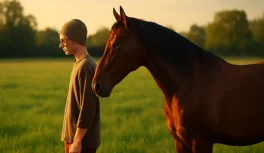
When you ride a horse, you don’t dominate — you negotiate. The horse feels your fear before you process it consciously. It reads your tension, your calm, your intention. It is a mirror with legs — a being that reflects back who you are with a precision no human can match.
Perhaps that is why so many cultures saw something divine in the horse. Not because the animal was supernatural, but because the relationship with it revealed something about what it means to be human. And that revelation, in any language and in any century, deserves a permanent symbol.