When the first treatises on classical equitation were written in Renaissance Europe — by Federici Grisone in Naples, by António Galvão in Lisbon — the horses they used as models were Iberian. Those horses were the direct ancestors of the Lusitano competing on dressage arenas around the world today. The relationship between the Lusitano and dressage is not a modern adaptation. It is a continuation of centuries.
Contemporary dressage — an Olympic discipline governed by the FEI — demands very specific qualities from a horse: impulsion without tension, lateral flexibility, capacity for collection, responsiveness to aids, and a genuine willingness to work in partnership with the rider. The Lusitano has all of these qualities encoded in the breed — not by coincidence, but because it was the Lusitano itself that inspired the foundations of the discipline.
Why Does the Lusitano Excel at Dressage?
The answer lies in conformation and temperament working together.
Hindquarters that support collection: The Lusitano’s well-developed, rounded hindquarters and favorable joint angles allow the hind legs to step naturally under the body — what trainers call “engagement from behind.” Without that engagement, advanced collected movements like piaffe and passage lose quality and sustainability.
High neck set and natural arch: The Lusitano’s long, arched neck, set high on the chest, allows the horse to elevate the forehand naturally. Horses with lower, more horizontal neck set require far more training to achieve the same result — and frequently do so with tension detectable by judges.
Powerful hindquarters: The Lusitano’s hindquarters provide the thrust necessary for movements that place high load on the hind joints. Without posterior power, the airs above the ground are simply impossible.
Responsiveness to subtle aids: Advanced dressage relies on aids that become increasingly invisible as levels progress. The Lusitano — refined by centuries of classical equitation — responds to nuances invisible to outside observers.
Has the Lusitano Competed at the Olympics?
Yes. Lusitano dressage gained growing international visibility from the 1990s onward. In a field dominated by Dutch and German Warmbloods bred specifically for modern sport over decades of targeted selection, the presence of the Iberian breed is a statement in itself.
Gonçalo Carvalho was one of the first Portuguese riders to reach the world elite of dressage on Lusitano horses. His partnership with Rubi throughout the 2000s demonstrated that Iberian horses could compete at the highest levels of a discipline that seemed increasingly reserved for large-framed, expansive-moving Warmbloods.
João Victor Oliva (Brazil) brought Lusitanos to FEI international circuits from the 2010s onward, becoming one of the breed’s most visible ambassadors in the global sport scene.
Classical Dressage vs. Competition Dressage: Where Does the Lusitano Shine?
It’s essential to distinguish these two fields.
FEI competition dressage: Codified tests that evaluate precision, impulsion, regularity, and harmony in specific movements. The Lusitano competes here but faces comparison with Warmbloods whose longer strides are favored by modern scoring criteria that reward amplitude.
Classical dressage and High School: A discipline valuing deep collection, genuine harmony, and the execution of the airs above the ground. Here the Lusitano has no rival. The airs — levade, croupade, capriole — were developed specifically with Iberian horses and are still performed almost exclusively by Lusitanos and Lipizzanos of Iberian blood.
The Portuguese School of Equestrian Art (Lisbon) and the Spanish Riding School of Vienna (Austria) are the two great world centers of classical dressage — and both built their tradition on horses of Iberian origin.
How Do You Train a Lusitano for Dressage?
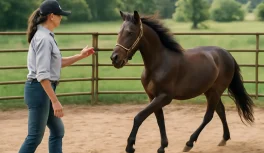
Training a Lusitano for dressage requires patience and an approach that respects the breed’s sensitive nature. Methods based on pressure or mechanical repetition produce resistances in this breed that are very difficult to undo.
Foundation phase (6–18 months): Balance, relaxation, impulsion, and contact. The rider works toward a horse that moves forward regularly and accepts the reins without tension. No advanced work before this phase is solid.
Development phase (18–36 months): Lateral work — leg yield, renvers, travers — foundations of the half-halt and early pirouette work.
High school (36+ months): Piaffe, passage, canter pirouettes, half-pass. The airs, when pursued, begin with the levade — the balance movement that underpins every other air above the ground.
The Lusitano’s sensitivity means the rider must maintain emotional consistency throughout training. Horses of this breed detect tension, frustration, or impatience before those states appear in the aids — and respond to them in ways that look like resistance but are, in reality, a response to the rider’s own involuntary communication.
What Is the Hardest Dressage Movement for the Lusitano?
This question comes up often among riders who work with the breed.
The Lusitano has natural ease in collected movements — piaffe, passage, pirouettes — which are the heart of classical equitation. Difficulty, when it appears, tends to come in extended movements that dominate modern FEI tests: extended trot, extended canter, extensions that demand long, sweeping strides.
This reflects the difference between the Lusitano’s morphology — compact, with naturally elevated movement — and the Warmblood’s — generally longer, with horizontally expansive strides. It is not a deficiency. It is a difference of type. Riders who understand this develop extensions with patience, using impulsion and flexibility exercises that allow the horse to expand its natural stride without sacrificing the collection quality it already possesses.