If there is one horse that captures the best of equine breeding in the Americas, that horse is the Quarter Horse. Compact, muscular, explosive, with a temperament that wins over working ranchers and weekend riders alike — the Quarter Horse is not just a breed. It is a story of intelligent selection, real work, and passion that traveled across centuries and oceans to become one of the cornerstones of Brazilian agribusiness and equestrian sport.
In this article, you will understand where this extraordinary breed came from, what makes it so special, and why, once you ride a Quarter Horse, it is very hard to want another.
Where Does the Quarter Horse Come From?
The story of the Quarter Horse begins around 1600, in the North American English colonies that would become the United States. It is considered the first horse breed developed in the Americas — and that origin already says a great deal about what it is.
The genetic base came from the blending of two worlds:
- Horses brought by English and Spanish colonists with Oriental blood — Arabian and Turkish — contributing refinement, speed, and endurance
- Descendants of Iberian horses turned loose in the Americas, the ancestors of mustangs, rustic and adapted to harsh conditions
The result was an animal unlike anything that had existed before: compact, powerfully hindquartered, explosive over short distances, and highly functional for cattle work on vast American ranches.
Why the Name “Quarter Horse”?
The name is no metaphor. In the 17th and 18th centuries, American colonists organized straight-track races on village streets on weekends — literally between one tavern and the next. The races were exactly one quarter of a mile long — approximately 402 meters. In these fast, explosive contests, the horses of the developing breed were unbeatable: they broke hard from the start, hit top speed in seconds, and crossed the line before any other animal had found its stride.
The nickname stuck and eventually became the official breed name.
In 1940, organization arrived with the founding of the American Quarter Horse Association (AQHA) in Texas — which would become the world’s largest horse breed registry. The first officially registered horse was the stallion Wimpy, born in 1937 at the King Ranch, a farm that would become legendary in the breed’s history.
How Did the Quarter Horse Come to Brazil?
The breed reached Brazil in the 1950s, and the story has a name and an address: Swift King Ranch (SKR), linked to the King Ranch of Texas, brought the first animals to Fazenda Bartira in Rancharia, in the interior of São Paulo state.
The first imports were the stallion Saltillo Jr. and a group of selected mares. Soon after came other sires — including Caracolito, whose impact on Brazilian genetics would be felt for decades.
The adaptation was immediate. Ranchers working with cattle quickly recognized that the Quarter Horse had exactly what they needed: strength, short-distance speed, cattle instinct, and reliable temperament. The breed spread rapidly — and on August 15, 1969, the Brazilian Quarter Horse Breeders Association (ABQM) was founded at Parque da Água Branca in São Paulo.
Today, the ABQM has registered more than 650,000 animals and organizes some of Brazil’s largest equestrian events. It is one of the world’s largest breed associations — and the Quarter Horse is, without exaggeration, one of the pillars of Brazilian equine industry.
What Does the Quarter Horse Look Like?
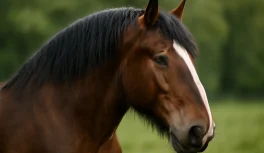
Anyone who looks at a Quarter Horse for the first time notices immediately: this is a horse built to be used. It is not the tallest, nor the most refined — but it projects a sense of concentrated power that impresses anyone who knows horses.
In numbers:
- Height: between 14.3 and 15.3 hands (1.50–1.60 m)
- Short, compact, and deep body
- Wide chest with well-developed pectoral muscle
- Strong, well-connected back
- Wide, sloping, and extremely muscular hindquarters — the breed’s great “engine”
That hindquarter is not merely visual. It generates the explosive launch from the start, enables the sliding stop, facilitates the quick turn in barrel and pole events, and provides lateral power in cattle work.
Head and limbs:
- Short and expressive head, with large, alert eyes
- Short to medium neck, well-muscled and connected
- Limbs with solid bone, firm joints, and good hooves
The result is what breeders call a “stocky short horse”: an animal that always looks ready to work, with a physical presence that needs no height to command respect.
What Coat Colors Are Accepted in the Quarter Horse?
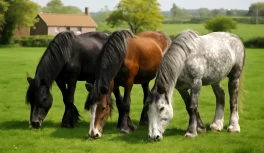
The breed standard accepts a wide variety of coats, including: chestnut, dark chestnut, bay, light bay, palomino, brown, roan, gray, dun, and black.
Not accepted for official registration: pinto, paint, or white horses in their varieties. A horse with these characteristics may have the Quarter Horse body type, but will not enter the ABQM registry as a purebred.
What Is the Quarter Horse’s Temperament Like?
One of the greatest reasons for the Quarter Horse’s popularity — perhaps even more than its speed or strength — is temperament.
In general, it is:
- Docile and balanced: responds well to training, not prone to unpredictable reactions
- Intelligent: learns quickly and retains what it learned
- Willing: has a genuine desire to work alongside the rider
This combination makes the Quarter Horse reliable under pressure — whether in cattle work, a rodeo event, or a ride with beginners. It “gives its all” with whoever is in the saddle.
Where Does the Quarter Horse Excel?
Quarter-Mile Racing
The breed’s original sport — the straight 402-meter race — remains one of the Quarter Horse’s specialties. In short sprints, many individuals reach impressive speeds, making the Quarter Horse one of the fastest horses in the world over short distances.
Cattle Work
The famous cow sense — the Quarter Horse’s almost supernatural instinct for working cattle — is one of the breed’s most celebrated traits. In cutting, working cow horse, and roping events, the Quarter Horse demonstrates a cattle-reading ability that goes beyond training: it anticipates the steer’s movements, positions itself before the rider signals, and stops hard when needed.
Barrel Racing and Western Events
Three-barrel and six-pole events are almost synonymous with the Quarter Horse. The combination of explosive start, agile hindquarters, balance in turns, and the ability to “sit down” in the pivots is exactly what these disciplines demand. The breed dominates western sports arenas in Brazil and worldwide.
Recreation and Rural Riding
The Quarter Horse is not only an elite athlete. Its endurance, balanced temperament, and willingness make it an excellent companion for long trail rides, rural riding, and family outings — when well selected and appropriate to the purpose.
Myths and Facts About the Quarter Horse
“Quarter Horses are small” — Myth. They are compact, which is different. The 14.3–15.3 hand height is intentional: it provides stability, simplifies mounting, and concentrates strength without excess weight.
“They only work for barrel racing and rodeo” — Myth. They work cattle, race on straight tracks, excel at rural riding, handle long trail rides, and serve as family horses when well managed. They are one of the most versatile horses in existence.
“They are too hot for a beginner” — Depends on the bloodline. Some lines bred for high-performance sport tend to be more reactive. But the breed in general is known for its balanced temperament and adaptability to riders of different levels.
Is a Quarter Horse Worth It?
If you want a horse that is strong, agile, and fast; has a balanced temperament; works for both ranch use and sport and leisure; and carries market recognition and value — the Quarter Horse is unquestionably one of the best options available.
It is a ranch horse, a competition horse, a trail horse, a family horse. And when you watch one burst out of the gate, roll back tight on a barrel, stop hard on a steer, or keep steady through a long ride, the reason this horse conquered the world becomes clear: centuries of intelligent selection created something truly extraordinary.