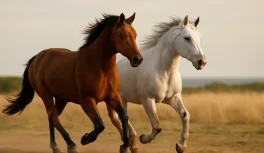
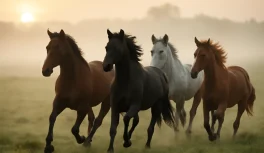
A round canter isn’t the fastest canter — it’s the one that feels right: consistent rhythm, a horse that’s light in the hand, hindquarters engaged, and corners that don’t turn into battles. If yours isn’t there yet, these six arena exercises for canter will help you build it, one step at a time.
Three Ground Rules Before You Start
1. Rhythm first, exercise second. If the canter loses its cadence mid-exercise, stop the exercise. Half-halt, breathe, reorganize — then continue. 2. Short quality sets beat long messy ones. Work in sets of 8–15 strides while the horse is still building strength and balance. 3. A large circle is an ally; a small circle is a test. Start at 20 meters. Shrink only when the large circle feels easy and balanced.
What Does a “Round Canter” Actually Feel Like?
You’ll know you’re there when: the horse doesn’t fall onto the forehand (the contact stays light), the 1-2-3 beat holds without speeding up, turns happen without the shoulder drifting out, the horse can shorten and lengthen slightly without it turning into a race, and transitions out of the canter are clean — no falling apart.
Two or more of those markers means you have something solid to build on.
Exercise 1: Large Circle (20 Meters) to Stabilize the Rhythm
Goal: balance and consistent cadence.
When to use it: horse that rushes, leans on the hand, or loses balance in turns.
How to do it: pick up the canter on a 20-meter circle. Ride one full lap aiming for the same rhythm start to finish. Return to trot before quality drops, then repeat 3 to 6 times.
What to watch for:
- If the horse rushes: short half-halt, breathe, hold the circle line.
- If the horse falls in: think “shoulder on the track.”
- If the horse falls out: inside leg supports the curve.
Success marker: the canter at the end of the lap matches the canter at the start.
Exercise 2: Spiral (Circle In, Circle Out)
Goal: control of the horse’s body — shoulder and hindquarters — without losing cadence.
When to use it: horse that drifts, bulges, or crooks in the canter.
Step by step: begin on a 20-meter circle at canter. Quietly reduce to 18 meters, then to 15 — no rushing — then expand back to 18 and 20 meters.
Key rules: if the horse speeds up or loses balance during the inward spiral, you moved too fast. Return to 20 meters, reorganize, and try again. Limit yourself to two spirals per rein in early sessions.
Success marker: the horse adjusts its body, not its speed.
Exercise 3: Trot Serpentine + Canter Departure Off the Arc
Goal: prepare the horse’s body and reliably ask for the correct lead.
When to use it: trouble with canter transitions or frequent wrong-lead departures.
How to do it: ride a flowing serpentine at trot (three generous arcs). At the exit of one arc, half-halt to organize and ask for the canter. Hold 8–12 strides, then return to trot.
Why it works: the serpentine sharpens straightness and direction-awareness. Departing off an arc tilts the odds toward the correct lead — the horse’s body is already set up to support it.
Success marker: the horse departs into canter without first rushing the trot.
Exercise 4: Direction Changes with a Trot Bridge (Canter–Trot–Canter)
Goal: control, straightness, and clean lead changes; eliminates rushing and disunited strides.
When to use it: horse that runs, disunites, or loses the line when changing direction.
How to do it: canter one rein for 8–12 strides; trot 3–6 steps (organize and straighten); change direction across a long diagonal or wide half-turn; ask for canter on the new rein for another 8–12 strides.
The key insight: those trot steps in the middle are the “bridge.” They make the direction change calm and clear instead of rushed and scrambled.
Success marker: the horse changes direction unhurried and re-departs in balance.
Exercise 5: Figure Eight (Two Large Connected Circles)
Goal: improve cornering and direction changes under control.
When to use it: horse that loses balance or rushes through the direction change.
Safe version: ride a large circle at canter (right rein) for ¾ of a lap. Return to trot at the center, change direction. Ask for canter on the second circle (left rein) for ¾ of a lap. Repeat, alternating.
Why it’s effective: it trains both horse and rider to reorganize cleanly between directions — without a standoff at the change.
Success marker: the direction change happens without the horse bolting forward.
Exercise 6: Collected–Working Transitions Within the Canter on a Straight Line
Goal: teach the horse to adjust the canter without rushing or breaking to trot.
When to use it: horse that confuses “lengthen” with “run,” or “shorten” with “break.”
How to do it: on a long side or large circle, ride 6 strides of working canter; 4 strides of collected canter (organize with half-halt and seat); 6 strides of working canter. Stop while it’s still good.
Success marker: the canter changes size while the rhythm stays the same.
A Ready-to-Use 15-Minute Session
1. Warm-up (5 min): rhythmic trot with walk–trot–walk transitions. 2. 20-meter circles at canter (4 min): 4 sets of one lap (or 8–12 strides). 3. Figure eights with trot at center (4 min): 4 clean direction changes. 4. Trot serpentine + canter departure (2 min): 2 attempts each rein. 5. Cool-down at walk: 2 minutes, on a loose rein.
Goal: finish with a calmer, more balanced canter than when you started.
Common Mistakes in These Exercises
- Tightening the circle when the horse rushes → do the opposite: open the circle and rebuild the rhythm.
- Pushing through when quality drops → return to trot, reorganize, repeat.
- Insisting on a canter direction change no matter what → use trot as a bridge; it’s cleaner and builds better habits.
- Constant leg pressure throughout → leg that asks, then sustains — no hammering.
A Round Canter Is Built with Smart Repetition, Not Force
Circles, serpentines, and well-ridden direction changes work like steady polishing: each repetition removes a little of the rush, the imbalance, the stiffness — until the canter becomes what it always could be: round, stable, and light. And when that happens, something else shifts too: the horse starts trusting the gait. So do you.