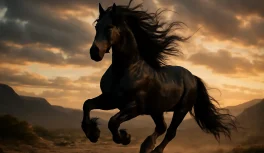
In 2002, DreamWorks released an animated film that accomplished something many considered impossible: it placed a horse at the center of a narrative without giving him a human voice, without making him an anthropomorphized character, without betraying his animal nature — and still created one of the most charismatic and emotionally rich animated characters of the early twenty-first century.
Spirit — Stallion of the Cimarron is, twenty-three years after its release, one of those films that continues to be discovered by new generations. Children who saw it in 2002 now show it to their own children. And the film still works — not out of nostalgia, but because the story it tells is universal.
What makes Spirit so enduring?
A Horse That Does Not Speak — and Therefore Shouts Louder
The boldest decision made by directors Kelly Asbury and Lorna Cook was not to give the protagonist a human voice. Spirit narrates his own story with thoughts — but on screen, what we see is a horse that whinnies, snorts, shakes his mane, and uses his body to express himself. There is no conversation, no ironic commentary, no jokes in the style of typical animated films of the era.
The result is that Spirit feels like a real horse. His animation was based on photographic reference and movement studies of real horses, supervised by equine behavior experts. The animal’s eye, specifically, received special attention: the animation team studied how real horses move their eyes to express fear, distrust, curiosity, and affection.
This creates an immersion rare for an animated film. When Spirit suffers, you feel it is real pain — not cartoon drama.
The Story: Freedom Against Domestication
Spirit is a young wild mustang who leads a herd on the American plains in the nineteenth century. Captured by soldiers of the US Army, he resists forced breaking with everything he has — and refuses to yield. A general tries to break him, without success: Spirit is not tamed; he is simply impossible to domesticate by force.
In military captivity, Spirit meets Little Creek, a young Lakota warrior also captured. The two escape together, and it is with Little Creek that Spirit learns something fundamental: there is a difference between being domesticated by force and choosing to trust someone. Little Creek never forces Spirit to obey — and it is precisely for this reason that the horse chooses to help him.
During their adventure, Spirit falls in love with Rain, a domesticated pinto mare belonging to Little Creek — and this relationship adds an emotional layer to the film that few animated movies dare to explore without making it mawkish.
The story ends with Spirit returning to his free herd — but not without having changed. The freedom he defends is not the absence of connection. It is the freedom to choose with whom and how to connect.
The Soundtrack Nobody Forgets
Half of Spirit‘s emotional impact comes from its soundtrack — composed by Hans Zimmer (orchestral score) with songs by Bryan Adams. The combination worked in an unexpected way: Adams’s songs comment on the narrative from the inside, like an inner voice for a horse that cannot speak.
Here I Am, Get Off of My Back, This Is Where I Belong, and above all I Will Always Return — the last playing over the final scene of Spirit reuniting with his herd — became part of a generation’s collective memory.
Zimmer won the Grammy Award for Best Compilation Soundtrack for Visual Media for the work.
What Spirit Says About the Relationship Between Humans and Horses
Beneath the adventure and the animation, Spirit is a philosophical argument about the relationship between humans and animals. The film clearly distinguishes two models of relationship:
The army’s model: capture, submission by force, domination. The general who tries to break Spirit is the antagonist not because he is cruel by nature, but because he represents a system incapable of imagining any other form of relationship with animals.
Little Creek’s model: respect, patience, reciprocity. Little Creek never asks Spirit to be anything other than what he is. He offers connection — and waits to see whether the horse will choose to accept it or not.
For anyone who works with horses or is passionate about equines, this second model resonates with something very concrete: the idea that the richest relationship with a horse is the one he chooses, not the one imposed upon him.
Why Showing Spirit to Children Makes Sense
Spirit is classified as a children’s film — but it teaches things that many adults have yet to learn. It teaches that freedom does not mean the absence of relationship. That respect is more effective than force. That trust is built, not demanded. That cultural differences can be bridges, not walls.
And it does all of this through a horse that does not speak a single word.
That is the magic of Spirit — and it is why, two decades later, it still makes children sob at the final scene.