In 1998, when Robert Redford released The Horse Whisperer, most of the audience had never heard the term. It sounded like a poetic metaphor — someone who literally whispers to horses. But beneath the cinematic title lay a real practice, with historical roots and a concrete philosophy about how humans and horses should relate to one another.
The film — based on Nicholas Evans’s novel and starring Redford alongside Kristin Scott Thomas and Scarlett Johansson — is not simply a love story with a ranch backdrop. At its core, it is a documentary disguised as fiction about what happens when you decide to understand a horse instead of controlling it.
What Is a Real Horse Whisperer?
Before discussing the film, it is important to understand what the term means in actual equestrian practice.
A horse whisperer — also called an equine communicator or natural horsemanship trainer — is someone who works from an understanding of horse behavior and natural body language, rather than using force, coercion, or punishment to achieve obedience.
The approach has concrete scientific foundations: horses are prey animals, highly sensitive to body language and posture. A predator advances. A predator makes direct eye contact. A predator enters personal space without permission. When a human mimics predatory behavior around a horse, the horse feels it — and responds with fear or flight.
The world’s finest horse whisperers — such as Monty Roberts (whose “Join-Up” technique was demonstrated before Queen Elizabeth II) and Buck Brannaman (whose work is shown in the 2011 documentary Buck) — developed techniques based on one simple principle: a horse is not a machine to be controlled. It is a social being that needs leadership, not domination.
Robert Redford studied with Brannaman to prepare for his role. Much of the technique that Tom Booker demonstrates in the film is based directly on Brannaman’s real work.
The Plot of The Horse Whisperer
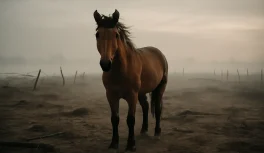
Grace MacLean, a fourteen-year-old girl, goes out riding in the snow with a friend one winter morning. A truck strikes them — Grace’s friend and her horse are killed. Grace survives, but loses part of one leg. Her horse Pilgrim survives physically, but is left completely traumatized: aggressive, in constant panic, impossible to approach.
The veterinarians recommend euthanizing Pilgrim. Grace’s mother Annie — a successful New York magazine editor played by Kristin Scott Thomas — refuses. She researches and finds Tom Booker, a Montana rancher with a reputation for healing horses no one else can help.
Annie drives Grace and Pilgrim by trailer all the way to Tom’s ranch in Montana. What follows is a narrative of three simultaneous healings: the horse’s, the girl’s, and — indirectly — the mother’s.
Why the Film Works Beyond the Romance
There is a romantic subplot between Annie and Tom Booker that has been criticized as formulaic. The critique has some merit — the arc is predictable. But what saves The Horse Whisperer from being mere ranch romance is its portrayal of Tom’s work with Pilgrim.
Redford filmed the rehabilitation process with a slowness and attention to detail rarely seen in Hollywood productions. Pilgrim does not improve overnight. Tom has no magical breakthrough moment. The process is gradual, sometimes invisible, with setbacks and tiny advances.
What the film depicts with accuracy:
- Tom observes Pilgrim without approaching until the horse is ready to be observed
- He never forces contact — he waits for the horse to choose to approach
- He uses deliberate body language: when he wants the horse to stop, he stops. When he wants the horse to come, he retreats
- The process begins in open space, without fences, without reins — just two beings in a field
For anyone who knows equines, this is moving precisely because it is correct. What Tom does in the film is what good equine behavior trainers actually do.
The Film’s Legacy for the Equestrian World
The Horse Whisperer reached screens at a moment when natural horsemanship — the movement of communicating with horses based on ethology and behavior rather than force — was still marginal in the mainstream.
The film changed this in a meaningful way. Following its release, there was a measurable increase in interest in naturalistic equine communication techniques: horse behavior clinics sold out registration lists, books on the subject became bestsellers, and names like Monty Roberts, Pat Parelli, and Clinton Anderson moved from specialized circuits into the general public.
Some have argued that The Horse Whisperer did more for the natural horsemanship movement than any book or course. That may be an exaggeration — but not by much.
Is It Worth Watching Today?
Yes. The romance between Annie and Tom has not aged quite as well as the rest of the film — but what The Horse Whisperer does with horses remains rare in contemporary cinema. And Scarlett Johansson, in one of her early significant roles, delivers a Grace who is as wounded as Pilgrim — and heals by the same process: being seen, not forced.
If you are interested in equine behavior, it is one of the most important films you can watch. If you are simply a film lover, it is a well-crafted drama about healing and reconnecting with what matters. In either case, it is worth the time.