Few images in the history of cinema have the immediate power of a stagecoach at full gallop with a cloud of road dust and a lone rider on the horizon — except, perhaps, a yellow Mustang tearing through the streets of San Francisco in pursuit. American cinema built its visual identity, in large part, on two icons: the horse and the car. Sometimes in separate worlds, sometimes in direct collision, horses and automobiles defined how stories of adventure, freedom, and escape were told on the screens of the twentieth century.
The Western and the Birth of a Visual Language
How did John Ford use horses to create the visual grammar of American cinema?
American cinema grew up with the western. And the western, by definition, was the world of horses. The earliest Hollywood productions — still in the early twentieth century, when film was silent — found in the frontier an inexhaustible visual repertoire: duels, cavalry charges, stagecoach chases, lone riders against the horizon.
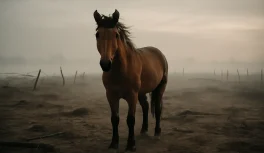
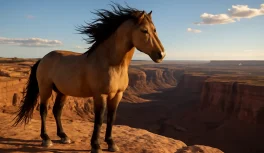
John Ford, the director who most completely defined the visual grammar of the genre, built his work on horses. “The Iron Horse” (1924), “Stagecoach” (1939), “Fort Apache” (1948), “The Searchers” (1956) — in all of them, the horse is not merely a means of transport. It is a character. Ford’s camera knew how to frame horses like few filmmakers before or since: the gallop seen from below with the ground rushing past, the silhouette of rider and animal cut against the Monument Valley sunset, the cavalry group appearing on the horizon like an inevitable storm.
Why was Steve McQueen equally at home with horses and cars?
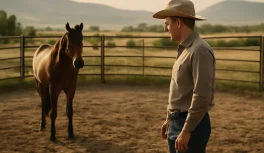
Actors like John Wayne and Gary Cooper became so associated with horses that their competence in the saddle was part of their résumé. Steve McQueen learned to ride for his early roles before becoming the king of car chases. The transition was so natural that many fans noticed it: McQueen treated cars and horses with the same casual confidence of someone who had grown up controlling powerful things.
The Moment Cars Took the Screen
Why did ‘Bullitt’ (1968) redefine the car chase in American cinema?
The 1960s were the turning point. With the American automotive boom and the rise of muscle car culture, Hollywood began replacing horses with engines as the symbol of freedom and danger.
“Bullitt” (1968), with Steve McQueen at the wheel of a Highland Green Ford Mustang 390 GT, redefined what a car chase could be. The 10-minute sequence through the streets of San Francisco — filmed with cameras inside the cars, under the chassis, and at angles that placed the viewer in the passenger seat — became the benchmark against which all subsequent chase sequences would be measured.
Was the Mustang in ‘Bullitt’ symbolically the wild horse of the western?
The Mustang in “Bullitt” was not just a car. It was the automotive answer to the wild horse of the western — fast, unpredictable, with a will of its own. McQueen had traded the saddle for the steering wheel, but the feeling was the same: a man and a powerful machine acting together, defying the rules, always on the verge of escaping everything.
When Horse and Car Shared the Screen
How did ‘Giant’ (1956) use horses and cars to symbolize the clash between old and new?
The most literal confrontation between horses and cars in cinema appears in the transition genre — films that show precisely the historical moment when one world replaced the other.
“Giant” (1956), with Rock Hudson and James Dean, is set in a transitioning Texas: horses and trucks appear side by side, and the tension between the old rancher and the new oil businessman has in its animals and vehicles its most eloquent symbols. The final sequence, where James Dean appears in an automobile while Hudson is on horseback, visually summarizes the entire shift of eras.
“Hud” (1963), with Paul Newman, goes further: there is a brutal scene in which an entire cattle herd must be slaughtered, driven to their end by trucks while cowhands watch from horseback. The mechanization of the ranch, which Newman’s character embraces while the older men resist, uses horses and trucks as its dramatic axis throughout the film.
Why did films like ‘Hud’ and ‘McCabe’ use horses and machines as a dramatic axis?
Robert Altman’s “McCabe & Mrs. Miller” (1971), set in the early twentieth-century American Northwest, uses the contrast between horses and the first signs of modernity (telegraphs, industrialized firearms) to create a specific melancholy — that of a world ending without anyone seeming to notice.
The Unlikely Duo: Horses in Car Films
What does Peckinpah’s ‘Junior Bonner’ say about horses and cars as symbols of their owners?
There is a smaller but consistent genre of films in which horses and cars appear together not as historical opposites, but as elements of the same contemporary narrative.
Sam Peckinpah’s “Junior Bonner” (1972) is about a rodeo cowboy competing while the town around him transforms rapidly — shopping malls, real estate developments, progress. The tension between the rodeo world (horses, bulls, dust) and automotive modernity is not metaphor; it is the literal setting. The cars in the film are as carefully chosen as the horses — and both say something about their owners.
“Racing Stripes” (2005), a children’s film about a zebra who wants to be a racehorse, deliberately works with the visual association between the racetrack and the racing circuit. The narrative logic of the two worlds is identical: speed, training, rivalry, glory.
How did ‘Spirit’ (2002) use the train as an antagonist to tell the same story as cars vs horses?
In animation, “Spirit: Stallion of the Cimarron” (2002) uses the arrival of the first trains — not cars, but the motor technology of the same era — as the main antagonist of a wild horse who refuses domestication. The train is depicted as a threatening mechanical creature, and the parallel with the automobile in later westerns is evident.
What Cinema Understood Before History Did
Why is the stagecoach chase and the Dodge Charger police chase the same story?
Hollywood intuitively grasped something that historians took decades to articulate: horses and cars are not opposites — they are icons of the same human impulse. The need for speed, for movement, for controlling something more powerful than ourselves, for heading toward the horizon.
Westerns did not end with westerns. They became road movies, chase films, racing films. The stagecoach fleeing bandits became the Dodge Charger running from police. The lone rider in the desert became the solo driver on the track. The camera still frames the horizon the same way — only what is running toward it has changed.
Why did Hollywood return to filming horses in ‘Secretariat’ and ‘Seabiscuit’ in the 21st century?
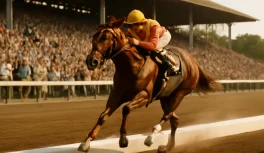
And when, in recent years, racing films began incorporating horses again — in “Secretariat” (2010), in “Seabiscuit” (2003), in Hollywood’s renewed interest in equestrian stories — it became clear that the cycle had never really ended. Screens love horses and cars. They always have. They probably always will.