In 1979, a commercial director named Carroll Ballard received an unlikely chance: to make a feature-length fiction film produced by Francis Ford Coppola. The budget was modest. The cast was unknown. The story — a boy and an Arabian horse on a deserted island — seemed too simple for serious cinema.
The result was The Black Stallion, ranked by the American Film Institute among the 100 greatest American adventure films of all time, and considered by critics such as Roger Ebert and Pauline Kael to be one of the most visually beautiful works of the decade. More than 45 years later, it still appears on lists of the finest equestrian films ever made — and still presents horses with an honesty rarely seen on screen.
What made The Black Stallion special? And why did its saga — which included a sequel, a television series, and a remake — never reach the height of the original?
The Story: Silence, Trust, and a Deserted Island
Alec Ramsey, an American boy, is traveling on the same ship as a black Arabian purebred of explosive temperament, nicknamed “The Black” by the crew. The ship sinks. Alec and the horse are the only survivors, and they end up stranded together on a deserted Mediterranean island.
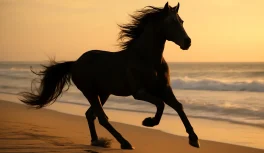
What follows is one of the most extraordinary opening hours in cinema history — almost dialogue-free, without dramatic scoring, just the boy and the horse building trust on a paradise island. Ballard films this process with documentary patience: no accelerated editing, no sudden transformation. The horse first tolerates the boy’s presence. Then accepts food from his hand. Then allows him to approach. Then — in a sunrise beach sequence that remains one of the most emotional in equestrian cinema — allows him to ride.
This is a model for how to film horses: without tricks, without anthropomorphism, without pretending the animal is anything other than what it is. Ballard lets the horse be a horse — and for that reason, the relationship feels real.
The film’s second half, once Alec returns to the United States and the horse becomes a racing protagonist, is competent but less transcendent. What people remember about The Black Stallion is the island.
Walter Farley’s Book and the Literary Saga
The Black Stallion was originally published in 1941 by Walter Farley — who began writing it at the age of sixteen. The book became a classic of equestrian juvenile literature and spawned more than twenty sequels, all written by Farley over several decades.
The complete series — known as “The Black Stallion Series” — is a publishing phenomenon: it sold more than 12 million copies, was translated into dozens of languages, and introduced Arabian purebred horses into the imagination of generations of young readers.
What Farley did with the Arabian in his books was what Spielberg would later do with other horses in cinema: treat it with seriousness, as a character with history and personality, not as backdrop for human adventures. The Black in particular is described with a combination of power and sensitivity faithful to the real temperament of the Arabian breed — known for its intelligence and emotional bond with humans.
Caleb Deschanel’s Cinematography: A Visual Monument
To understand why The Black Stallion still impresses visually, one must talk about Caleb Deschanel — the cinematographer who later worked on films like The Passion of the Christ, National Treasure, and The Natural.
On the deserted island, Deschanel filmed on a small island off the Italian coast using almost exclusively natural light. The result is images that look like paintings — golden dawn light, long afternoon shadows, the texture of black coat against white sand. The underwater sequences, where we see the horse and the boy swimming together, are especially impressive for the era — filmed without digital tricks, just underwater cameras and enormous patience to capture the right moments.
Deschanel was nominated for the Academy Award for his work — one of the few nominations the film received despite its critical reputation.
The Black Stallion Returns (1983): The Disappointing Sequel
Four years after the original, Kelly Reno returned as Alec Ramsey in The Black Stallion Returns, directed by Robert Dalva — the first film’s editor.
The premise: the Black’s original owners — an Arab family — reclaim the horse and take him to Morocco, where he will be used in a major desert race called “La Gran Carrera.” Alec stows away on a plane to find his horse.
The film has more action and more exotic locations than the original — Morocco is competently photographed — but loses precisely what made the original special: the silence, the patience, the sense of something being built slowly. The relationship between Alec and the Black is here taken for granted, not constructed — and for this reason it has less emotional impact.
It is watchable, especially for those who already loved the characters. But it is clearly inferior.
The Television Series (1990–1993)
Between 1990 and 1993, the cable channel Family Channel produced The Adventures of the Black Stallion — a Canadian series that ran for three seasons and 78 episodes. With a different cast (the character of Alec was reinterpreted by Richard Ian Cox), the series was clearly aimed at a juvenile audience and made no attempt to capture the contemplative tone of the film.
For a specific generation, particularly in the 1990s, the series was the first contact with the world of Alec and the Black. For those who knew the film, it was enjoyable but clearly lesser.
Why the Original Remains Unmatched
There is something in the first hour of The Black Stallion that has never been repeated in equestrian cinema — before or since. Ballard filmed something that the finest nature documentary makers spend years trying to capture: the exact moment when a wild animal chooses to trust a human being.
It is not staged. It is not anthropomorphized. There is no musical score underlining what we should feel. It is simply a horse and a boy, on an island, building something that has no adequate name in human language — and that anyone who has ever had a horse recognizes immediately.
That is why The Black Stallion still matters.