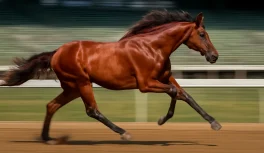
Spell the name backward and you get “murder.” The British press noticed this coincidence almost immediately after Red Rum became famous in the 1970s, and the eerie overlap gave the horse an aura that fit oddly well with the sport he dominated: the Grand National, the most brutal and unpredictable horse race in the world.
Red Rum won the Grand National at Aintree three times — in 1973, 1974, and 1977. He finished second in both 1975 and 1976. In over 170 years of the race’s history, that five-consecutive-year streak of podium finishes has never been matched. Experts widely agree it likely never will: the combination of longevity, consistency, and the specific ability to excel at Aintree that Red Rum demonstrated is, from a statistical standpoint, one of the most improbable achievements in equestrian sport.
Why Is the Grand National the World’s Hardest Race?
Before understanding Red Rum, you need to understand Aintree. The Grand National covers 4.3 miles with 42 fences, including some of the most demanding obstacles built for any race on earth.
Becher’s Brook requires the horse to jump a fence whose landing side is significantly lower than the takeoff side, creating a steep downward angle that can unbalance horses unprepared for it. The Chair is the tallest fence in the race, with an open ditch on the inner face. The Canal Turn demands a 90-degree turn immediately after landing — a coordination and balance requirement that eliminates technically limited horses instantly.
In standard steeplechase, roughly half the field completes the race. At the Grand National, the non-completion rate is historically much higher, and falls and injuries are part of the brutally honest character of the event. In that context, winning once is extraordinary. Winning three times is without precedent.
The Improbable Story Before Aintree
Red Rum was born in Ireland in 1965, a son of Quorum out of Mared. His early racing career was entirely unremarkable — he ran in small flat races with mediocre results, then transferred to steeplechase without any indication he would be different from the hundreds of horses that attempt and fail the British jumping circuit every season.
What changed was the arrival of Ginger McCain — a used-car dealer from Southport, England, who trained horses in improvised facilities behind his car lot, far from the establishment centers of Newmarket. McCain was not a conventional trainer. He worked outside the mainstream, without the resources or the reputation of the big yards.
When Red Rum arrived at McCain’s in 1972, the horse had a serious, ongoing case of laminitis — an inflammatory condition affecting the laminar tissue inside the hooves that causes chronic pain and can end any horse’s career. Conventional advisors had recommended retiring him from competition.
How Did Beach Sand Save Red Rum’s Career?
McCain’s method, born of necessity from the facilities he had, was different from anything the racing establishment was doing: he trained Red Rum daily on the beach at Southport, long trots and gallops on the wet sand at the water’s edge.
Sand absorbs impact differently from tarmac and even turf — it’s softer, more irregular, demands more balance and muscular effort from the horse, but dramatically reduces the stress on the bones and connective tissue of the limbs. Over time, the veterinarians monitoring Red Rum noted something that clinical specialists still study today: the combination of seawater, regular sand exercise, and McCain’s careful management had stabilized the horse’s hoof condition in a way conventional treatments had failed to achieve.
Red Rum wasn’t cured — he was managed, with a quality of life and an athletic capacity that defied the original prognosis.
The Three Grand National Victories: 1973, 1974, and 1977
1973 was the first — and the most dramatic. Red Rum ran as a long shot, far from the favorites, carrying a weight that trainers considered less than ideal for that distance. The race appeared decided when Crisp, the powerful Australian favorite, opened an enormous lead approaching the final fence. Red Rum caught him in the last two furlongs, stride by stride, and crossed the line first — breaking the course record in the process. The crowd at Aintree was stunned.
1974 was cleaner — a demonstration that 1973 had not been luck.
1975 and 1976 brought two second-place finishes. In most other sporting contexts, consecutive runner-up finishes at the world’s hardest race would be celebrated. In the shadow of Red Rum’s own legend, they were almost footnotes.
1977, at age 12, Red Rum returned to Aintree and won a third time. At 12 years old, in a race that physically and mentally taxes horses the way the Grand National does, he didn’t simply complete the course — he won it. The crowd’s reaction was described by veterans of the event as something closer to a historic moment than a sporting result.
What Does Aintree Demand That Other Races Don’t?
Not every great jumper thrives at Aintree. The race demands a combination of qualities that go beyond the technical ability to clear tall fences:
Stamina over the full course — 4.3 miles eliminates horses built only for three-mile races.
Adaptability to variable ground — Aintree has different soil types along the circuit, and horses that can’t adjust quickly lose time and energy.
Tolerance for massive crowds — the Grand National draws one of the largest live audiences on the British equestrian calendar, with tens of thousands of spectators very close to the track. Sensitive horses underperform in that environment.
Ability to read terrain after fences — especially at Becher’s Brook and the Canal Turn, what happens in the stride immediately after landing is as critical as the jump itself.
Red Rum had all of these qualities in combination — which explains why he could be less dominant at other venues and absolutely supreme at Aintree specifically.
The Retirement Years and the Legacy
Red Rum retired from racing in 1978, at 13 years old. Ginger McCain kept him in Southport, where the horse spent more than a decade as a local and national celebrity — opening festivals, appearing at charity events, showing up on television. By the 1980s, Red Rum was a name recognized by British people who had never watched a jump race in their lives.
When he died in October 1995, at the age of 30, Red Rum was buried at the Aintree finish line — the place that had defined his existence. A plaque marks the spot today, and the racecourse maintains a statue in his honor in the parade ring.
Ginger McCain trained horses for two more decades after Red Rum’s retirement — and returned to win the Grand National again in 2004 with Amberleigh House. But in every interview for the rest of his life, he always came back to the same point: Red Rum had been different. Not just for what he had done, but for how — with a serene consistency that, according to McCain, made it seem as though the horse knew exactly what Aintree required of him.