Every time a red Ferrari appears on the starting grid of a Grand Prix — with that rearing horse on a yellow background on the bodywork — very few people in the grandstands know they are looking at a war symbol. Not a war metaphor. A symbol that was literally painted on the fuselage of a fighter aircraft, in a burning European sky, more than a century ago.
The story of the Ferrari Cavallino Rampante is one of the most extraordinary in world sport: it begins on a World War I battlefield, passes through tragedy, crosses decades of racing, and ends as the most recognizable emblem in global motorsport. It is the story of how a real horse — or its representation — became the most famous symbol of speed in history.
Francesco Baracca: The Ace Who Painted the Horse on His Plane
Francesco Baracca was born in 1888 in Lugo, in northern Italy, into a noble family that cultivated the tradition of military cavalry. Before becoming a fighter pilot, Baracca served in the Piemonte Real Cavalleria regiment — the Piedmontese cavalry — and it is from this phase that the first connection between the horse and the central character of this story originates.
When Italy entered the First World War in 1915 and aerial combat became a new dimension of the conflict, Baracca made the transition from cavalry to aviation — a path that many elite horsemen followed during that period, as the war horse began to be replaced by the flying machine as an instrument of battle. In the cockpit, Baracca showed the same talent he had in the saddle: he became Italy’s greatest fighter ace, with 34 confirmed aerial victories before his death.
The rearing horse emblem — the Cavallino Rampante — appeared on Baracca’s aircraft as his personal mark. The exact origin of the design is disputed by historians: some versions suggest the black horse was the emblem of a German enemy squadron shot down by Baracca, which he adopted as a trophy. Others point to a connection with Stuttgart — the city whose coat of arms bears a rearing horse, the same symbol used by Porsche to this day. The most documented version is simply that Baracca chose the horse as his personal emblem, without explicit reference to any enemy or specific city.
What is certain: the rearing horse became Baracca’s mark. And Baracca became legend.
Baracca’s Death and the Birth of the Myth
On June 19, 1918, Francesco Baracca died during a ground-support mission. The exact circumstances of his death were never fully clarified: was he shot down by enemy fire? By friendly ground fire? Did he suffer a mechanical failure? The controversy was never definitively resolved.
What was quickly resolved was Baracca’s status as a national hero. He died with 34 victories, was decorated with Italy’s highest military honors, and became a symbol of the generation that fought in the Great War. The Cavallino Rampante, with him, became part of the myth — the emblem of the ace that no one ever downed in direct aerial combat.
His parents, Count Enrico Baracca and Countess Paolina Biancoli Baracca, became custodians of their son’s legacy. And it was in that capacity that they encountered Enzo Ferrari — a meeting that would change the history of motorsport.
Enzo Ferrari and the Baracca Gift
Enzo Ferrari was not yet Enzo Ferrari when he competed in the Ravenna race in 1923 — he was a young driver with ambition and talent, but without the title of founder of one of the most famous brands in human history. The Ravenna race was one of his victories on the period’s circuit, when he raced for Alfa Romeo.
After the race, Ferrari was introduced to Francesco Baracca’s parents, who lived in the region and maintained contact with the world of motorsport, which in those early years naturally overlapped with the culture of speed that Baracca had represented in aviation. Countess Paolina told Ferrari that Baracca’s success had brought her joy, and suggested he adopt the Cavallino Rampante as an emblem to bring him good luck.
Ferrari accepted. But he made one modification: while Baracca’s horse was black on a white background, Ferrari added a yellow background — the color of Modena, his hometown and the place that always inhabited the center of his identity.
1932: The Horse Appears on a Ferrari for the First Time
Scuderia Ferrari, the racing team founded by Enzo in 1929, officially adopted the Cavallino Rampante from 1932 onward. The date is recorded in Ferrari’s historical documents: the emblem appeared formally on the team during the race at Spa, Belgium, that year.
It is worth noting that in 1932, Ferrari was not yet making cars. The Scuderia raced Alfa Romeos. Enzo Ferrari was the director of a racing team, not an automobile manufacturer. The car that would carry the Ferrari name — and the Cavallino as a brand identity, not just a team identity — would not come until 1947, with the 125 S, the first model officially produced and sold as a Ferrari.
But the emblem was already what it is today: a black rearing horse on a yellow background, with the initials SF — Scuderia Ferrari — and the green, white, and red of the Italian flag at the top of the shield. A coat of arms. An identity statement that blended military heritage, regional pride, and sporting ambition without needing words to explain itself.
The Cavallino Rampante and Polo: A More Direct Connection Than It Appears
The story of the Cavallino Rampante is not merely historical curiosity. It has direct implications for how Ferrari relates to the equestrian world — including polo.
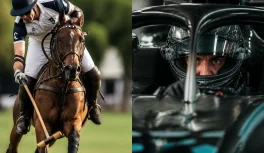
When Ferrari appears as a sponsor at polo tournaments, there is a symbolic congruence that no other automaker can claim: the brand literally has a horse on its logo. The horses on the polo field and the horse on the Ferrari banner are not simply accidental neighbors at a luxury event. They are representations of the same symbolic animal — the horse as an embodiment of speed, nobility, and power — in two distinct but culturally related contexts.
This congruence has not been lost on Ferrari’s brand managers over the years. The Ferrari Polo Classic and similar activations are a natural extension of this shared identity. When a red Ferrari parks next to a polo horse of the same color, the image seems almost calculated. In reality, it is — calculated over more than a century.
The Cavallino Rampante in the Twenty-First Century
Today, the Cavallino Rampante is one of the most recognized and most valuable logos in the world. Brand equity studies consistently place Ferrari among the highest desire-value brands on the planet — a position that has much to do with the visual identity consistency that the rearing horse has anchored since 1932.
The symbol has gone through technical refinements over the decades — adjustments to proportion, line weight, and surrounding typography — but never through radical redesigns. In an era when century-old brands frequently succumb to the temptation of modernizing their logos to appear relevant, Ferrari has kept its horse essentially intact. It is a choice that says a great deal about how the brand understands its relationship with time: the Cavallino does not need to look modern because it represents something that transcends eras.
Baracca died in 1918. Ferrari founded the Scuderia in 1929. The first Ferrari car was launched in 1947. And the horse — the same rearing horse that flew over European battlefields more than a century ago — still appears at every Grand Prix start, in the paddocks of high-level polo events, and on the bodywork of every car that leaves the factory in Maranello.
The real story of the horse that became the symbol of racing is not about motorsport. It is about the power of a symbol that carries with it the full history of the person who chose it — and the dignity of the person who created it.