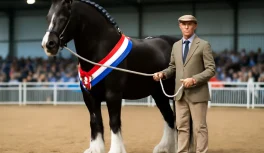
There are more than 350 recognized horse breeds worldwide. But when it comes to global presence, registration numbers, cultural impact, and sheer versatility, a handful of breeds stand apart from the rest. They appear on racetracks and in historical battlefields, in Olympic arenas and working ranches, in Hollywood films and European breed shows. These are the world’s most popular horse breeds — and each one tells a different story about how humans and horses shaped each other over centuries.
This guide covers the major breeds that define the global equestrian landscape: their origins, their distinctive characteristics, their uses today, and why they continue to fascinate breeders, athletes, and horse lovers on every continent.
The Arabian: The Root of Almost Everything
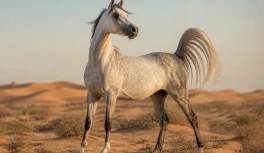
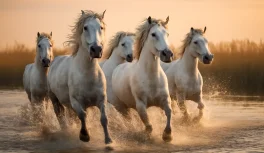
No discussion of popular breeds starts anywhere but with the Arabian. Developed in the Arabian Peninsula more than 4,500 years ago, the Arabian Horse is considered the oldest breed in the world and, by far, the most genetically influential. Virtually every modern racing and sport horse breed carries Arabian blood in its pedigree.
The Arabian is instantly recognizable: a wedge-shaped head with a slightly concave profile known as a “dished face,” wide nostrils, large expressive eyes, an arched neck, and a high-carried tail. Its skeleton has a unique anatomical quirk — one fewer lumbar vertebra than most breeds — which contributes to its short, strong back.
In temperament, the Arabian combines sharp intelligence, sensitivity, and exceptional physical endurance. It is the dominant breed in endurance competitions — long-distance events covering up to 100 miles — precisely because of its cardiovascular efficiency and recovery capacity that no other breed has matched.
The Thoroughbred: The Racing Machine
If the Arabian founded the modern horse, the Thoroughbred radicalized it. Developed in England during the 17th and 18th centuries by crossing English mares with imported Arabian, Turkish, and Barb stallions, the Thoroughbred was created with a single purpose: to run faster than any other horse on earth.
It delivers on that purpose completely. The Thoroughbred is the fastest horse in the world at middle distances — the best specimens reach 44 mph. Secretariat, the most famous among them, set records in the 1973 American Triple Crown that remain unbroken to this day.
Beyond racing, the Thoroughbred has influenced sport horse breeding worldwide. Its blood was fundamental in creating the European Warmblood breeds — the horses that dominate Olympic equestrian sport today.
The Quarter Horse: The King of Versatility
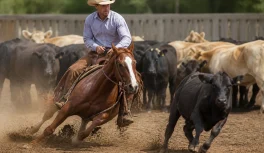
The American Quarter Horse holds a title rarely contested: the breed with the largest number of registrations in the world. The American Quarter Horse Association (AQHA) surpasses 6 million registered horses — a number that reflects not just popularity but the extraordinary versatility of the breed.
The name comes from its original specialty: quarter-mile races (approximately 400 meters), in which it is the fastest horse on the planet, capable of reaching 55 mph in explosive acceleration. But the Quarter Horse goes far beyond the racetrack. It is the cowboy’s horse, the rodeo athlete, the cattle-working partner — and in recent decades, has become one of the top choices for recreational riding on virtually every continent.
Muscular, compact, and calm in temperament, the Quarter Horse is also widely recommended for beginning riders.
The Friesian: The Black Nobility of the Netherlands
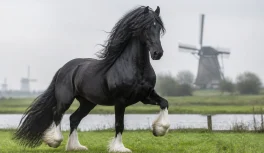
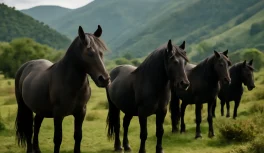
Originating in the province of Friesland in northern Holland, the Friesian is perhaps the most photographed horse in the world — and for obvious reasons. Its coat is invariably black, with no white markings, complemented by long, flowing mane and tail, and abundant feathering on the lower legs that swings rhythmically with each step. The image has something almost mythical about it.
Historically, the Friesian carried medieval knights into battle — its robust structure could support the full weight of armor and weaponry. With the decline of cavalry, it nearly disappeared entirely in the 20th century, reaching a critical point of only a few dozen registered stallions. Its recovery was a deliberate effort by Dutch breeders who saved the breed and transformed it into one of the most desirable horses in the world.
Today, the Friesian dominates equestrian shows, dressage, and film — appearing in movies including Conan the Barbarian, The Mask of Zorro, and Ladyhawke. Its temperament is surprisingly gentle for a horse of such imposing appearance.
The Warmblood: The Olympic Athlete
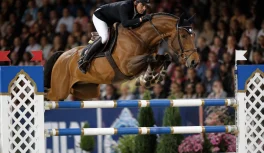
“Warmblood” is not a single breed but a family of European breeds created specifically for modern equestrian sport. Hanoverian, Oldenburg, KWPN (Dutch Warmblood), Trakehner, Westphalian — each with its own studbook, but all sharing the same breeding philosophy: crossing the cold blood of draft horses with the hot blood of Thoroughbreds and Arabians to find the perfect balance of power, elegance, and temperament.
The result dominates Olympic equestrian sport. In the Olympics and World Equestrian Games across all three disciplines — show jumping, dressage, and eventing — the overwhelming majority of horses are Warmbloods. Decades of intensive selection have produced animals with extraordinary athleticism, extended gaits, powerful jumping, and trainability that no other horse category can consistently replicate.
The Appaloosa: The Spots That Tell a Story
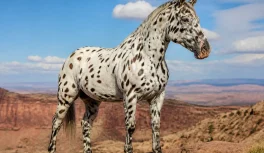
The Appaloosa is one of the most visually distinctive breeds in the equestrian world. Its markings — which can range from leopard (dark spots on a light base) to snowflake (white spots on dark coat) to blanket (white rump with or without spots) — result from a specific genetic complex called the Leopard Complex, which also causes unique characteristics including visible white sclera and striped hooves.
The breed has deep roots in the culture of the Nez Percé people, Indigenous inhabitants of the American Northwest who, in the 17th and 18th centuries, developed a sophisticated selective breeding program to produce strong, agile horses with striking coat patterns. When the United States expelled the Nez Percé from their lands in 1877, the breed nearly vanished — but the Appaloosas survived and were formally recognized by the Appaloosa Horse Club in 1938.
Today they are used in western riding, cattle work, trail riding, and leisure, and have a passionate fan base worldwide that extends far beyond interest in their distinctive markings.
The Morgan: The Horse That Built a Nation
The Morgan has a remarkable origin: the entire breed descends from a single stallion named Figure, born in Vermont, United States, around 1789. Figure — later renamed Justin Morgan after his owner — was extraordinarily small, standing about 14.2 hands, but defeated larger horses in speed races, pulling contests, and endurance tests.
The Morgan was foundational to American history: it plowed fields in New England, carried soldiers in the Civil War, pulled carriages, and later served as the genetic base for the Saddlebred, Tennessee Walking Horse, and Standardbred. Today, the Morgan is beloved for its consistent temperament, versatility, and a connection with humans that riders describe as unusual — a horse that genuinely seems to want to please.
Why Do Certain Breeds Dominate the World?
What transforms a breed into a global phenomenon goes beyond beauty or speed. The world’s most popular breeds share certain qualities: versatility (they serve multiple functions), accessible temperament (they learn quickly and are manageable), distinctive visual presence (they are easily recognized), and rich history (they carry cultural narratives that transcend sport).
No breed is universally “the best.” The best breed is the one that matches the purpose, the rider’s experience, and the context in which the horse will live. But knowing the world’s most popular breeds means understanding how humanity — across different cultures, climates, and centuries — chose its most valued equine partners.