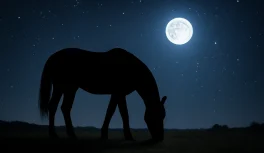
Dreaming about horses is one of the most frequently searched topics in dream dictionaries, spirituality sites, and oneiric psychology — and not without reason. The horse is one of the most recurrent archetypes in human dreaming, present in cultures that never had contact with one another, with a symbolic consistency that defies simple explanation.
This article explores what different traditions say about dreaming of horses — from Jung’s analytical psychology to Islamic interpretation, from European folklore to Afro-Brazilian traditions — and what contemporary science can add about why horses appear in dreams with such frequency and emotional power.
Dreaming About Horses in Jungian Psychology
Carl Jung was the theorist who most systematically explored equine symbolism in dreams. In his Archetypes and the Collective Unconscious, Jung identified the horse as a symbol of the instinctual forces and the libido in the broadest sense — not sexuality specifically, but total vital energy.
For Jung, the horse in dreams represents:
- The psyche in its dynamic aspect — energy in motion, not at rest
- The self in the process of integration — especially during major life transitions
- The forces of the body — what the body knows before the mind formulates it
The horse is not a passive figure in Jungian dreams: it is active, it has will, it can cooperate or resist. That agency is central to the meaning — the dream horse is not an object the dreamer uses, but a being that interacts.
What Does It Mean to Control — or Be Controlled by — the Horse in a Dream?
The relationship between dreamer and horse is central in Jung’s framework:
- Riding with ease and harmony: healthy integration between mind and instinct — the ego works with the deep forces rather than suppressing them
- Uncontrollable horse, or one that throws the rider: conflict between the ego and unconscious forces; energy that is not being recognized or integrated
- A gentle horse that approaches: an invitation from the unconscious to draw near to instinctual forces without fear
- A horse that flees when the dreamer tries to mount: flight of vital energy; possible dissociation between mind and body
Dreaming of a White Horse: What Different Traditions Say
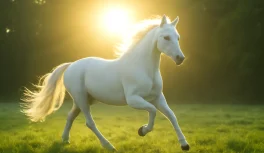
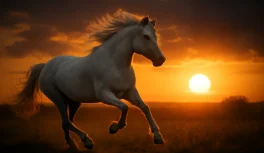
The white horse in a dream is interpreted positively in virtually every tradition that has documented its symbolism:
In the Arabic and Islamic tradition: dreaming of a white horse signals honor, elevated status, and victory over adversaries. A white horse that allows itself to be ridden indicates that blessings are coming without resistance. A white horse galloping toward the dreamer signals good fortune approaching rapidly.
In Hindu interpretation: a white horse in a dream is associated with Kalki — the final redeemer — and indicates that the dreamer is aligned with the dharma, that their actions are in harmony with the cosmic order.
In Western popular psychology: the white horse in a dream signals mental clarity, the right objective, strength available for noble use. It is the symbol of the hero who has found their cause and has the resources to advance.
Why Does the White Horse Tend to Appear in Dreams at Moments of Major Decision?
Psychologists observe that archetypal symbols of power and clarity tend to emerge in dreams when the psyche is processing major decisions or life transitions. The white horse specifically appears when a person is aligning internal resources — as if the unconscious were signaling that the forces needed to move forward are already available, waiting only for the conscious decision to act.
Dreaming of a Black Horse: Layered Interpretations
The black horse in dreams is more complex — not necessarily negative, but carrying multiple layers of meaning:
In the Arabic tradition: a black horse indicates power, authority, and success in business that happens away from public visibility. A businessman who dreams of a black horse may be processing an important transaction not yet revealed to the world.
In European folklore: a black horse in a dream is a signal for attention — something is moving in the shadows of the dreamer’s life that deserves care before it becomes a problem. Not a warning of catastrophe, but of vigilance.
In Jungian interpretation: the black horse is the Shadow presenting itself. Not as an enemy, but as an ignored aspect of the personality asking for integration. The more threatening the black horse in the dream, the greater the ego’s resistance to recognizing that aspect of itself.
Dreaming of Horses in Afro-Brazilian Tradition
In traditions of African matrix — Candomblé, Umbanda, and related religions — the horse carries a specific and powerful meaning. The cavalo de santo (literally “the saint’s horse”) is the medium who receives spiritual entities: to be a horse is to be vehicle, portal, instrument of the sacred.
Dreaming that you are the horse — that someone or something is riding you — is interpreted as a sign that a spiritual entity is communicating directly. It may indicate a calling to mediumship or an urgent message from a protective entity.
Dreaming that you ride a horse in Afro-Brazilian traditions indicates that you are receiving active spiritual support — that benevolent forces are carrying you in a process that does not depend solely on your conscious effort.
What Is the Spiritual Difference Between Riding a Horse and Being Ridden in a Dream?
The distinction is fundamental in mediumistic traditions: riding the horse indicates agency — you direct, you guide, you hold the power. Being ridden indicates receptivity — you are the vehicle, you serve, you receive. Both positions carry their own spiritual dignity. What determines the dream’s meaning is the accompanying emotion: serenity indicates alignment, fear indicates resistance to the spiritual role being assumed.
Dreaming of an Injured, Sick, or Dead Horse
Regardless of which tradition is consulted, an injured or dead horse in a dream signals a depletion of vital energy:
- Injured horse: blocked energy, stalled projects, suppressed creativity — something that should be in motion is stopped
- Exhausted or weak horse: real burnout of the dreamer — the unconscious warning that the pace must change before collapse occurs
- Dead horse: end of a cycle, radical transformation — not necessarily negative, but signaling that something must be left behind for a new phase to begin
How Do You Distinguish a Warning from Processing in Dreams About Injured Horses?
Most dreams are processing, not prophecy. An injured horse in a dream rarely means an actual horse will be harmed: it means that important vital energy in the dreamer’s life is at risk or already compromised. The relevant question is always: In what area of my life do I feel a lack of strength, speed, or freedom?
The answer that arises spontaneously upon waking — before rational judgment kicks in — tends to be the most accurate.
What Science Says About Dreaming of Horses
Dream research indicates that animals appear in roughly 20–30% of human dreams. Horses appear with a frequency disproportionate to the actual contact most people have with them — suggesting that the horse occupies a genuine place in oneiric processing that goes beyond simple personal experience association.
One neuroscientific hypothesis is that the horse simultaneously activates brain networks associated with power, speed, freedom, and potential danger — a rare combination that generates intense emotional activation, making the dream memorable and recurrent.
From an evolutionary standpoint, humans and horses share more than ten thousand years of coevolution. The human brain may have developed response patterns to horses so deeply ingrained that they persist in dreams even when conscious contact with the animal is minimal. Spiritual traditions called this “ancestral memory” — science calls it evolutionary memory processing. The result in dreams is the same.