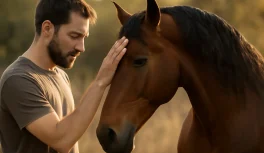
Some horses are built for specialists. They require a firm, experienced hand, precise timing, and years in the saddle before they can be ridden safely. And then there are horses that — without sacrificing character or capability — manage to be accessible to riders across a wide range of ages and experience levels. The Missouri Fox Trotter belongs unmistakably to that second category.
That’s not marketing language. It’s the product of more than two centuries of natural selection in which nervousness, unpredictability, and reactivity were penalized — not by a panel of judges, but by the daily realities of settlers, farmers, and rural workers who had no time and no tolerance for difficult horses. What survived that selection is an animal with a disposition that fits family contexts with remarkable consistency.
What “Good Temperament” Actually Means in Practice
Before discussing the Missouri Fox Trotter specifically, it’s worth defining what good equine temperament means in practical terms — because “gentle” is a word used far too loosely in the horse world.
A horse with genuinely good temperament for family and recreational use has specific, verifiable characteristics:
Low fear reactivity: the horse doesn’t panic at unfamiliar situations — a piece of plastic blowing in the wind, an unexpected sound, an animal crossing the trail. It may show attention or curiosity, but it doesn’t explode.
Tolerance of handling: it accepts being touched, groomed, having hooves picked up, receiving veterinary care, being shod, without excessive resistance.
Consistency: the behavior is predictable from one day to the next. The rider who rode yesterday finds the same horse today.
Willingness to cooperate: the horse shows a genuine desire to work with the rider rather than against them. It responds to light aids, doesn’t require excessive pressure.
Tolerance of the inexperienced rider: it accepts communication errors without punishing the rider with dangerous behavior.
The Missouri Fox Trotter fulfills all of these criteria with a consistency that is widely documented by owners across different countries and riding contexts.
Why the Breed Is the Way It Is
The Missouri Fox Trotter’s temperament isn’t an accident — it’s the direct product of its selection conditions. Ozark settlers needed horses for uncontrolled situations: rural doctors responding to nighttime emergencies, farmers covering large properties alone, tax collectors and messengers navigating increasingly busy towns. A nervous horse was a liability in any of those contexts.
Over generations, animals with calm, cooperative, reliable temperaments were bred more frequently than nervous or reactive ones. There was no formal temperament selection program — but the result was the same. The calm disposition is, to a significant degree, in the breed’s genetic code.
That doesn’t mean all Missouri Fox Trotters are identical in temperament. As with any breed, individual variation exists, and training and socialization matter enormously. But the genetic starting point is favorable — and it distinguishes the breed from many alternatives.
Missouri Fox Trotter and Children
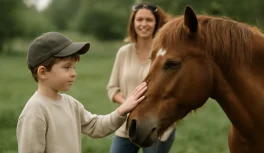
The relationship between Missouri Fox Trotters and children is one of the most frequently cited qualities by families who acquire horses of this breed. The combination of medium size (less intimidating than a large warmblood), smooth gait (less startling for a child new to riding), and calm temperament creates a naturally safer learning environment.
That doesn’t mean any child should ride any Missouri Fox Trotter without supervision or preparation. No horse of any breed is automatically safe with any child — the size, strength, and unpredictability of any equine requires respect and education. But on the spectrum of horses families consider for their children, the Missouri Fox Trotter consistently ranks among the most suitable options.
Children who grow up riding Missouri Fox Trotters often report that their first experience on a conventional trotting horse afterward is a surprise — the conventional trot feels jarring compared to the fox trot they knew first.
Missouri Fox Trotter for the Returning Rider
One of the most common buyer profiles in the Missouri Fox Trotter market is the returning rider: someone who rode in their youth, stopped for decades due to work, family, or life commitments, and now wants to return to the sport — but finds that their knees, back, or hips have made the conventional trot a problem.
The Missouri Fox Trotter resolves this issue elegantly. The fox trot eliminates the vertical impact that makes the conventional trot painful for many people in middle age and beyond. A rider who can no longer handle hours on a trotting horse often discovers they can ride a Missouri Fox Trotter with comfort and genuine enjoyment.
This is one of the reasons the breed has grown especially quickly in countries with aging recreational horse populations — Western Europe, North America — where there’s a large contingent of riders who love the sport but have encountered physical barriers to continuing.
Versatility Beyond the Trail
A common misconception about the Missouri Fox Trotter is that it’s “just a trail horse.” The reality is that the breed demonstrates remarkable versatility across a range of contexts.
Western pleasure and showing: the breed has a strong tradition in MFTHBA shows and regional circuits. Western pleasure, equitation, trail in-hand, and driving classes are all part of the show calendar.
Pleasure driving: the Missouri Fox Trotter’s calm temperament and steady rhythm make it an excellent partner for light carriage driving. The breed’s disposition is well-suited to the requirements of safe, enjoyable hitch work.
Therapeutic riding: the smooth gait has direct application in therapeutic riding programs. The fox trot’s rhythmic, predictable movement is especially valuable for riders with impact sensitivity or for people who need a riding experience with minimal physical disruption. The gentle side-to-side motion stimulates balance and core engagement without jarring impact.
Ranch and cattle work: the working heritage remains functional. Missouri Fox Trotters are used on American ranches for cattle work — sorting, checking fences, moving livestock — especially on properties with rough terrain where comfort over long hours is relevant.
Parades and public events: the calm temperament makes the Missouri Fox Trotter well-suited for parades, public events, and situations with crowds and unexpected sounds — contexts that nervous horses make dangerous.
Practical Considerations When Choosing
For families considering a Missouri Fox Trotter as a first horse or as an addition to an existing equestrian household, some practical considerations help make a well-informed choice:
Evaluate the specific horse’s history: temperament is shaped by training and socialization, not just breed. A Missouri Fox Trotter with a good training foundation will confirm the breed’s reputation; an animal with inadequate training or negative experiences may not match the positive stereotype.
Ride before you buy: always. There’s no substitute for riding the specific horse you’re considering.
Consider age and history: an adult Missouri Fox Trotter with a documented history of family use is generally safer for beginners than an unstarted youngster, even if the young horse is less expensive.
Verify the fox trot: in a purchase context, ask to see and feel the gait. A clean, smooth, consistent fox trot is a sign of a quality individual; irregular or intermittent gait may indicate training issues or physical problems.
The Missouri Fox Trotter’s reputation as a family horse isn’t universal — individual animals exist that, due to training or individual temperament, don’t match the stereotype. But the breed statistically has one of the best temperament reputations in the saddle horse world, and that reputation was earned long before anyone had a marketing budget to promote it.