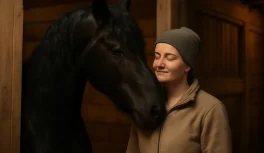
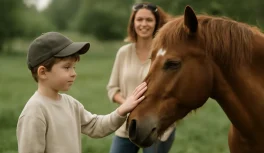
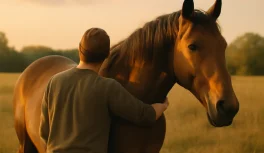
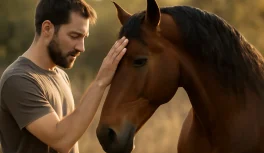
Most experienced equestrians will tell you that a horse seems to “know” how you’re feeling — that arriving at the barn stressed produces a different animal than arriving calm. For years this observation lived in the realm of horsemanship lore, appreciated by practitioners but dismissed by those who saw anthropomorphism everywhere. Then researchers started testing it.
What they found is that horses perceive human emotions through a multi-channel system that operates partly through channels humans didn’t expect to be relevant — including the electromagnetic field generated by the human heart.
What does the science actually show?
The first major controlled study on horses and human emotional perception was published in 2016 in Biology Letters by researchers at the University of Sussex. The design was deliberately strict: horses were shown photographs of unfamiliar human faces expressing either anger or happiness. No other cues were available — no body language, no voice, no familiar context.
The results were clear. When shown angry faces, horses increased heart rate and turned to view the image with their left eye — a behavioral indicator of negative threat processing routed through the right hemisphere of the brain. This left-eye bias for negative stimuli is documented across multiple species and reflects a neurological architecture for threat processing that is evolutionarily conserved.
Horses didn’t need context, familiarity, or a relationship with the person in the photograph. They were reading emotional state from a static image of a face they had never seen.
Do horses remember emotional encounters?
Yes — and this is the finding that most surprised researchers who worked in the area.
A follow-up study published in Current Biology in 2018 by researchers at the University of Sussex and France’s National Institute of Agronomic Research investigated equine emotional memory. The protocol was precise: an unfamiliar human interacted with a horse while expressing either anger or happiness — no physical threat, no reward, just facial expression and approach body language. Hours later, the same person returned with a neutral expression.
Horses that had been exposed to the angry expression in the first encounter responded to the person’s return — despite the neutral expression — with measurably higher vigilance, elevated heart rate, and significantly lower willingness to approach. Horses exposed to the happy expression showed greater openness.
The horses had formed an emotional impression of a specific person and were applying that impression to a later interaction with the same individual in a different state.
Beyond the face: the multiple channels of emotional perception
Facial expression is one channel. But horses read human emotional state through several simultaneous inputs:
Cardiac electromagnetic field. As documented by HeartMath Institute research, the horse’s nervous system receives information from the electromagnetic field generated by the human heart. That field’s coherence — its regularity and rhythm — varies with emotional state. A stressed human’s cardiac field is irregular and contracted; a calm human’s is organized and expansive. The horse registers this difference before any physical contact occurs.
Vocal tone. Horses distinguish between calm and agitated voices with high accuracy, even when the language is unfamiliar. Studies in which recorded voices were played at controlled volumes showed that horses responded to emotional tone independently of volume or content.
Micro-body cues. Horses register subtle postural shifts, changes in breathing pattern, micro-tension in the muscles of the hands holding the lead rope, and gait pattern changes that correlate with emotional activation. An experienced horse handler familiar with “feel” is processing these signals consciously; horses process them automatically.
Smell. Humans emit cortisol-related compounds through sweat when stressed. Horses have a vomeronasal organ (Jacobson’s organ) specifically adapted to process chemical social signals. There is preliminary evidence that horses respond differently to sweat from stressed versus calm humans.
The system is redundant: horses cross-reference multiple channels simultaneously, which means a human attempting to “mask” stress through deliberate posture while maintaining an incoherent cardiac field and elevated cortisol chemistry is unlikely to fool the animal.
What makes horses particularly sensitive?
Horses are prey animals. Their survival as a species depended on the early and accurate detection of threat signals from the environment — including threat signals embedded in the behavior of other social partners. A horse that misread a pack-member’s alarm as irrelevant paid with its life.
This evolutionary pressure created a nervous system with exceptional sensitivity to subtle variations in the emotional state of nearby organisms. The same capacity that made horses excellent at detecting predator-anxiety in herd mates makes them excellent at detecting anxiety, tension, and agitation in the humans who work with them.
The sensitivity isn’t trained. It’s biological and present from birth. What training does — in both horses and handlers — is shape how that sensitivity is expressed: toward flight, toward stillness, toward engagement, or toward learned helplessness.
How does this change training and handling?
The practical implications are direct.
A rider or handler who believes they can separate their internal state from their horse’s behavior is misunderstanding the relationship. The horse is not responding to the visible technical execution of aids — it’s responding to the full field the rider is emitting, of which the technical execution is only one component.
This is why accomplished trainers across traditions emphasize preparation of self as much as preparation of horse. Not as personal philosophy, but as operational fact: the work goes better when the human brings coherence to the interaction. The horse is not better-behaved because you “deserve” it — it’s better-behaved because you’re emitting a field the animal’s nervous system interprets as “safe to relax.”
For anyone who works with horses — whether as a recreational rider, a competitive athlete, or a professional — this reframe is significant. The most important variable in any session may not be the technique you brought. It may be the state you brought.