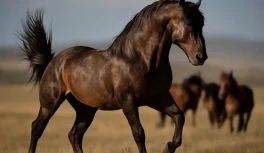
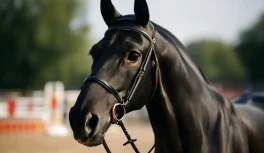
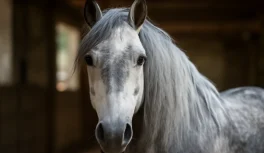
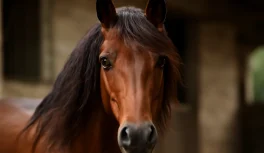
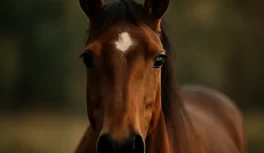
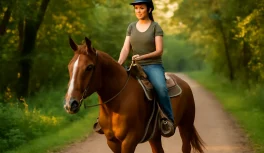
Some horses you ride with technique. Some horses you have a conversation with. The Mangalarga Marchador’s temperament places the breed firmly in the second category. Breeders and riders who have worked with well-raised animals from this breed consistently use the same words: docile, intelligent, generous, reliable.
These aren’t marketing terms. They’re the result of over two centuries of selection that prioritized, above all else, a horse that was genuinely good to work with — one that brought people back to the field, not drove them away from it.
Why does the Mangalarga have this temperament?
Understanding the Mangalarga Marchador’s temperament begins with understanding how it was selected. Unlike breeds developed for track speed or arena jumping, the Mangalarga was developed for daily use on Brazilian interior farms.
In that context, a nervous, unpredictable, or difficult-to-handle horse represented a real risk. Workers who needed to use the animal every day — in varied terrain, weather, and stress conditions — had neither the time nor the resources to manage difficult horses. Such animals simply weren’t used for breeding.
This selection continued for more than two centuries. The accumulated result is a temperament pattern that, in well-raised and well-handled horses, manifests as:
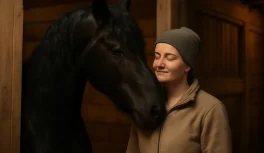
Genuine docility: the Mangalarga tends to receive human contact naturally. It doesn’t need to be “re-earned” at each session — it recognizes the relationship with its rider and responds to it.
Controlled curiosity: breed animals tend to be attentive to their environment without being hyperreactive. They observe, process, and respond — rather than fleeing before evaluating what happened.
Willingness to work: this is the characteristic that most surprises riders from other breeds. The Mangalarga generally wants to go — it doesn’t need convincing at each step.
Memory and learning: breed horses learn quickly and retain what they’ve learned. Well-conducted training sessions produce visible results in shorter timeframes than in many other breeds.
Is the Mangalarga Marchador suitable for beginners?
Yes — and this is one of the most common questions from anyone considering their first horse.
Some important caveats:
“Docile” doesn’t mean “without reaction”: a well-tempered Mangalarga responds to rider, environment, and pressure situations proportionally. It won’t buck, won’t kick without reason, won’t explode without warning. But an animal mistreated, subjected to abusive training, or maintained in poor conditions can develop defensive behaviors like any other horse.
Handling history matters: the temperament a rider encounters in any Mangalarga depends significantly on how that specific animal was raised and worked. A foal raised with appropriate socialization from the first months of life — accustomed to human contact, sounds, different terrain — will be considerably easier to work than an animal that spent its first years in semi-liberty with minimal human interaction.
The breed makes it easier, but doesn’t replace learning: for beginners, a well-tempered Mangalarga Marchador is a real advantage. But learning to ride still requires guidance from a qualified instructor.
For intermediate and advanced riders, the Mangalarga’s temperament provides a working foundation that allows rapid advancement in refinement of aids, quality of contact, and subtle communication.
Emotional mirroring: the horse reflects the rider
One of the most fascinating characteristics of equine temperament — not exclusive to the Mangalarga, but very present in it — is the capacity to mirror the rider’s emotional state.
Horses are prey animals with nervous systems extremely sensitive to detecting emotional states in other organisms. An agitated, anxious, or impatient rider arrives to the horse through a series of signals — tension in the hands, breathing rhythm, body rigidity — and the horse processes these signals as environmental information.
In the Mangalarga, this sensitivity combines with the docile temperament in a very specific way: the animal tends to regulate the rider as much as the rider regulates the animal. Arrive calm, find a calm horse. Arrive agitated, and the horse reflects back an amplified version of what you brought.
Experienced breeders know this mirroring well. It’s why many say that riding a good Mangalarga is always, to some degree, work on oneself.
Temperament in a family context
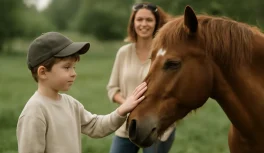
One reason the Mangalarga Marchador is frequently recommended as a first family horse — including for children — is the combination of medium size, comfortable gait, and balanced temperament.
Very large horses can intimidate children. Horses with irregular gaits can create insecurity. Breeds with more reactive temperaments can create unpredictable situations that frighten inexperienced riders.
A well-selected, well-raised Mangalarga tends to minimize these risks. Not because it is a horse “without reaction” — but because the threshold for extreme reactions is higher, and recovery to calm after a scare is faster.
This is not a universal guarantee — individual temperament varies, and any horse can become difficult with poor handling. But as a starting point, the breed offers real advantages for families entering riding.