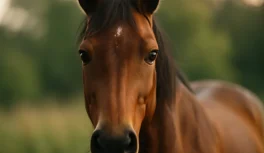
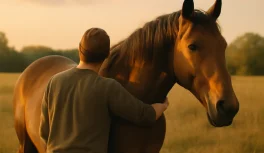
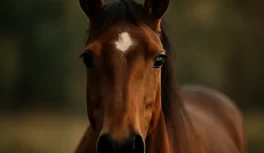
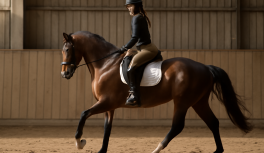
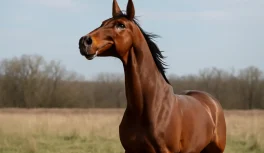
The horse’s visual field is one of the most impressive in the mammal world. Nearly 350 degrees of panoramic coverage, achieved through a lateral eye placement that gives unmatched environmental awareness. But this extraordinary field comes with trade-offs: two distinct blind spots, a narrow zone of binocular depth perception, and visual processing that works very differently from what humans experience. Understanding the horse’s visual field isn’t just interesting biology — it’s the foundation for understanding how horses behave, react, and process their environment.
What does the horse’s visual field actually cover?
The horse’s total visual field covers approximately 340 to 350 degrees around its body. This is achieved through the lateral placement of the eyes on either side of the skull, with each eye covering roughly 190 degrees independently.
This panoramic range means a horse standing still, with its head in a natural resting position, can see nearly everything around it without turning its head — everything, that is, except for two specific zones:
- A cone-shaped blind spot directly behind the hindquarters, extending several feet beyond the tail
- A smaller dead zone directly in front of the nose and below the head
These blind spots are not design flaws. They are a direct consequence of the same eye placement that enables the panoramic field. The architecture that gives horses near-350-degree awareness creates two unavoidable gaps as a geometric side effect.
Why are horse eyes positioned on the sides of the head?
This is the evolutionary question behind all equine vision. Horses evolved as prey animals in open grassland environments where predators could approach from any direction. In that context, the most valuable visual capability is coverage — detecting a threat coming from the side or rear before it closes the distance to attack range.
Predators (wolves, large cats, bears) tend to have forward-facing eyes that maximize binocular overlap and precise depth perception, useful for calculating the distance to a target during pursuit. Prey animals evolved the opposite configuration: lateral eyes that sacrifice binocular precision for panoramic sweep.
The horse didn’t evolve to identify an approaching threat with surgical precision. It evolved to notice that something is moving at all — anywhere in a 350-degree field — and react before identification is even necessary.
How does the horse’s visual field compare to a human’s?
Human visual field: approximately 180–190 degrees total, with about 120 degrees of binocular overlap in front. Good for fine detail and depth perception; limited for peripheral detection.
Horse visual field: approximately 340–350 degrees total, with only 55–65 degrees of binocular overlap in front. Exceptional for peripheral detection and motion awareness; less precise for calculating depth in the lateral zones.
Neither is “better” — both are optimized for different survival demands.
The binocular zone: where the horse judges depth
Within the horse’s broader visual field, there is a forward-facing zone where the fields of both eyes overlap. This is the binocular zone — approximately 55 to 65 degrees directly in front of the horse — and it’s where the animal achieves genuine stereoscopic depth perception.
In this zone, the brain receives slightly different images from each eye. The difference between the two perspectives allows the visual system to calculate distance. This is the zone the horse uses to:
- Judge the height and distance of a jump obstacle before takeoff
- Navigate uneven or unfamiliar terrain
- Assess objects directly ahead at close and mid range
The binocular zone is narrow by human standards, but it’s positioned where it matters most: forward and slightly downward, covering the approach path ahead and the ground immediately in front of the hooves.
What are the monocular zones in horse vision?
The monocular zones are the lateral portions of the visual field covered by one eye only, with no overlap between the two eyes. Each eye covers roughly 190 degrees, and most of this coverage is monocular.
In the monocular zones, the horse:
- Detects motion with exceptional sensitivity — even subtle movement at the far edge of the field registers immediately
- Has limited depth perception — without two overlapping images to compare, the brain can’t calculate distance with stereoscopic precision
- Processes images independently — what the left eye sees is not automatically integrated with what the right eye sees
The monocular zones are the horse’s primary surveillance system: wide coverage, continuous monitoring, extreme sensitivity to motion. What they sacrifice in depth precision they compensate with breadth of awareness.
Why head position matters so much for equine vision
Because the horse has no centrally fixed fovea pointing forward (as humans do), the direction of the binocular zone changes entirely with head position. This is one of the most practically important aspects of equine vision for riders, trainers, and handlers.
Head raised: binocular zone points toward the horizon. The horse is scanning for distant movement or assessing an unfamiliar environment.
Head at natural angle (neck gently arched): binocular zone points slightly forward and down. The horse is evaluating nearby terrain and what’s in the immediate approach path.
Head lowered to grazing position: binocular zone points toward the ground immediately ahead. The horse is monitoring what’s underfoot.
When a rider holds a horse’s head in constant deep flexion, they redirect the binocular depth perception zone downward. The horse doesn’t lose depth perception, but it’s aimed at the wrong distance for assessing what’s coming. In jumping, this is directly relevant: horses need to raise the head sufficiently as they approach an obstacle to use the binocular zone for assessment before the jump enters the frontal blind spot in the final strides.
The bilateral learning effect: why horses need both sides
One of the least intuitive aspects of equine visual processing is that information doesn’t automatically transfer between the two eyes. A horse that has evaluated a frightening object calmly through its left eye may react with genuine alarm when the same object appears on the right for the first time.
This isn’t stubbornness — it’s the result of independent monocular processing. The evaluation performed through one eye, processed by one hemisphere of the brain, doesn’t automatically apply to the other side.
Practical implication: when introducing a horse to anything new — a blanket, a piece of equipment, an unfamiliar obstacle — present it on both sides. The “safe” assessment made on the left has to be established independently on the right. This isn’t extra work; it’s basic equine neuroscience.
What the horse’s visual field means for everyday handling
Understanding how the horse’s visual field is structured changes how you move around horses at a fundamental level:
- Approach from the shoulder or neck — never from directly behind, where the blind spot begins
- Announce your presence when moving behind a horse, even one you know well
- Give horses transition time when moving between bright and dim environments — the adaptation lag is real and significant
- Present new objects from both sides, not just the near side