There is something about the presence of a miniature horse that shifts the atmosphere of a room in a way no therapy manual can fully describe. Part of it is their size — close to a child’s, non-threatening. Part of it is their gaze — large, dark, lateralized, observing without pressing. Part of it is the fundamental nature of these animals, who have lived for millennia attuned to the body language and emotional states of those around them. In therapeutic work, that millennia-old sensitivity becomes a tool. And the documented results continue to surprise health professionals around the world.
Why Horses Work in Therapy — and Why Miniatures Are Exceptional at It
Equine-assisted therapy has roots that stretch back to ancient Greece, where Hippocrates wrote about the benefits of horse riding for patients with physical ailments. The modern, clinically structured version — known as hippotherapy and equine-assisted therapy — has existed formally since the second half of the 20th century, particularly after German physiotherapist Lisbeth Jansen documented the effects of equine movement on the neuromuscular system of patients with cerebral palsy in the 1960s.
But why horses specifically? The answer exists in three layers:
The movement: a horse at the walk produces a three-dimensional pattern of movement (vertical, horizontal, and lateral) that is remarkably similar to the human walking pattern. When a patient rides, their center of gravity responds to this movement in a way the brain recognizes as “walking.” For people with motor difficulties, this provides sensory-motor stimulation that conventional physical therapy cannot replicate.
The presence: horses are prey animals with neurology wired for detecting emotional states. In wild herd settings, the ability to read a companion’s mood can be the difference between surviving or not. That same capacity shows up in therapeutic contexts: horses respond to the human’s emotional state, and that response — the ear that rotates, the tension that increases or decreases in the neck, the step that quickens or settles — functions as an immediate mirror of what the patient is feeling.
The bond: the human-horse relationship has a unique quality — the horse is large enough to be physically impressive, yet responds gently to correct handling. That encounter of size and trust challenges and strengthens simultaneously.
Miniature horses bring all three layers with a critical operational advantage: they are physically far less intimidating. An 8-year-old child with severe autism who would never approach a 1,100-lb (500 kg) horse can sit on the floor and look into the eyes of a 200-lb (90 kg) miniature. The barrier to entry is radically lower — and that’s precisely where transformation begins.
Therapeutic Modalities
Hippotherapy
Hippotherapy is a physical therapy, occupational therapy, or speech-language pathology treatment that uses the horse’s movement as a therapeutic tool. The patient mounts — or is positioned on — the moving horse, and the health professional addresses specific therapeutic goals while the animal moves.
Full-sized horses are most common in hippotherapy because the larger back produces a broader movement pattern — more stimulation per step. Miniature horses are not typically used in mounted hippotherapy for adults, but they play an important role in pediatric protocols, especially for very young children or those with severe tactile hypersensitivity, where the gradual approach pathway begins with the miniature before progressing to the full-sized horse.
Equine-Assisted Therapy (EAT)
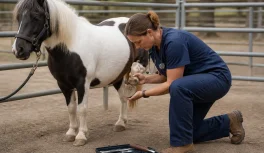
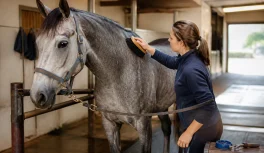
Broader than hippotherapy, equine-assisted therapy encompasses any structured therapeutic intervention that uses the horse as a co-therapist. The patient doesn’t have to ride — they can work on foot with the animal (grooming, leading, hoof cleaning), participate in activities near the horse without direct touch, or simply be in the same space as part of a desensitization protocol.
In this modality, the miniature horse is the star. Its accessible size permits:
- Work in enclosed or semi-enclosed spaces where a large horse wouldn’t fit
- Direct access to the muzzle, mane, and back without a mounting block or stepstool
- Natural, close eye contact — a miniature’s muzzle height falls at eye level for a child aged 5 to 7
- Significant reduction in initial fear in populations that have never had contact with equines
Miniature Horse-Assisted Therapy
In the United States and Europe, a specific line of work with mini horses has gained clinical recognition for particular populations:
Patients with dementia and Alzheimer’s: mini horses are brought into long-term care facilities and specialized memory units. Interaction with the animal — touching, grooming, talking — activates affective memories and reduces agitation episodes in patients who no longer respond to conventional interventions. Studies at American facilities have documented reductions of up to 40% in agitation episodes.
Hospitalized children: therapeutic visitation programs with mini horses in pediatric long-stay units — including pediatric oncology — show reduced cortisol, decreased pain perception, and improved mood in patients who often face prolonged isolation.
Autism: the horse’s response to the patient’s emotional state functions as instant biofeedback. For children struggling with emotional regulation, learning that their internal state produces a visible effect on the animal’s behavior is one of the first steps toward developing emotional awareness.
What the Research Says
Scientific evidence for equine-assisted therapy has grown significantly over the past decade. The most robust studies document:
For autism: a meta-analysis published in the Journal of Autism and Developmental Disorders in 2017 analyzed 14 studies and found significant improvements in verbal communication, social interaction, and adaptive behaviors in children with ASD who participated in equine-assisted therapy programs.
For cerebral palsy: hippotherapy shows documented benefits in muscle tone, balance, and gait quality in children with CP. The American Congress of Rehabilitation Medicine (ACRM) includes hippotherapy in its recommendation guidelines for certain patient profiles.
For mental health: multiple studies with adults experiencing PTSD — particularly military veterans — document symptom reduction after structured equine-assisted therapy programs.
For older adults: research in geriatric care settings shows improvements in mood, reduced isolation, and in some studies, improved cognitive markers after regular interactions with therapy animals, including mini horses.
Important caveat: the literature still has limitations in sample size and protocol heterogeneity. Results are promising and consistent enough to justify clinical use, but the exact mechanisms — and which populations benefit most — continue to be investigated.
How an Equine-Assisted Therapy Program Works
A well-structured program involves far more than “bringing the animal to the patient”:
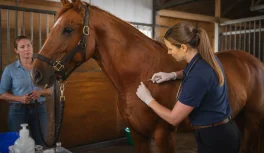
Multidisciplinary team: a serious equine-assisted therapy center has a physical therapist, occupational therapist, or psychologist responsible for the therapeutic protocol; a certified equestrian instructor; and an animal welfare professional responsible for the horse’s care and health.
Individualized assessment: each patient undergoes evaluation before the program begins. Contraindications exist — recent fractures, some orthopedic conditions, and certain health states can contraindicate the activity. The assessment defines therapeutic objectives and the protocol.
The animal as co-therapist: the professional continuously monitors the animal’s state. A tense or stressed miniature horse is not a co-therapist — it’s a risk. The animal’s health and well-being are not secondary to the therapy; they are part of it.
Progression: work begins with approach and familiarization steps before any direct interaction. Each session builds on the previous one.
Evaluating a Legitimate Therapy Center
Some criteria for assessing a center that works with miniature horses:
- Staff credentials: a licensed health professional responsible for the protocol (physical therapist, occupational therapist, psychologist, or equivalent); equestrian instructor with specific equine-assisted therapy training
- Program certification: in the US, PATH International (Professional Association of Therapeutic Horsemanship) is the reference organization; in the UK, Riding for the Disabled Association (RDA); and equivalent bodies in other countries
- Animal condition: horses must be calm, well-maintained, with up-to-date veterinary records and clear signs of well-being
- Documented protocol: individualized therapeutic goals, session records, and outcome tracking are hallmarks of a serious clinical program