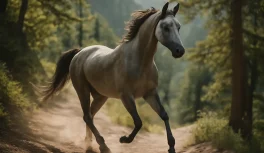
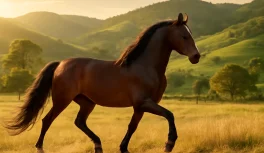
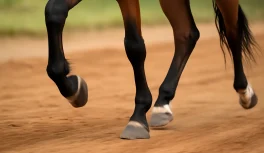
There’s an experience that riders describe in nearly identical terms — regardless of whether they’re Puerto Rican, Colombian, American, or Brazilian. It’s the first time they ride a good Paso Fino at full gait. Most reach for the same phrase: “it feels like I’m standing still.” Some add: “like floating.” Others simply go quiet for a few seconds, absorbing what just happened.
The Paso Fino horse gait isn’t just smooth. It’s a biomechanical solution to a problem that conventional equitation never fully solved: how to carry a human being for hours on an animal weighing 900 pounds without the rider absorbing constant impact. The answer lies in the lateral four-beat gait — and the Paso Fino has refined that solution to its highest possible degree.
What Is the Lateral Four-Beat Gait?
To understand why the Paso Fino gait is different, it helps to understand how conventional horses move first.
At the trot — the two-beat gait — legs move in diagonal pairs: left front and right hind together, then right front and left hind. This creates a suspension moment between beats when no foot touches the ground. The rider “drops” in that moment and must post or absorb the impact directly. Over long rides, this accumulates and causes fatigue, back pain, and discomfort.
In the lateral four-beat gait — the Paso Fino’s natural gait — the legs move in independent sequence: right hind, right front, left hind, left front. At no point are both hinds or both fronts simultaneously airborne. The horse always has two or three feet on the ground, creating continuous support that eliminates the suspension moment — and with it, the vertical impact on the rider.
The practical result: while the trot rider rises and falls with each stride, the Paso Fino rider stays virtually motionless vertically. The horse moves around the rider, not beneath them in a way that shakes them.
The Three Gait Speeds: Paso Fino, Paso Corto, Paso Largo
The Paso Fino gait isn’t a fixed point — it’s a spectrum with three main variations, each suited to a different purpose.
Paso fino (show gait)
The pure paso fino is the breed’s most collected, most precise gait. Steps are short, rapid, and extremely regular — a living metronome with four beats per cycle. Speed is low (4–6 mph), but the visual impression is one of continuous vibration: hooves seem to barely touch the ground before returning to the air.
This is the gait evaluated at shows. The tablero — a wooden platform installed in the arena — amplifies hoof sound so judges and spectators can hear the regularity of the four beats. Any irregularity — a louder beat, a diagonal moment — is audible before it’s visible.
For the rider, pure paso fino produces delicate vibration — described as “sitting in a gently massaging armchair.” For the observer, it’s hypnotic: the horse appears to tremble in place while moving forward.
Paso corto (working gait)
The paso corto is the extended paso fino — greater stride reach, greater speed (6–12 mph), maintaining laterality and smoothness. This is the gait that defines the breed’s practical utility: with it, a Paso Fino can cover 20–30 miles per day of comfortable trail riding.
The paso corto demands more from the horse than the pure show gait — more posterior thrust, more extension — but produces less vibration for the rider. The sensation is one of smooth, constant gliding, like a boat on calm water.
Paso largo (fast gait)
The paso largo is the Paso Fino’s speed gait. The horse fully extends, stride length increases, speeds can reach 20–25 mph. Laterality is maintained — no trot, no canter — but smoothness decreases slightly as speed increases.
Few Paso Fino horses execute a truly correct paso largo: it’s the most demanding variation to maintain without “breaking” (transitioning to trot or canter) under effort. Horses with a solid paso largo are highly valued.
How Is the Gait Evaluated in Competition?
The evaluation of the Paso Fino gait in formal competition has precise criteria that reflect the breed’s philosophy: smoothness, regularity, naturalness, and minimal impact on the rider.
The tablero: In most American and Puerto Rican shows, horses pass over a wooden platform (typically elevated plywood) that amplifies hoof sound. The judge hears four regular, equidistant beats — any irregularity is immediately detectable. Horses with diagonal gait (two beats instead of four) are eliminated.
Rider lightness: The rider is evaluated by position — the less effort the rider makes to remain in the saddle, the better. A rider who posts, grips, or sways excessively indicates a less smooth gait. The ideal is the rider absolutely still, with light contact.
Naturalness: The gait must be produced effortlessly by the horse, without mechanical or presentation devices. Horses with natural gait have an advantage over those that depend on intensive training to maintain the march.
Is the Gait Genetic or Trained?
This is one of the most debated questions among Paso Fino breeders and riders — and the answer is: both.
Genetic component: The lateral four-beat gait has clear genetic basis. Equine genetics research has identified mutations in the DMRT3 gene associated with lateral gaits in multiple breeds — including the Paso Fino, Mangalarga Marchador, Tennessee Walker, and Icelandic Horse. Horses with these mutations have a natural predisposition to gait rather than trot.
Paso Fino horses bred from parents with solid gait have a high probability of being born with the correct gait. Quality-bred foals often exhibit natural paso fino before they’re ever ridden.
Training component: Genetic gait still needs to be developed. A Paso Fino with genetic predisposition but inadequate training may “break” to trot under excess speed, difficult terrain, or a rider who doesn’t support the gait with proper aids.
The good trainer works to amplify the horse’s natural gait — not to create a gait that doesn’t exist. Methods that force the gait using mechanical devices (weighted boots, chemical stimulation) are controversial practices prohibited in serious competitions.
Why Does the Paso Fino Gait Resist Cantering?
A curiosity that surprises first-time observers: well-trained Paso Finos tend to maintain their gait even when excited, startled, or on steep descents. Where other horses automatically canter, the Paso Fino often continues in paso.
This isn’t coincidence. It’s the result of centuries of selection for horses that maintained their gait under pressure. A colonial administrator who needed to traverse plantations in wet weather — with slippery ground and an agitated horse — needed an animal that wouldn’t break to unstable canter when nerves flared.
This resistance to instinctive cantering is today one of the Paso Fino’s advantages for mature riders, beginners, and people with physical limitations: the horse rarely “explodes” unpredictably.