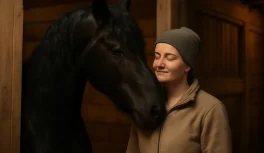
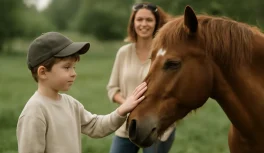
It’s not coincidence that mental health programs around the world have independently reached the same conclusion: something happens when humans spend time near horses that doesn’t happen with the same consistency in any other therapeutic context. The reduction in anxiety observed in equine-assisted programs isn’t just a matter of fresh air, exercise, or distraction. It has measurable physiological markers — and a biological explanation that research is progressively mapping out.
The relationship between horses and anxiety is, at once, intuitive for those who’ve experienced it and genuinely surprising in its depth for those who study it.
What happens in the body when we’re near horses?
The most rigorous studies on the physiological effects of horse proximity measure two primary markers: salivary cortisol (the principal stress hormone) and heart rate variability (HRV — the indicator of autonomic nervous system balance).
Results are consistent across multiple independent studies: adults and children with elevated anxiety show measurable reductions in salivary cortisol after 15 to 30 minutes of interaction with horses in calm environments. HRV, which tends to be low under chronic stress, increases in the same time window.
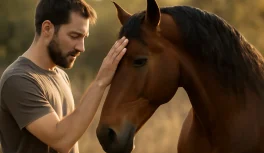
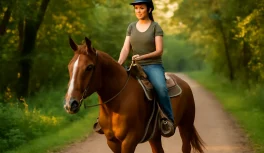
These changes occur both during riding sessions and during ground-based sessions — simply caring for the horse, grooming, walking alongside it, or just being present in the same space.
Why does the horse’s mere presence produce this effect?
The answer current research offers involves at least three parallel mechanisms:
The cardiac electromagnetic field. The horse’s heart generates an electromagnetic field approximately five times more intense than the human heart, detectable at distances of up to 6 feet. In calm, well-cared-for horses, this field shows high coherence — a regular, rhythmic pattern that, when it enters the range of the human nervous system, induces a tendency toward synchronization. The human autonomic nervous system, receiving that coherent signal, tends to downregulate its own activation.
Sensory feedback from contact. Touch with animals — particularly the acts of grooming, stroking, or simply resting a hand on the horse’s flank or neck — stimulates the release of oxytocin in the human organism. Oxytocin, often called the “bonding hormone,” has a direct anxiolytic effect: it reduces the hypothalamic-pituitary-adrenal axis response that regulates cortisol production.
The demand for presence. Horses respond to the handler’s internal state with immediacy. An agitated person approaching a calm horse will observe the change in the animal — ears shift, posture changes, the horse may move away or increase vigilance. This immediate feedback creates an involuntary demand for presence: for the horse to remain calm, the person needs to regulate their own activation. It’s live biofeedback, operating in real time.
Is there a difference between being near horses and near other animals?
The question has been investigated in comparative studies. The answer appears to be: yes, there is something specific about horses that distinguishes them from other therapy animals — though the exact reasons remain a matter of discussion.
Some hypotheses in the literature:
The horse’s size creates a physically distinct experience. Standing beside an animal that weighs over 1,000 pounds and remains calm in your presence is, for the nervous system, a qualitatively different experience of safety — a potential threat become a partner.
The horse’s electromagnetic field is significantly larger than that of dogs, cats, or other therapy animals. The cross-species cardiac coherence effect documented in humans near horses may simply be more pronounced than with smaller species.
Horses are highly social prey animals with sophisticated emotional communication systems. Their response to human emotional state is more immediate and visible than in most other animals — creating the real-time biofeedback that other species don’t offer with the same intensity.
What does the research show about horses and anxiety in children?
Much of the most rigorous research on equine therapy and anxiety has been conducted with children — particularly those with autism spectrum disorder and generalized anxiety — for methodological reasons: variables are easier to control in this population, and effects tend to be more pronounced.
A systematic review published in the Journal of Child and Family Studies in 2020, analyzing 35 controlled studies, found that equine therapy programs produced significant reductions in anxiety scores in children with ASD in 28 of the 35 studies reviewed. The effect was larger in programs that combined riding with ground-based interaction — suggesting multiple mechanisms contribute to the outcome.
In adolescents with generalized anxiety disorder, smaller but well-controlled studies found that 8 to 12 weeks of equine therapy participation (two 60-minute sessions per week) produced anxiety score reductions comparable to group cognitive-behavioral therapy — with the notable difference that adherence to the horse program was substantially higher.
Adherence is, for any mental health program, a critical variable. And horses, based on available evidence, create a motivation to show up that conventional treatments often struggle to match.
Do you need to ride to benefit?
Not at all. And this has considerable practical importance.
For people with severe anxiety, the idea of riding a horse for the first time can itself be a source of anxiety — creating a paradox. The good news is that most of the mechanisms described here operate independently of riding.
The electromagnetic field works through simple proximity. The live biofeedback operates in ground-based interaction. Oxytocin is released through touch and care, not through athletic effort. “Ground-based equine therapy” programs — in which participants never ride, but interact with horses through feeding, grooming, pasture walking, or simple presence — have documented results comparable to mounted modalities for conditions like PTSD and generalized anxiety disorder.
This broadens access significantly. You don’t need to know how to ride to experience what the research shows. You need only to be present — and the horse does the rest.
What to look for in an equine therapy program
Serious equine therapy programs are run by licensed mental health professionals — psychologists, licensed clinical social workers, occupational therapists — in partnership with certified equine specialists. Many national equine therapy associations (such as PATH International in the US) maintain registries of accredited centers.
When evaluating a program, a few criteria are worth attention: the visible welfare of the horses used (a chronically stressed horse is not an effective therapeutic instrument), the credentials of the professionals involved, clarity around therapeutic goals, and a protocol for tracking progress.
The benefit is real. The science is growing. And horses, it seems, have known it far longer than we have.