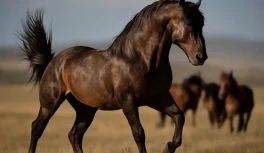
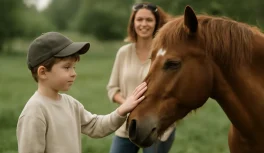
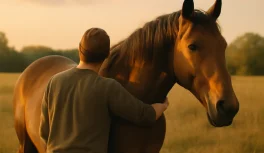
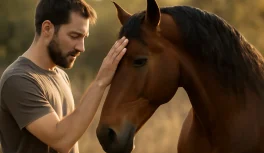
The word “breaking” carries weight that doesn’t fit what actually happens when someone works well with a mustang. There’s no breaking here. Gentling a mustang — done responsibly — is translation: you learn to speak the horse’s language while it learns to understand yours.
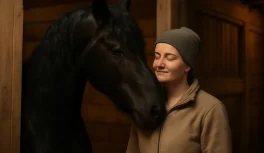
The result, when done with method and patience, is one of the most genuine bonds equestrian life creates.
What Gentling Means — and Why It Matters
Gentling means making a horse safe and willing — creating conditions for it to accept human contact voluntarily, not through coercion. This isn’t just a philosophical preference: it’s practical efficiency.
A horse that associates humans with threat learns — and unlearns — in ways that create long-term problems. A horse that learns humans are predictable and safe becomes confident, and that confidence generalizes to new challenges. The foundation you build in gentling determines what every subsequent training session can accomplish.
Before You Begin: Safety Is Non-Negotiable
Working with an untouched mustang requires proper infrastructure. A round pen at least six feet high, with no exposed sharp edges, is the ideal environment for early sessions. Enough space for the horse to move without feeling cornered, but contained enough to keep the work focused.
Personal safety gear — helmet, boots, gloves — is not optional. A mustang in a heightened stress state is unpredictable, and respecting that is not pessimism: it’s professionalism.
If you have no experience with reactive or frightened horses, start with a professional present, at least for the first several sessions.
The Foundation: Pressure and Release
The principle that underlies almost all mustang work is simple to understand and hard to execute consistently: you apply a pressure (moving toward, a change in posture, a sound) and release it as soon as the horse responds — even minimally.
The logic: the release is the reward. When the mustang understands that a specific behavior caused the pressure to ease, it will repeat that behavior. Patience + consistency + timing = progress.
The most common mistake in this phase is applying pressure and not releasing at the right moment — or releasing out of exhaustion rather than in response to the horse.
The Milestones of Gentling
Phase 1: Accepting your presence
The horse stops actively moving away from you. It may still be alert, but no longer treats your presence as an immediate threat. This can take days or weeks depending on the individual.
Phase 2: Tolerating approach
You can stand within six feet without the horse urgently retreating. It may sniff the air, observe, return to eating — behaviors that signal a reduction in alertness.
Phase 3: First touch
For most mustangs, the first touch happens on the neck or shoulder — the least reactive areas. It’s common for the horse to freeze, tense, or pull its head away. The key is not retreating at the moment of tension, but releasing as soon as any relaxation appears.
Phase 4: Touch across the whole body
Neck, shoulder, back, hindquarters, legs — each area has its own process. The same pressure-and-release sequence. The same patience. The goal is for touch to become routine, not an event.
Phase 5: Halter and leading
Placing the halter is another step with its own timeline. After accepting the halter comes leading — moving together without resistance. This is where trust in motion begins.
Phase 6: Desensitization to objects and stimuli
Blankets, plastic bags, spray, sounds. A confident mustang doesn’t need a perfect environment — it needs tools to process new stimuli without panicking.
Phase 7: Saddle and rider
The saddle is its own full process: getting used to the weight of the equipment, simulated load, then a rider’s weight, then movement. The first ride is not an endpoint — it’s the start of a new chapter.
How Long Does It Take?
There’s no standard answer. Younger horses tend to respond faster to initial gentling. Untouched adult horses can be slower, but they’re not impossible — sometimes they’re more emotionally stable overall.
A rough planning reference:
- Basic gentling (accepting touch, halter): 30 to 90 days of regular work
- Leading, saddling, and initial riding: another 2 to 6 months
- Reliable work for regular use: 1 to 2 years
Anyone who promises significantly faster results is generally cutting steps — and the gaps show up later.
What Separates Good Work from Rushed Work
Good work: each session ends at a point of success. The horse is calmer at the end than at the beginning. Progress is steady, even if slow.
Rushed work: the horse yields because it has no way out, not because it trusted. The appearance is progress; the foundation is fragility. The problem surfaces when the context changes.
When to Call a Professional
- If the horse has a history of aggressive behavior (kicking, striking with force)
- If sessions are consistently getting worse, not better
- If you’re afraid — fear transfers from rider to horse more directly than most people expect
- If your infrastructure is inadequate
Calling a professional is not failure: it’s the wisest decision for the wellbeing of both.
What Comes After Gentling
A gentled mustang is not a finished horse. It’s a horse with a foundation. From there, the journey becomes about refinement, experience, and the gradual building of a horse you can take on trail rides, competitions, or simply to the field — with confidence on both sides.
That “after” is where many owners say the work proves its worth more than any price paid.