The image of the wealthy footballer buying supercars and yachts isn’t wrong — it just isn’t complete. There’s a growing group of soccer players who own horses and farms who chose to counter the noise of professional football with the quiet of rural life and the particular silence that only comes from working with horses.
The combination seems unlikely at first. Horses demand patience, time, and sustained attention — qualities that don’t map easily onto the relentless schedule of elite modern football. But that contrast is exactly what draws many players toward it. In a sport that turns them into products and places them under constant surveillance, the farm is one of the last spaces that operates on different rules.
Thomas Müller: The Striker Who Comes Home to Horses
Thomas Müller is one of the most recognizable players in European football history. Eight-time German league champion with Bayern Munich. 2014 World Cup winner with Germany. Known as much for his tactical intelligence and wit as for the goals and assists that made him one of the continent’s most feared attackers.
What the soccer world knows about Müller, the equestrian world knows differently.
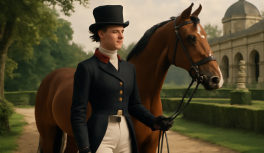
Müller keeps horses at his Bavarian property and has been a visible presence in German equestrian circles for years. His wife, Lisa Müller, is a professional dressage rider who competes at advanced national and international levels — one of the more accomplished equestrian careers connected to a top-flight football family anywhere in Europe.
What Is Thomas Müller’s Relationship With Horses?
It isn’t a hobby that came with marriage, though the marriage certainly deepened it. The farm in Bavaria is where the Müllers actually live, and horses are a daily part of that life. Thomas has spoken about the equestrian world with genuine familiarity — not as an outsider who follows his wife’s career, but as someone who understands the demands of the sport and shares the environment.
The mental contrast between the two worlds is striking. Dressage rewards patience, subtlety, and years of incremental progress. Football, at the Bundesliga level, rewards explosive decision-making under maximum pressure in real time. That the same household contains both — and that both people are elite in their respective fields — is one of the more interesting stories in German sport.
The image of the player who made defenders look slow all over Europe tending to horses on a quiet Bavarian morning is not a contradiction. It’s a portrait.
The Brazilian Connection: Football, Farms, and Roots
In Brazilian football, the relationship between players and rural life is older and more culturally embedded than in Europe. Many of the country’s greatest players came from small interior cities where rural life was the norm long before football arrived.
When careers generated wealth, the farm wasn’t an acquisition of arrival — it was a return. For players who grew up around land and animals, the ability to own and tend a farm represented something that had nothing to do with status: it was home, in a more fundamental sense than any apartment in São Paulo or apartment in Europe could be.
Horses are woven into that context naturally. The working horse culture of Brazil’s interior — the Criollo, the Mangalarga Marchador, the Quarter Horse in the southern states — has depth and tradition that far precedes any international equestrian sport. A player from the interior of Minas Gerais or Rio Grande do Sul who grew up around horses didn’t learn to love them from a lifestyle magazine. He was around them before he ever touched a football.
European Players and the Rural Retreat
Beyond Müller, the pattern of European footballers with rural properties and horses has become more visible in recent years. It’s particularly common among Spanish players, where the equestrian culture of Andalusia — one of the most storied horse regions in the world — overlaps with regions that have produced generations of top-flight footballers.
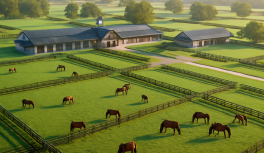
In England, rural properties with horses have become a frequent choice for Premier League players seeking some distance from the intensity of coverage that follows any public figure in British football. The countryside outside London, or in counties like Cheshire and Surrey, has seen a steady accumulation of working farms owned by players who made exactly this calculation.
Why Football and Horses Find Each Other
The simplest explanation is also the most accurate: elite football and serious horsemanship both demand a quality of presence that cannot be faked.
A high-level player learns, very early, to separate what he controls — his movement, his decision, his positioning — from what depends on others — teammates, the opponent, the referee. That ability to manage attention under uncertainty transfers to equestrian work with surprising directness.
The horse, like the game, accepts no divided attention. Both demand the complete person — and it’s that kind of demand that elite players seek instinctively, even away from the pitch. The farm isn’t a rest from intensity. It’s a different form of the same intensity, without the referee and without the cameras.
Müller captured it in his characteristically precise way: there’s a clarity on the farm that modern football rarely offers. On the pitch, everyone has an opinion. With the horses, what counts is what you do — not what they say you did.