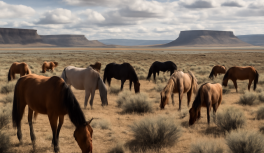
Horses appear hundreds of times in the Bible — from the horses of Pharaoh pursuing Moses at the Red Sea to the final vision in Revelation. But no biblical scene involving horses reaches the symbolic force and cultural impact of the Four Horsemen — arguably the most reproduced apocalyptic image in Western history, referenced in literature, cinema, politics, and art for two uninterrupted millennia.
Horses in the Bible Beyond the Apocalypse
Before reaching Revelation, it is worth acknowledging that the horse runs through the entire biblical narrative. In the Old Testament, horses are instruments of war and imperial power — frequently associated with the might of Egypt and other nations, in constant tension with Israelite faith.
The prophet Isaiah (31:1) warns: “Woe to those who go down to Egypt for help, who rely on horses.” The message is clear: trusting in the military power of horses is trusting in human power rather than divine. The horse here functions as a symbol of human self-sufficiency — a temptation that God’s people must resist.
In the book of Job (39:19–25), God describes the warhorse with one of the most poetic passages in Scripture: “Do you give the horse its strength, or clothe its neck with a flowing mane? […] He laughs at fear, afraid of nothing; he does not shy away from the sword.” Here the horse is not a symbol of idolatry — it is an admirable creation of God, a being that embodies the grandeur of creation.
Why Did God Forbid the Kings of Israel From Acquiring Many Horses?
Deuteronomy 17:16 explicitly instructs that the king of Israel “must not acquire great numbers of horses for himself.” The context is theological: horses were the cutting-edge military technology of the ancient world. Possessing them in abundance meant not needing to trust God for protection. The horse, in this specific biblical context, represents the seduction of worldly power over faith — the shortcut that makes divine dependence unnecessary.
The Four Horsemen of the Apocalypse: Overview
The vision in Revelation 6:1–8 describes four horsemen released when the Lamb (Christ) opens the first four seals of a sealed book. Each rider mounts a horse of a distinct color, and each color signals the theme that rider represents. Together, they form the most powerful and enduring image in Christian eschatological symbolism.
The Rider on the White Horse (Rev 6:1–2)
The first rider mounts a white horse, carries a bow, and receives a crown — and “went out conquering and to conquer.” His identity is the most debated in two thousand years of Christian theology.
Main interpretations:
- Christ or the Gospel: the stephanos (victor’s crown) and the mission to conquer suggest the expansion of God’s kingdom across the world
- The Antichrist: a perfect imitation of Christ, parodying the true white horseman of Revelation 19
- Conquest / Imperialism: a historical representation of Roman power or any empire that subjugates peoples by force
The ambiguity is central: the white horseman can be both the highest form of spiritual power and its most dangerous simulacrum. The Bible does not resolve this enigma — and perhaps that is precisely the point.
What Distinguishes the White Horseman at the Start of Revelation from the One at the End?
The first rider (ch. 6) has an ambiguous identity — he can be blessing or curse. The rider in chapter 19 is explicitly identified as Christ: “Faithful and True.” The arc of Revelation moves from ambiguity to revelation — from the difficulty of distinguishing the sacred from the false to the moment when that distinction becomes absolute and final.
The Rider on the Red Horse (Rev 6:3–4)
“Its rider was given power to take peace from the earth and to make people kill each other. To him was given a large sword.” The red horse is war — not as an abstract concept, but as the concrete reality of human conflict.
The large sword (machaira megas) is specifically the close-combat sword — not a ceremonial or long-range weapon. The red horseman represents immediate, visceral violence, with no safe distance between aggressor and victim.
The red color of the horse belongs to the same semantic family as blood and fire — colors of urgency and immediate destruction. Where the white was ambiguous, the red is direct: no alternative interpretation exists here. This rider exists to destroy peace.
The Rider on the Black Horse (Rev 6:5–6)
The third rider carries scales — an instrument of precise measurement — and a voice announces: “Two pounds of wheat for a day’s wages, and six pounds of barley for a day’s wages, and do not damage the oil and the wine.”
The scales are the symbol of rationed famine — when basic foods must be weighed and priced, abundance has ended. A day’s wages for only a day’s bread is the definition of survival without margin.
The protection of oil and wine (luxury goods) while grain becomes scarce represents the inequality that accompanies famine: the wealthy keep their refined products while the poor fight for basic food. This rider does not bring mere scarcity — he brings the structural injustice of selective scarcity.
Why Is Famine in the Apocalypse Represented by Black Rather Than Another Color?
The choice of color is precise: war (red) is visible, immediate, bloody. Famine (black) operates in the shadows — it is the invisible consequence, the slow process that lacks apparent drama but kills more efficiently than the sword. The black horse is what operates outside direct view, silently transforming reality.
The Rider on the Pale Horse (Rev 6:7–8)
“I looked, and there before me was a pale horse. Its rider was named Death, and Hades was following close behind him.” The pale horse (chloros in Greek — greenish, the color of decomposition) is the most terrifying of the four.
Death and Hades as a pair: Death harvests, Hades collects. They are given “power over a fourth of the earth to kill by sword, famine and plague, and by the wild beasts of the earth.” The pale horseman synthesizes the previous three: where Conquest, War, and Famine pass, Death inevitably follows.
The color chloros — grayish-green, the skin tone of someone in the process of dying — is chosen with anatomical precision. Not the black of consummated death, nor the red of violent death: it is the pallor of the dying process, the greenish cast of flesh losing its blood.
The Return of Christ on the White Horse (Rev 19:11–16)
Revelation ends with a second white horseman — this time without ambiguity. “I saw heaven standing open and there before me was a white horse, whose rider is called Faithful and True.” On his robe and on his thigh was written: King of Kings and Lord of Lords.
The armies of heaven follow him — also on white horses. The final white horse is the vehicle of cosmic resolution — not chaotic destruction, but the restoration of perfect justice. The narrative arc of Revelation forms a complete circle: it begins with riders who destroy and ends with the Rider who restores.
The Cultural Legacy of the Four Horsemen
Few biblical symbols have penetrated secular culture so thoroughly. In English, “the Four Horsemen of X” is a current expression for any group of four entities that together bring ruin to a given field. Bands, sports teams, films, political campaigns — the horsemen inhabit the global imagination regardless of religious conviction.
The enduring force of this image cuts across modern secularism because it is, at its core, a powerful synthesis of the four forms of social collapse: conquest, war, famine, and death. The same four horsemen appear in the human crises of every century.