There’s an apparent contradiction in how horses handle low light. A horse will graze calmly in an open field at midnight, navigating fence posts and water troughs without visible effort. The same horse may pause for a full twenty seconds before stepping into a dim barn aisle in the middle of a bright afternoon. If horse night vision is so effective, why does the animal seem to struggle with shade?
The answer reveals something important — and counterintuitive — about equine visual biology.
Why do horses see well in the dark?
Horse night vision rests on two structural advantages that work together to amplify available light.
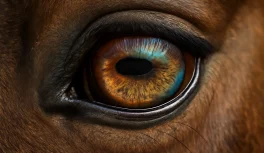
The first is the tapetum lucidum — a reflective layer positioned behind the retina. When light enters the eye and passes through the photoreceptors, some is captured and converted to nerve signals; the rest would ordinarily be absorbed and lost. The tapetum lucidum reflects that remaining light back through the retina a second time, giving the photoreceptors another chance to capture it. Effectively, it doubles the eye’s light-gathering efficiency in dim conditions.
This is the structure responsible for the characteristic “eye shine” you see in horses (and cats, dogs, and many other animals) when a flashlight or headlight catches them in the dark. The glow is light bouncing back off the tapetum lucidum.
The second structural advantage is rod cell density. The equine retina has a significantly higher proportion of rod photoreceptors than the human retina does. Rods specialize in low-light detection — they’re extremely sensitive to light variations but don’t process color or fine detail. A retina packed with rods is a retina built for darkness.
Can horses see in total darkness?
No — no land mammal can see in truly zero light. What the tapetum lucidum and high rod density provide is the ability to function at much lower ambient light levels than humans require. On a clear night with starlight or moonlight, horses have enough light to navigate, graze, and monitor their surroundings with genuine effectiveness.
The horse’s large eyes — approximately 5 centimeters in diameter, the largest of any land mammal — are also part of this equation. A larger pupil aperture at full dilation captures more photons per unit of time. Size matters for light-gathering in the same way a camera lens aperture matters: bigger opening, more incoming light.
In conditions of true darkness (a completely sealed space with no light source), horses are as blind as any other mammal. But that condition almost never occurs in natural or well-designed domestic environments.
Why does the horse’s eye shine in headlights?
That’s the tapetum lucidum at work. When a direct light source hits the horse’s eye at the right angle in low ambient light, the light passes through the retina, reflects off the tapetum, and exits back through the pupil — directly toward whoever is holding the flashlight or driving the car. The result is the characteristic green or yellow-green glow that experienced horsemen learn to watch for when moving around horses in the dark.
Why does a horse hesitate to enter a dark barn?
If horse night vision is good, the barn-entrance hesitation seems paradoxical. The explanation is adaptation lag — the time required for the eye to adjust when ambient light levels change dramatically.
The equine eye adapts more slowly to rapid luminance changes than the human eye does. When a horse moves from bright afternoon sunlight into a shaded or covered space, there’s a transition window — several seconds to several minutes, depending on the light differential — during which visual acuity is temporarily reduced. The horse literally sees less during this window than it will once fully adapted.
For a prey animal whose survival depends on uninterrupted environmental surveillance, voluntarily entering a space where vision is temporarily compromised is a real risk assessment. The hesitation is not stubbornness — it’s the horse evaluating whether it’s safe to be briefly vulnerable.
How does adaptation lag affect handling in practical situations?
Very directly. Forcing a horse through a light-to-dark transition before it has had time to adapt doesn’t override the adaptation process — it increases stress and builds negative associations with that environment.
Practical adjustments:
- Pause at the threshold: when leading a horse from a bright exterior into a dim barn, trailer, or covered arena, stop briefly at the entrance and allow a few seconds of adjustment before asking for forward movement
- Use transition lighting: gradual lighting in barn entries (rather than abrupt bright-to-dark contrasts) significantly reduces hesitation and stress. The eye needs a ramp, not a sudden drop
- Don’t escalate pressure: a horse that hesitates at a dark entry is not being deliberately difficult. Increasing pressure during the adaptation window creates a conflict between the handler’s demand and a genuine sensory limitation
Horses that are familiar with a specific space hesitate less there, because they’ve built spatial memory that substitutes for the visual information they’re temporarily missing during adaptation.
The evolutionary logic of equine night vision
The horse’s effective low-light vision wasn’t accidental. The large predators that historically hunted horses — big cats, wolves, large canids — are most active during twilight and nocturnal hours. An equine visual system that failed at sunset would leave horses essentially defenseless during peak predator activity periods.
The tapetum lucidum, high rod density, and large eye size are predator-defense adaptations as much as they are sensory tools. The horse that can monitor 340 degrees of field in near-darkness, detect motion at the periphery, and identify a predator’s silhouette while it’s still at a distance — that animal was the one that survived to reproduce.
Do horses sleep at night?
Yes, but not in the way humans do. Horses use polyphasic sleep — multiple short rest cycles distributed across the day and night. They can doze while standing, thanks to the passive stay apparatus in the legs that locks the joints without sustained muscle effort. These standing dozes cover light sleep stages.
Deep sleep (REM), which requires lying down, happens in short sessions — typically 30 minutes to two hours per day in total, usually concentrated in the early morning hours when ambient light is lowest and the herd provides maximum collective vigilance.
Horses in groups distribute the alertness burden: while some members doze or lie down, others remain standing and scanning. This cooperative vigilance is one of the practical reasons herd living improves individual rest quality — and why isolated horses often show more anxiety and less deep sleep than those kept with companions.