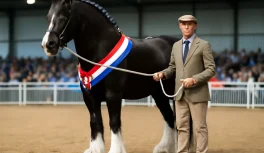
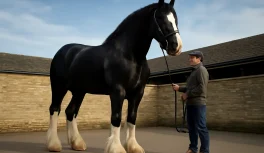
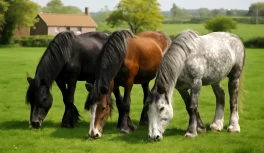
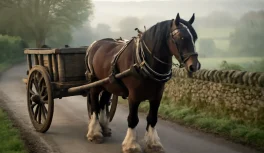
The Clydesdale is one of the most commanding horse breeds to ever walk this earth. Weighing over a ton, with silky feathered legs and a presence that stops crowds in their tracks, this Scottish giant manages to combine what you rarely see in a single animal: massive size and genuine gentleness, raw power and undeniable elegance. See a Clydesdale for the first time and you won’t easily forget it — spend time with one and you may never want another breed.
The Clydesdale is a study in paradoxes: enormous but docile, powerful but sensitive, historically built for the hardest work imaginable yet now among the most celebrated animals at festivals, fairs, and advertising campaigns worldwide. This article goes deep into everything that makes this breed extraordinary — from its Scottish origins to its contemporary cultural role, covering physical traits, temperament, care, and what makes these horses truly unlike any other.
Origins: Born to Work the Scottish Lowlands
The name Clydesdale comes from the River Clyde, which runs through Lanarkshire in southwestern Scotland. In the 1700s, local farmers began crossing native Scottish draft mares with Flemish stallions — heavy horses imported from the Flanders region of present-day Belgium — to produce animals with greater pulling power for the region’s heavy, waterlogged farmland.
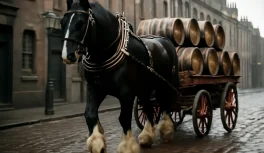
The result was a breed capable of pulling plows through clay-dense soil, hauling coal from the mines, and moving massive loads through the rapidly expanding industrial cities. In 1877, the Clydesdale Horse Society was founded, formalizing breed standards and establishing the studbook that continues to this day.
At the height of the Victorian era, an estimated 140,000 Clydesdales were exported annually from Great Britain — to Australia, New Zealand, North America, and South America. This was the world’s preferred draft horse on four continents, an animal that literally moved civilization before the combustion engine made muscles obsolete.
Physical Traits: What Makes the Clydesdale Unmistakable
A typical adult weighs between 1,760 and 2,200 lbs (800–1,000 kg), with exceptional individuals reaching 2,400 lbs (1,100 kg) or more. Height ranges from 16 to 18 hands at the withers, placing the Clydesdale among the tallest horse breeds in the world — competing for that distinction with Britain’s Shire Horse and France’s Percheron.
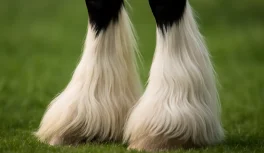
But what truly sets the Clydesdale apart visually isn’t just size. It’s the leg feathering — the abundant, silky hair that grows from the knee and hock, forming those characteristic flowing fringes that sway with every stride. This feathering is one of the most prized and carefully maintained traits in the breed.
Other Defining Characteristics
Head — broad and expressive, with a slightly convex profile. The eyes are large and alert, intelligence visible even from a distance.
Neck — high and arched, set into a well-defined wither that gives the Clydesdale its characteristic upright, proud carriage.
Body — powerfully compact and muscular, with well-sprung ribs, a relatively short back, and a slightly sloping croup. The hindquarter muscle development is especially prominent.
Legs — robust, with dense bone, wide joints, and large, rounded hooves — essential for distributing the horse’s weight across uneven ground without sinking in wet terrain.
Movement — despite their size, Clydesdales have an active, cadenced walk with real knee and hock action. The trot is bold and energetic, the elevated leg motion creating a visual spectacle that’s hard to look away from.
Coat Colors: A Range with Personality
The Clydesdale isn’t a single-color breed. The most common coat is roan — a mix of white hairs interspersed with bay or black, creating a layered visual depth — followed by bay in its golden-to-dark-brown range, brown in medium to dark shades, and black, less common but present in the breed. Gray appears rarely.
Nearly all Clydesdales carry white markings on the face and legs. The white leg markings are particularly striking because they contrast with the feathering — dark feathering over a white leg, or white feathering against a dark coat, creates a layered visual impact that’s instantly recognizable in the show ring.
Temperament: A Giant with a Gentle Soul
If the size intimidates, the temperament wins you over completely. Clydesdales are renowned for being calm, biddable, and genuinely affectionate with people. They respond well to handling, build strong bonds with their caretakers, and rarely display unprovoked aggression.
That docility isn’t weakness — it’s the result of centuries of selection for cooperative work. A horse that spooks at everything or resists commands is useless in a coal mine or on a busy 19th-century city street. The Clydesdale needed to be absolutely reliable, and that quality runs deep in the genetics.
This makes the breed a strong recommendation for first-time owners of large horses, therapeutic riding programs, and public-facing events. Seeing a small child standing next to a Clydesdale at an equestrian festival is something that surprises only those who know the breed only by size.
The Clydesdale Today: From Working Horse to Cultural Icon
With the mechanization of agriculture in the 20th century, Clydesdale numbers collapsed. By the 1970s the breed was classified as at-risk, with worryingly low populations in the United Kingdom. The Rare Breeds Survival Trust still lists the Clydesdale as “vulnerable” in certain regions.
The recovery came from three directions at once. First, renewed interest in low-impact agriculture and animal-powered farming on small and mid-sized operations. Second, the show ring, where the Clydesdale dominates by presence, movement, and sheer visual impact. Third — and perhaps the most powerful — pop culture.
The Budweiser Horses and the Power of Visibility
The Budweiser Clydesdales transformed the breed into a global symbol. Since 1933, the American brewer’s commercials featuring Clydesdales have become cultural events in their own right, especially during the Super Bowl. These horses tour the United States at public events, accumulate social media followings, and have introduced the breed to millions of people who’ve never set foot on a farm.
That cultural effect is hard to quantify but easy to observe: ask anyone what a Clydesdale is and there’s a good chance they mention beer before they mention Scotland.
Caring for a Clydesdale: When Your Horse Outweighs a Car
Owning a Clydesdale means scaling everything up. A healthy adult in light maintenance consumes between 33 and 44 lbs (15–20 kg) of hay per day, plus concentrated feed as activity demands. Water needs are proportional: 12 to 20 gallons (45–75 liters) per day depending on workload and temperature.
Stabling must match the horse’s dimensions. Stalls smaller than 13×13 feet (4×4 m) are inadequate for an adult Clydesdale; 13×16 to 16×16 feet (4×5 to 5×5 m) is ideal, with minimum door clearance of 8 feet (2.4 m). Tack, grooming equipment, and all accessories must be sourced or custom-made for a breed this size.
Caring for the Feathering
Leg feathering care is labor-intensive and specific. Feathering traps moisture and can cause a skin condition known as “scratches” or “mud fever” — a dermatitis sometimes called cleft disease in draft breeds. Regular inspection and cleaning of the lower legs, including careful drying after exposure to wet conditions, is a non-negotiable part of the Clydesdale care routine.
The hooves, being exceptionally wide, require a farrier experienced with large draft breeds. Improper shoeing compromises posture and can cause joint damage over time.
Why the Clydesdale Still Matters
In an era of farm machinery, precision agriculture, and automation, a horse that weighs a ton might seem like a relic. But the Clydesdale doesn’t just survive — it grows in cultural relevance — for reasons that go beyond practical utility.
It represents a living connection to a time when animal muscle literally powered the world. There’s something deeply moving about watching a Clydesdale in full motion — those fringes flying, the great hooves resounding against the ground — that no machine can replicate or replace.
For breeders, it’s challenge and passion. For spectators, it’s pure spectacle. For the history of horsemanship, it’s an essential chapter that deserves to keep being written.
The Clydesdale isn’t just a horse breed. It’s a statement.