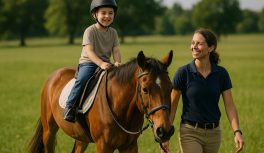
Not every horse can work in equine therapy. The horse selected for therapeutic riding must bring together a very specific combination of physical, temperamental, and behavioral characteristics — qualities that allow it to carry patients with special needs, including those who display involuntary movements, unexpected sounds, and demands that bear no resemblance to conventional riding.
Choosing the right horse is one of the most consequential decisions an equine therapy center makes — and the criteria behind that choice reveal a great deal about what makes the therapy work.
Temperament: The Single Most Important Quality
Before any analysis of breed or physical conformation, temperament is the non-negotiable criterion in therapeutic horse selection.
A horse suited for this work must be:
Calm and predictable — startle reactions, bolting, or unpredictable behavior are incompatible with therapeutic work. The horse must maintain composure in the presence of wheelchairs, crutches, spastic movements, sudden vocalizations, medical equipment sounds, and all the behavioral variations that patients with different conditions may present.
People-oriented — the therapeutic horse has intense, constant contact with humans throughout the day. It must genuinely accept that contact — being touched in various places on its body, having its personal space entered, being approached by strangers repeatedly across many sessions.
Pressure-tolerant — there will be moments of irregular physical pressure on its back, accidental rein tension, asymmetrical weight distribution. The horse must process these stimuli without reacting abruptly.
Responsive without being hypersensitive — it should respond appropriately to the team’s cues but not amplify stimuli disproportionately. The balance between responsiveness and calm is rare and highly prized.
Ideal Physical Characteristics
Beyond temperament, certain physical traits make horses better suited for therapeutic work:
Height and Build
The ideal height range is approximately 14 to 16 hands (56–64 inches, or 142–163 cm at the withers). Horses that are too tall make mounting more difficult and increase the perception of risk for patients with anxiety around height. Very small ponies may not produce the pelvic movement needed to deliver therapeutic benefit.
Broad, Level Back
The horse’s back must be wide enough for the patient to sit with stability, and level enough to avoid discomfort or uneven pressure. Horses with very angular or sharp withers are not suitable.
Rhythmic, Even Walk
The walk is the gait most used in equine therapy — and its quality directly determines the quality of the therapeutic stimulus. A regular, well-cadenced walk with good amplitude produces the movement impulses that work the patient’s balance and posture. An irregular walk reduces the value of every session.
Sound Limbs and Feet
Orthopedic problems in the limbs alter gait quality and can compromise the regularity of movement transmitted to the patient. Limb and hoof health is continuously monitored in therapeutic horses.
Breeds Most Commonly Used
There is no single breed designated for equine therapy — individual temperament always outweighs breed generalizations. That said, certain breeds appear more frequently because their typical traits align well with therapeutic requirements:
Quarter Horse
The most common breed in equine therapy centers worldwide. The Quarter Horse has a naturally calm, cooperative temperament, excellent back conformation, a regular walk, and appropriate build. It is versatile, easy to work with, and widely available.
Paint Horse
A descendant of the Quarter Horse, the Paint shares the same calm temperament and suitable conformation, with the addition of colorful coat patterns that often delight patients — especially children.
Warmbloods
Certain warmblood breeds, particularly the calmer individuals within the breed’s temperament range, are used in European centers for their movement quality and back conformation. They require rigorous individual screening.
Medium-Sized Ponies
For young children or smaller patients, medium-sized ponies (above 12 hands) can be excellent — provided they have the right temperament. Welsh ponies and Haflingers are frequently mentioned in this context.
Selection and Training: What the Process Actually Involves
Finding a horse with the right temperamental profile is only the beginning. Specific training for equine therapy can take six months to over a year.
Progressive desensitization — the horse is gradually exposed to everything unusual about the therapeutic environment: wheelchairs, crutches, therapy balls, equipment sounds, involuntary movements, asymmetrical weight in the reins. Each stimulus is introduced patiently until the horse demonstrates consistent indifference.
In-hand and longe work — developing regularity of gaits, responsiveness to the handler’s cues, and the ability to maintain rhythm under irregular loads.
Progressive loading — the horse begins carrying weights, then people, in graduated increments, with careful behavioral evaluation at each stage.
Ongoing assessment — even after being approved for therapeutic work, the horse is regularly evaluated. Changes in behavior, signs of fatigue, or stress indicators are reasons to adjust workload or schedule rest.
Horse Welfare: The Part That’s Often Overlooked
One dimension that is frequently underestimated: the therapeutic horse works hard, and its care must be proportionate to that demand.
Session limits — most protocols cap therapeutic sessions at four to six per day per horse, with rotation across the center’s herd.
Rest days — free weekends and periodic breaks are essential to the horse’s physical and mental wellbeing.
Health monitoring — regular veterinary care, consistent farriery, and nutrition calibrated to the level of physical effort.
Stress signals — ears pinned flat during sessions, excessive muscle tension, avoidance behaviors with people — these are signs the horse is overloaded or distressed. A serious equine therapy center actively monitors for them.
Horse welfare is not just an ethical consideration — it is a therapeutic one. A stressed horse is not an effective therapeutic partner.