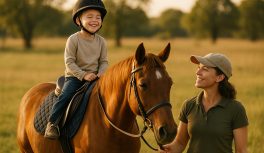
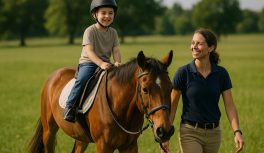
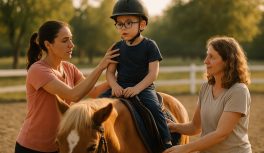
The relationship between equine therapy and autism is one of the most active and promising areas within the research on complementary interventions for Autism Spectrum Disorder. Over the last two decades, dozens of studies around the world have investigated what happens when a child or adult on the spectrum engages in regular, structured contact with horses in a therapeutic setting — and the results follow a pattern that goes well beyond the anecdotal.
This article brings together what the science knows, what is still being investigated, and what families and clinicians need to understand before incorporating equine therapy into a treatment plan for someone with autism.
Why the Horse Works Differently for People with Autism
Most therapies designed for autism take place in controlled environments, with humans as mediators — therapists, teachers, parents. Those environments have real value. But they also carry the social complexity that is often one of the greatest sources of stress for people on the spectrum.
The horse changes that equation in fundamental ways.
The horse has no social expectations. It does not require eye contact. It does not interpret silence as rejection. It does not become frustrated with atypical behavior. For a child with autism who lives under constant pressure to meet social norms that don’t come naturally to them, the horse is a genuinely neutral partner — and that neutrality matters enormously.
The horse responds to behavior, not diagnosis. When the child becomes agitated, the horse grows more tense. When she calms down, the horse settles. This immediate, honest, nonverbal feedback creates a behavioral mirror that many children with autism respond to with surprising clarity — sometimes more readily than they respond to verbal instructions from human adults.
The sensory environment is rich but predictable. The horse’s scent, body warmth, coat texture, the rhythmic sound of hooves — these are intense sensory stimuli, but they follow a consistent pattern. For children with sensory hypersensitivity, gradual habituation to this environment can itself be therapeutic.
What the Research Shows
The scientific base on equine therapy and autism has grown substantially. Here are the most relevant findings:
Social Communication and Language
A systematic review published in the Journal of Autism and Developmental Disorders in 2018, analyzing 14 randomized controlled studies, found statistically significant improvements in social communication skills following equine interventions. Participating children demonstrated greater communication initiative, more eye contact, and measurable gains in functional language compared to control groups.
Repetitive and Restrictive Behaviors
Multiple studies document reductions in repetitive behaviors — stereotypies and self-stimulatory movements — during and after equine therapy sessions. The most widely accepted hypothesis is that the rich, organized sensory input from the horse’s movement “regulates” the nervous system in a way that reduces the need for self-stimulation.
Emotional Regulation
Research using validated emotional regulation scales shows improvements in children with autism following equine therapy programs, including fewer dysregulation episodes and greater capacity to tolerate frustration.
Attention and Executive Function
Tasks requiring sustained attention, sequential instruction-following, and impulse control have shown measurable improvement in studies with children with ASD who participated in equine therapy, compared to those who did not.
How Equine Therapy Fits Into an Autism Treatment Plan
Equine therapy does not replace the evidence-based interventions established for autism — ABA, PECS, speech therapy, occupational therapy, and others. It functions as a complementary component within an integrated treatment plan.
The strongest outcomes emerge when:
- Equine therapy has specific goals aligned with the child’s overall treatment plan
- There is regular communication between the equine therapist and other providers on the team
- The family is involved and understands the purpose behind each activity
- Frequency is consistent — weekly sessions maintained for at least six months
Equine therapy is particularly valuable for children with autism who struggle to engage with conventional therapies. The intrinsic motivation generated by the horse frequently increases openness to working on skills that, in other contexts, are actively resisted.
Approaches Most Commonly Used for Autism
Ground-Based Equine-Assisted Activities
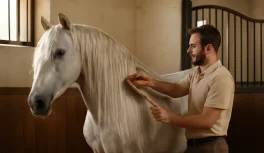
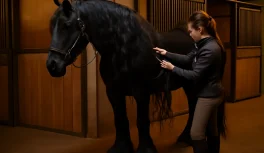
For children at the more challenging end of the spectrum, the work often begins without mounting at all. Grooming the horse, offering food, leading with a halter — these activities address nonverbal communication, joint attention, sequencing, and sensory regulation, without the added demands of balance and riding movement.
Hippotherapy
For children with motor difficulties alongside autism, hippotherapy — passive positioning on the horse in motion — delivers the sensory and regulatory benefits of equine movement without requiring active participation in directing the animal.
Therapeutic Riding
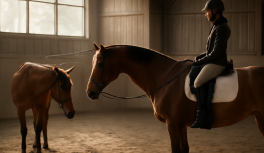
For children with stronger motor and cognitive function, learning to ride and direct the horse develops responsibility, communication, and planning skills — alongside the physical and sensory benefits.
What to Expect in the First Months
Progress in equine therapy for autism is not linear. The first sessions typically involve adjustment — to the environment, to the animal, to the routine. Some children connect with the horse almost immediately; others need weeks before they can approach without dysregulation.
Months 1–2: Adaptation, building a bond with the horse and the team. Simple goals around sensory tolerance and basic attention.
Months 3–4: More active engagement. Communication initiatives toward the horse. First functional exercises during the ride.
Months 5–6: Evaluation of initial objectives. Generalization — behaviors learned in the equine therapy context beginning to appear in other environments.
Families often notice changes outside the sessions before therapists have formally documented them: the child who asks to go “see the horse,” who imitates a canter around the living room, who uses for the first time a word she learned during a session.
These are signs that something important is happening.