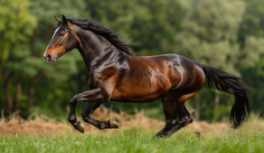
There are athletes who dominate a season. Rarely, one emerges who dominates a full four-year cycle. Winx dominated nearly five — without a single defeat.
Between September 2015 and April 2019, the Australian mare won 33 consecutive races, an absolute record in Australian racing and one of the greatest sustained performances in any timed equestrian discipline in the world. She didn’t win ordinary races: she won the Cox Plate — Australia’s most prestigious weight-for-age race — four consecutive times. She was named the world’s best racehorse for four years running. And when she retired, she did so in peak competitive form, a decision by her connections that amounts to something close to revolutionary in the culture of thoroughbred racing.
From Unremarkable Foal to National Phenomenon
Winx was born on August 14, 2011, in Australia, a daughter of Street Cry out of Vegas Showgirl. Her pedigree was respectable but not elite — the kind of profile that produces solid performers, not necessarily historic ones. Her first two seasons on the track were promising but inconsistent. She won regularly but also lost, finished off the podium, showed the normal variability of a young Thoroughbred still being developed.
What changed was maturity — and the partnership with trainer Chris Waller and jockey Hugh Bowman. Waller, a New Zealander based in Australia known for his patience in long-term horse development, calibrated Winx’s competition program to avoid overextending her in her development seasons. Bowman, in turn, built with the mare a riding communication that observers compare to what Edward Gal had with Totilas in dressage — a synchrony that made race decisions nearly invisible.
The Cox Plate: Four Wins, Four Years
The Cox Plate, run at Moonee Valley racecourse in Melbourne, is considered Australia’s most demanding weight-for-age race for horses aged three and older. Its format — tight turns on a smaller track, demanding different tactics than the open circuits where most top races are contested — makes repeated victories particularly difficult, even for high-caliber horses.
Winx won in 2015, 2016, 2017, and 2018. Each year she faced different competition, different track conditions, different strategies from her rivals. Each year she crossed the finish line first.
The 2018 victory was particularly significant: she equaled the Cox Plate consecutive wins record held by Kingston Town from the 1980s and then surpassed it. When she crossed the line for the fourth time at Moonee Valley, Winx had become the horse with the most wins in the Cox Plate’s history.
What Made Winx So Difficult to Beat?
Australian racing analysts identified two physical characteristics that set Winx apart from her contemporaries: an exceptionally long stride that created a mechanical advantage in straight runs, and an above-average cardiac recovery rate documented in post-race examinations showing her heart rate returning to resting values far faster than most Thoroughbreds.
Beyond physiology, there was a tactical element: Winx raced with a reserve. Bowman rarely used her at maximum effort in the middle stages, preserving for the final sprint an energy that rivals frequently no longer had. In racing, this is called “holding something in hand” — and Winx responded to that management in a way few horses can sustain race after race at the highest level.
Four Years as the World’s Best Racehorse
The title of world’s best racehorse is assigned annually by the Longines World’s Best Racehorse Rankings, a system that compiles results from top races around the globe and assigns comparable performance ratings. It’s the most widely recognized method for comparing horses that have raced in different countries and different types of races.
Winx topped the rankings in 2016, 2017, 2018, and 2019 — a four-year sequence that had not been seen in the modern international turf era. That recognition is especially significant because Australian racing, while highly competitive internationally, carries less global visibility than European and North American circuits. For a horse from the Southern Hemisphere to be named the world’s best four years running is a result that pushed against the structural biases in the evaluation system.
She never raced in Europe or North America — her connections chose to keep her in Australia throughout her career. Some critics cited this as an argument against the full extent of her dominance. The response from her supporters is always the same: the comparative ratings placed her above any competitor in the world for each of those four years.
How Did Winx Differ From Other Great Mares in Racing History?
Racing has a peculiar gender dynamic: great mares are celebrated, but rarely placed in direct comparison with great stallions. Weight-for-age allowances mean mares typically carry less weight in open races — which, for some, undermines direct historical comparisons. And historically, top mares tended to compete mainly against other females in sex-restricted races.
Winx dismantled that logic. She didn’t just compete against males regularly — she beat them regularly, carrying level weights in open races. In the Cox Plate, there’s no gender separation: she won against the best Australian horses of either sex. That willingness to compete — and dominate — under equal conditions is what places her in a different category from the great mares who came before.
The April 2019 Retirement: A Statement, Not Just a Decision
When Winx’s connections announced her retirement in March 2019 ahead of her final race, Australian racing had a reaction rarely seen in the sport: relief mixed with gratitude.
In racing, horses almost never retire early. The commercial pressure to keep competing — from prize money, appearance fees, and breeding value negotiated against active records — keeps animals in training long past their optimal window. Winx was retired at seven, still in peak form, because her owners decided the symbolic value of ending an undefeated career outweighed any further competitive gain.
Her final race, the Longines Queen Elizabeth Stakes at Randwick Racecourse in April 2019, was won with comfort. The crowd’s standing ovation lasted more than ten minutes.
What Became of Winx After Racing?
Winx was sent to Coolmore Australia to become a broodmare of exceptional value. Her first foals began reaching the track in 2022, and Australian racing follows each one with the attention reserved for potential heirs to a legend. None has yet shown their mother’s signs. But it’s early — and the turf is patient when it comes to waiting for the next impossible thing.