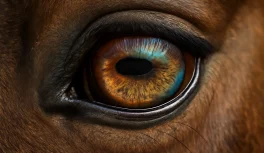
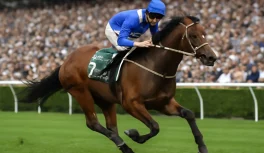
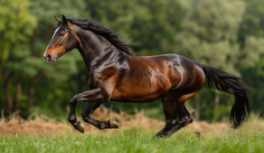
If the white horse represents light, purity, and accessible sacred power, the black horse in spiritual tradition inhabits the opposite end of the symbolic spectrum — not as its malevolent opposite, but as its necessary counterpart. The black horse is the mystery that cannot be fully illuminated, the force that operates in the depths, the transformation that only happens when the ego consents to descend into the dark.
This article explores the symbolism of the black horse across traditions from Celtic mythology to the Apocalypse, from the Jungian unconscious to global folklore — and why, in virtually every serious spiritual tradition, black is never simply darkness but energy not yet revealed.
The Black Horse in Jungian Psychology
Carl Jung was among the first modern thinkers to systematize black horse symbolism. In his analysis of dreams and myths, Jung observed that the black horse frequently represents content from the Shadow — that part of the psyche that the ego rejects, suppresses, or simply fails to recognize as its own.
The Jungian Shadow is not evil in itself: it is the unintegrated, the unacknowledged potential, the raw energy that, when denied, operates through behavior below the level of conscious awareness. A black horse appearing in a dream does not announce disaster — it announces that powerful forces are moving behind the scenes of consciousness, asking to be recognized.
What Does It Mean to Be Chased by a Black Horse in a Dream?
In Jungian interpretation, being pursued by a black horse is one of the most significant dreams a person can have — not because it is terrifying, but because it signals that the Shadow is demanding attention. The energy you are running from is proportional to the strength of the horse that represents it. The larger and more imposing the black horse in the dream, the greater the unintegrated potential that awaits recognition.
The Kelpie: Scotland’s Water Horse
The Kelpie is one of the most terrifying spirits in Scottish folklore — a water horse that lives in lakes and rivers, assumes an attractive form (usually black, sometimes dark greenish-grey) and invites the unwary to ride it. Once a rider touches the Kelpie, they become stuck to the animal — and the Kelpie plunges into the depths with its victim.
The symbolism is impressively rich: the Kelpie represents the seduction of the depths, the danger of being swept away by forces one does not understand. The dark aquatic horse is the perfect metaphor for the power of the unconscious — beautiful, irresistible, but absolutely fatal for anyone who approaches without respect and discernment.
In Scottish tradition, the only way to subdue a Kelpie was to capture its silver bridle — indicating that the energy of the depths can be harnessed, but it demands courage and the right instrument. The lesson is psychologically precise: the shadowy contents of the psyche can be integrated, but not through flight or brute force.
The Dullahan: Ireland’s Headless Rider
The Dullahan of Irish mythology is the archetypal herald of death — a headless rider who mounts a black horse (sometimes pulling a carriage of bones) and appears to those who are about to die. Wherever the Dullahan stops, someone dies.
The black horse of the Dullahan represents the inevitable force of death — not as punishment, but as natural passage. The dark horse carries a rider who cannot be argued with, bargained with, or avoided. This is precisely why it generates such fear: not because it is evil, but because it is absolutely certain.
The deliberate choice of the black horse — rather than any other animal — as the mount of death’s herald is revealing: black conceals what lies beyond. Death does not show its face; the black horse does not reveal what waits on the other side. Both are portals to the unknown.
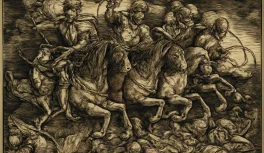
The Black Horse of the Apocalypse: Famine
In the Book of Revelation, the third horseman rides a black horse. Where the white represents conquest and the red represents war, the black carries scales — a symbol of rationed famine, of the cruel precision with which resources must be measured when scarcity arrives.
The biblical black horse is economic famine: not merely the absence of food, but the system of inequality that allows some to have while many go without. The voice that announces the price of wheat and barley while protecting the oil and wine is the voice of the system that survives the crisis while the poorest absorb it.
Why Is Famine Represented by Black Rather Than Another Color?
Famine operates in the shadows — it is the invisible consequence of war, the slow process that lacks dramatic spectacle. There is no visible bloodshed, no staged battle. The black horse is what operates outside direct view, silently transforming economic reality. It is the color of quiet deprivation, of the suffering that does not call attention to itself.
The Black Horse Across World Traditions
The Horses of Hades in Greek Mythology
The horses that pulled Hades’ chariot were invariably black — beings whose names (Alastor, Nycteus, Orphnaeus, Aethon) reference night, punishment, and fire. They were the horses that knew the way to the underworld — knowledge that no living being possessed. The black horse of Hades was not an instrument of malice: it was the vehicle of knowledge of the depths, of what exists beyond death.
In Voodoo and Afro-American Religions
In some traditions of Haitian voodoo and Brazilian Umbanda, the black horse is associated with entities of heavy work, protection, and the opening of paths — particularly Ogum and Exu. Not as malevolent entities, but as forces that operate at crossroads, where the world of the living meets the world of the dead. The black horse here is raw power available to those who know how to invoke it with respect.
In the Islamic Dream Tradition
In traditional Islamic dream interpretation, a black horse indicates power, authority, and success in matters that unfold away from public visibility. Wealth accumulated quietly, projects that mature out of the public eye before emerging with full force.
Why the Spiritual Black Horse Is, Ultimately, a Symbol of Power
The cultural resistance to the black horse as a positive symbol is rooted in the oversimplified dualism that equates light with good and dark with evil. But more sophisticated spiritual traditions — from Taoism to Jungian psychology, from hermeticism to Afro-Brazilian religions — recognize that darkness is not the opposite of the sacred: it is part of it.
The most potent symbol in Taoism is the Yin-Yang: light and dark in perpetual circulation, each containing the seed of the other. There is no Yin without Yang, no white horse without black horse. The tradition that honors only the bright half of the spectrum does not find balance — it finds the illusion of balance, while the black horse gallops in the dark waiting to be recognized.
The spiritual black horse does not represent the absence of light: it represents light before it is revealed. Like potential before it becomes manifest, like a seed before it germinates, like knowledge before it becomes conscious. The deepest transformation always begins in the dark.