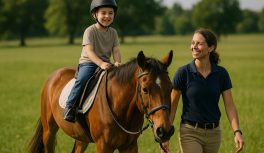
The first time a child climbs onto a horse during an equine therapy session, something happens that no outside observer can fully measure in the moment. The body relaxes in unexpected ways. Eyes that rarely made contact start to look up. Communication that had been blocked for months — sometimes years — finds a new path. And parents who arrived carrying cautious hope leave carrying something different: evidence.
Equine therapy for children is today one of the most studied and documented applications of horse-assisted intervention. When conducted well, the results are frequently remarkable — and this article explains exactly why.
Why Children Respond So Strongly to Equine Therapy
Children have nervous systems in full development — which represents both a vulnerability and a window of opportunity. The neurological plasticity of childhood means that therapeutic interventions delivered in the early years carry a potential for impact that far exceeds what those same interventions can achieve in adulthood.
Equine therapy engages that window in a way that is genuinely unique. Contact with the horse simultaneously activates multiple systems of child development:
The sensorimotor system — the three-dimensional movement of the horse’s walk stimulates the vestibular system (balance), the proprioceptive system (body awareness in space), and the tactile system (sensations of warmth, texture, and pressure). For children with sensory processing disorders, this kind of structured, rhythmic stimulation is often transformative.
The emotional system — horses do not judge. They do not grow impatient. They carry no expectations shaped by diagnostic labels. For a child accustomed to environments of constant evaluation, the horse offers a radically different kind of partnership — and that difference unlocks something.
The cognitive and language system — the need to interact with the horse (giving commands, responding to the animal’s behavior, following activity sequences) drives attention, memory, language, and reasoning in a context that is both motivating and meaningful.
Conditions Most Commonly Addressed
Equine therapy for children is indicated across a wide range of conditions. The most frequently seen in specialized centers include:
Autism Spectrum Disorder (ASD)
Autism may be the condition where equine therapy for children has generated the most research over the last two decades. Studies published in peer-reviewed international journals document improvements in social communication, eye contact, functional language, and reduction of repetitive behaviors following regular equine therapy programs.
The horse operates as a neutral social partner — unlike humans, it responds to the child’s behavior without the complex layers of social expectation that often overwhelm children on the spectrum.
Cerebral Palsy
Children with cerebral palsy benefit especially from the horse’s movement. The equine walk transfers to the child’s hips and trunk a movement pattern that closely resembles human walking, stimulating the muscles involved in posture and locomotion in ways that complement — but do not replace — conventional physical therapy.
Down Syndrome
Improved muscle tone (typically low in children with Down syndrome), language development, motor coordination, and social skills are the most consistently reported benefits. The affective bond formed with the horse also has a positive effect on self-esteem.
ADHD
For children with attention-deficit/hyperactivity disorder, the equine therapy environment creates conditions that are uniquely well-suited: the horse naturally commands and sustains attention in a way that textbooks and screens rarely achieve. And the work of regulating one’s own behavior so as not to startle the animal teaches self-regulation in the most concrete way possible — with immediate, visible consequences.
Global Developmental Delays
Children with global developmental delays, learning difficulties, or sensory integration challenges without a specific diagnosis also respond well to equine therapy as a complementary intervention.
What a Pediatric Session Actually Looks Like
The session begins before the horse. The arrival at the center — the smell of hay and leather, the sound of hooves on the ground — is already therapeutic stimulus. Children with sensory sensitivity go through a gradual habituation process that is itself part of the work.
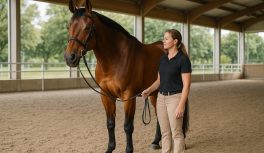
First contact with the horse typically happens on the ground: the child is encouraged to touch, groom, and offer food. This establishes trust and connection — essential for children who struggle with new experiences.
During the ride, the team — generally including a therapist, a horse handler, and side walkers — proposes activities tailored to each child’s therapeutic goals:
- Maintaining an upright position as the horse walks (trunk strengthening)
- Reaching for objects in different positions (coordination, balance)
- Answering questions or naming objects (language, attention)
- Following sequences of instructions (memory, executive function)
- Singing, counting, playing — functional activities woven into movement
Typical sessions run 30 minutes, weekly, with periodic reassessment of therapeutic objectives.
What Parents Report Beyond the Clinical Data
The research captures measurable improvements. But parents frequently describe something the scales don’t fully account for.
Children who barely made eye contact begin to look up. Children who rarely smiled during therapy sessions start arriving early and leaving satisfied. The intrinsic motivation generated by the horse transfers into other areas of daily life — as if the experience of succeeding with the horse opens an internal sense of “I can do this.”
Parents also report improvements in sleep, emotional regulation at home, and openness to other therapies. This is not surprising. Children who feel capable and accepted in one context respond differently across all contexts.
The element of genuine enjoyment is one of the most underestimated factors in pediatric equine therapy. When therapy is something a child wants to attend — rather than something the family has to coax them into — the trajectory of outcomes changes.
How Long Before Results Appear
Every family asks this. The honest answer: it depends.
For milder conditions, improvements in balance, posture, and engagement may appear within a few weeks. For more complex goals — language development, reduction of autistic behaviors, motor control in cerebral palsy — progress is gradual and measured in months.
Consistency is everything. Weekly sessions for at least six months are the minimum needed to properly evaluate the intervention’s impact. Families who step back after a month rarely get the chance to see what the work was actually capable of.
The most important thing to understand: equine therapy is not a miracle, but it is far more than a horseback ride. It is a serious therapeutic intervention, delivered by trained professionals, with clear objectives and continuous evaluation — and for many children, it changes developmental trajectories in ways that other approaches simply cannot reach.