A child who could barely hold her torso upright begins to sit taller and steadier. A teenager who avoided eye contact breaks into a smile while stroking a horse’s neck. An adult in rehab rediscovers a sense of movement he thought he had lost. Families and clinicians tell stories like these again and again when they talk about equine-assisted therapy, an approach that brings the horse into the treatment room (or, more accurately, the arena) as a partner in physical, emotional, and social development.
In this guide, you’ll learn what equine-assisted therapy is, how a session works, who can benefit, who’s on the team, and which precautions matter most. We’ll also be honest about its limits: it can help a great deal, but it doesn’t replace other treatments and it doesn’t promise a cure.
What Is Equine-Assisted Therapy?
Here’s the short answer: equine-assisted therapy is a therapeutic and educational method that uses the horse within an interdisciplinary framework, bringing together health care, education, and horsemanship to support the physical, cognitive, emotional, and social development of people with disabilities or special needs.
Depending on the focus, the practice goes by several names:
- Hippotherapy: physical, occupational, or speech therapists use the horse’s movement as a treatment tool
- Therapeutic riding: participants learn adapted riding skills with therapeutic and educational goals
- Equine-assisted therapies: the broadest umbrella, which also covers mental health interventions where the participant doesn’t always ride
Official recognition and regulation vary widely from country to country. In Brazil, for instance, the practice has been recognized by federal law since 2019, and a national association sets guidelines and accredits centers. In the United States, organizations such as PATH International and the American Hippotherapy Association set standards and offer professional credentials, while each therapist works under the rules of their own licensing board.
An Idea With Ancient Roots
The notion that riding is good for body and mind is very old; it shows up in the writings of physicians in ancient Greece. Structured equine-assisted therapy, however, is a modern development. It gained momentum in Europe in the second half of the 20th century, especially in German-speaking countries, where physical therapists began developing hippotherapy as a clinical tool.
One story often told in this context is that of Danish rider Lis Hartel. Despite lasting effects of polio that weakened her legs, she won the silver medal in dressage at the 1952 Helsinki Olympics. Her achievement drew worldwide attention to what horses could mean for people with disabilities and helped inspire therapeutic riding programs in several countries.
That bridge between therapy and sport is still very much alive. You can read more about it in our article on Paralympic equestrian sport.
Inside a Session: What the Horse Actually Does
What sets equine-assisted therapy apart is the horse itself, and above all its walk.
How Does the Horse’s Walk Help the Rider’s Body?
When a horse walks, its back moves in three directions at once:
- Up and down (the vertical plane)
- Forward and back (the horizontal plane)
- Side to side (the lateral plane), with a slight rotation
That combined motion travels into the rider’s pelvis and produces input remarkably similar to what the human body experiences while walking. For someone who can’t walk, or walks with difficulty, it’s a chance to receive that rhythmic, repetitive input in a way that’s hard to reproduce anywhere else.
With every stride, the rider makes small postural adjustments to stay balanced. That constant work engages muscle tone, balance, coordination, and body awareness, all in a playful, open-air setting.
More Than Movement: The Bond With the Animal
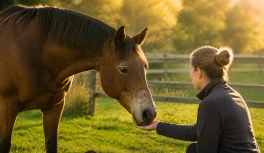
The benefits aren’t purely biomechanical. Contact with a large, warm, responsive animal builds motivation, sparks affection, and encourages communication. Many activities involve grooming, feeding, leading, and talking to the horse, which works on attention, language, self-esteem, and responsibility.
The human-horse bond, and what researchers have learned about it, is explored in depth in Why We Love Horses: What Science Says About the Bond.
Who Can Benefit From Equine-Assisted Therapy?
Equine-assisted therapy serves children, teens, adults, and older adults. It’s commonly recommended as a complement to other treatment for conditions such as:
- Cerebral palsy and other neurological conditions that affect movement
- Down syndrome
- Autism spectrum disorder (ASD)
- Motor or cognitive developmental delays
- Effects of stroke and traumatic injury
- Multiple sclerosis and other neurological diseases, depending on evaluation
- Learning, attention, and behavioral challenges
- Certain emotional and psychological conditions, in specialized programs
Every case is different. Whether therapy is appropriate always depends on a medical evaluation and on the center’s own assessment, which sets individual goals.
Contraindications: What to Check Before You Start
Equine-assisted therapy isn’t for everyone. Some conditions may rule it out or require adaptations, including certain orthopedic, spinal, or hip problems, uncontrolled seizures, and significant horse allergies, among others. That’s why no reputable center begins treatment without medical clearance and an initial assessment. When in doubt, talk to the physician in charge of care.
The Interdisciplinary Team
One core principle of the method is that no one works alone. A well-run session involves professionals from different fields who plan each participant’s goals together. Depending on the country and the center, the team may include:
- Physical therapist: posture, balance, muscle tone, and motor coordination
- Psychologist: emotional, behavioral, and social goals
- Occupational therapist: independence and everyday living skills
- Speech-language pathologist: communication, language, and oral-motor function
- Educator: learning and academic goals
- Equine professional: responsible for the horse, horse selection, and safe handling
- Horse leader and side walkers: lead the horse and walk alongside the participant for support and safety
A Typical Session, Start to Finish
Every center has its own routine, but many sessions follow a similar sequence. Knowing it in advance helps families feel calmer on day one.
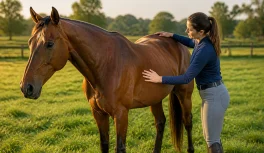
- Getting acquainted: the participant greets the horse, watches, touches, and, when possible, helps with simple care such as brushing
- Mounting with support: wearing a helmet and assisted by the team, the participant mounts from a ramp or platform, which is safer for everyone
- Activities at the walk: while the leader guides the horse, the therapist introduces posture exercises, reaching tasks, games, counting, or conversation, based on each person’s goals
- Changing the challenge: shifts in direction, walking speed, footing, or seating position make the work harder or easier
- Saying goodbye: the participant dismounts, thanks the horse, and often offers a treat approved by the team
Sessions are usually short, typically 30 minutes to an hour, because the work is demanding for both rider and horse. Consistency week after week tends to matter more than the length of any single session.
The Therapy Horse: A Very Special Coworker
Not every horse is suited to this job. A therapy horse needs a calm, predictable temperament, good health, a regular and rhythmic walk, and training that helps it tolerate noise, sudden movements, adaptive equipment, and several people around it at once.
There’s no required breed; the individual horse’s character is what counts. Therapy horses also need ongoing attention to their own welfare: breaks, rotated workloads, proper nutrition, and regular veterinary care. A horse that’s stressed or in pain simply can’t offer the movement and calm the work demands.
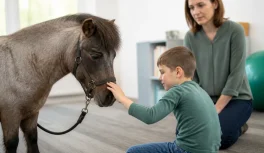
Some programs, especially in hospitals, schools, and long-term care facilities, also work with much smaller horses. Learn more in our article on the miniature horse in therapy.
Can Equine-Assisted Therapy Cure a Condition?
It’s a question many families ask, and it deserves a straight answer: equine-assisted therapy is not a cure for any condition. It’s a complementary therapeutic tool that can contribute to gains in balance, posture, coordination, communication, self-confidence, and social skills, depending on each person’s goals.
Results vary widely from one participant to the next and usually emerge over sustained treatment rather than a handful of sessions. Research on equine-assisted therapy is growing, but study quality and findings still differ from condition to condition. Be wary of any program that promises guaranteed results.
How to Choose an Equine-Assisted Therapy Center
Before you sign up, look for:
- A qualified team, with licensed health professionals who also have specific training in equine-assisted therapy
- A thorough initial assessment, with clear, documented goals
- Well-cared-for horses that are calm and suited to the work
- A safe setup: appropriate footing, equipment in good repair, and a helmet for the participant
- Accreditation or membership in your country’s therapeutic riding or equine-assisted therapy association, where one exists
- Open communication with the family and with the other professionals involved in the participant’s care
A Connection Without Borders
Equine-assisted therapy reveals one of the most moving sides of the relationship between people and horses. You’ll find it in centers across many countries, cultures, and economic realities, from big cities to small rural communities, often sustained by nonprofits and volunteers. That universal reach is the theme of the lead article in this series, on the love of horses that knows no borders.
If you know someone who might benefit, start with a conversation with their doctor, then look for a reputable center nearby. The horse does its part with remarkable generosity; the rest depends on a well-prepared team and a great deal of patience.