Equine foaling is one of the fastest — and most demanding — events in all of horse breeding. A healthy mare with a well-positioned foal can complete the entire labor in under 20 minutes. But when something goes wrong, every minute counts. The difference between a successful foaling and a tragedy is very often the breeder’s preparation.
This article explains the signs that announce foaling, the stages of a normal labor, when to intervene, and how to care for mare and foal in the first critical moments.
Why Equine Foaling Is Different
The mare has a placental mechanism known as a diffuse non-invasive placenta. Unlike cattle or humans, the equine placenta attaches to the uterus across a large, relatively superficial surface. When labor begins and intrauterine pressure increases, this attachment begins to break down — and the placenta stops oxygenating the foal.
This means that once the expulsive phase begins, the foal must be delivered quickly. The safe window for the expulsive phase is approximately 30 minutes. Beyond that, the risk of fetal hypoxia increases rapidly.
This is why any delay in the progression of equine foaling justifies immediate intervention.
Signs That Foaling Is Near
The intensive monitoring period begins in the final two weeks before the estimated foaling date. Key signs are progressive and intensify as the birth approaches:
Udder development: the teats become increasingly distended in the final weeks. In the 24 to 72 hours before foaling, they are fully developed and may show drops of wax or streaming milk at the tips.
Waxing or streaming milk: the secretion of milk from the teat ends is one of the most practical signs for estimating timing. When milk begins flowing or streaming regularly, foaling typically occurs within 24 to 48 hours.
Brix refractometer test: a simple, inexpensive instrument that measures total solids in the milk can be used to estimate colostrum readiness. When calcium levels in the milk rise above a certain threshold (above 200 ppm in specific tests) or when protein concentration increases, foaling is close. This method is more precise than visual observation alone.
Perineal relaxation: sinking of the muscles above the tailhead and relaxation of the vulvar ligaments are signs of pre-foaling hormonal activity. The vulva may appear more prominent and edematous.
Behavioral changes: in the hours before foaling, the mare may become restless, look at her flanks, lie down and get up repeatedly, sweat lightly, and show discomfort resembling mild colic. This is normal — it is Stage 1 of labor.
Most mares foal at night. This is not coincidence — it is an evolutionary behavior that reduces exposure of the vulnerable foal to predators. Operations with overnight monitoring systems (cameras, motion sensors, or sweat-detection alarms) have significantly lower rates of unattended foalings.
The Three Stages of Foaling
Stage 1: Preparation (1 to 4 hours)
Stage 1 is the early labor phase. The uterus begins contracting irregularly, the cervix dilates progressively, and the foal begins positioning for delivery. The mare shows signs of discomfort — restlessness, sweating, mild colic.
During this stage, the mare typically lies down and gets up repeatedly, seeking the most comfortable position. This is not the time to intervene — it’s the time to observe and ensure the environment is safe (clean stall, no hazards).
Stage 2: Expulsion (under 30 minutes)
Stage 2 begins with the rupture of the membranes and the flow of amniotic fluid (“breaking of the water”). From this moment, the clock is running.
The normal foal delivery sequence is: 1. Both front feet appear first, soles facing down (toward the ground) 2. The head appears resting on top of the two front limbs 3. The shoulders pass through the birth canal — the highest-effort step 4. The rest of the body follows quickly
The mare is normally lying down during this phase, producing strong, rhythmic abdominal contractions.
What to do: observe from a distance. Unless there is a positioning problem or delay, don’t interfere. Human presence too close may cause some mares to momentarily “hold back” labor.
Warning sign for malpresentation: if only one limb appears at the vulva, or if the soles of the hooves are facing up (toward the mare’s back), the foal is malpositioned. Call the veterinarian immediately.
Warning sign for delay: if more than 15 to 20 minutes have passed since membrane rupture and the foal has not advanced significantly, call the veterinarian. Do not attempt to pull the foal without guidance — force applied incorrectly can injure mare or foal severely.
Stage 3: Placenta Delivery (up to 3 hours)
After the foal is born, the placenta remains inside the uterus and must be passed. Under normal conditions, this occurs within 30 minutes to 3 hours after foaling.
Retained placenta (not passed within 3 hours) is a veterinary emergency. Decomposing placental material inside the uterus can trigger toxemia, laminitis, and septicemia — all potentially fatal for the mare. Never attempt manual placenta removal without veterinary guidance.
When the placenta passes, lay it flat and examine it — spread out on the ground — to confirm it is complete. The equine placenta has a characteristic “Y” shape when fully open. Any fragment remaining in the uterus must be treated as an emergency.
The First Moments After Birth
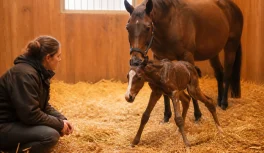
Once the foal is born, the umbilical cord usually breaks naturally when the mare stands or the foal moves. This is normal — do not cut the cord manually before it ruptures on its own, as blood transfer to the foal is still occurring in those first seconds.
After cord rupture:
Disinfect the umbilical stump: apply diluted iodine (2% to 4%) or chlorhexidine to the navel stump to prevent infection (omphalitis, “joint ill”). Repeat during the first 12 hours.
Check the membranes: if the foal was born with membranes over its muzzle (amniotic sac), remove them immediately so it can breathe.
The three benchmarks: standing within 1 hour, nursing within 2 hours, passing meconium within 3 hours. If any benchmark is significantly delayed, call the veterinarian.
Dystocia: When Foaling Goes Wrong
Dystocia is any complication that hinders or prevents normal progress of foaling. The most common causes are:
- Malpresented foal: a retained limb, laterally deviated head, or posterior presentation (foal emerging hind-end first)
- Oversized fetus: especially in crosses between breeds with very different body sizes
- Uterine inertia: the uterus loses contractile strength before expulsion is complete
Equine dystocia is more serious than in cattle because the window before fetal damage is much shorter. It is a veterinary emergency requiring immediate attention — not a situation for prolonged attempts without professional guidance.