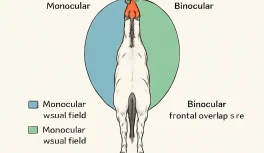
An animal with nearly 350 degrees of visual coverage — and still two areas where it sees absolutely nothing. Horse blind spots are one of the most consequential aspects of equine vision for anyone who works around horses, and knowing exactly where they are is among the most practically important things you can know.
This isn’t academic biology. Horse blind spots are directly involved in a significant portion of equine-related accidents in handling, training, and competition contexts. Understanding them prevents injuries — to horses and to people.
How many blind spots does a horse have?
A horse has two distinct blind spots, located at opposite ends of its body:
The posterior blind spot: directly behind the hindquarters, beginning at the base of the tail and expanding outward in a cone shape. At several feet behind the horse, this zone is approximately 6 to 10 feet wide. Anyone standing directly behind a horse — or moving silently into that space — is completely invisible to the animal.
The frontal blind spot: directly below and in front of the muzzle, when the head is held in a natural position. This is a downward-facing triangular zone beginning immediately below the nose and extending several feet forward at ground level. The horse cannot see what is directly under its own muzzle.
Together, these two zones explain dozens of horse behaviors that appear random or unpredictable until the visual architecture behind them is understood.
Why is the posterior blind spot dangerous?
The posterior blind spot is the higher-risk of the two from a human safety perspective. When a person, dog, or other animal approaches from directly behind a horse without auditory or visual warning, the horse receives no sensory input from that direction until the intruder is already very close.
For an animal whose nervous system was shaped by millions of years of predator pressure, a sudden presence materializing behind and near it matches one pattern: ambush attack. The response is automatic and immediate — a kick. This is not aggression. It is a defensive reflex activated by the perception of sudden threat in the one direction the horse has zero visual coverage.
How do you safely approach a horse from behind?
The foundational rule is simple: never approach a horse from directly behind without announcing your presence first. In practice:
1. Approach from the side — shoulder or neck level — where the horse can see you clearly before you’re within range 2. If you must pass behind a horse, speak to it before entering the posterior zone, and keep a hand touching the hindquarters as you move across 3. When working close to the rear — farriery, grooming, veterinary examination — position yourself close to the horse’s body rather than at arm’s length. A kick at close range has far less arc and force than one at full extension 4. Maintain continuous verbal or tactile contact when working in the posterior zone
These habits don’t “train away” the kick reflex — that’s hardwired and appropriate. They prevent the reflex from being activated in the first place.
What causes the frontal blind spot?
The frontal blind spot seems counterintuitive: how can an animal fail to see what’s directly in front of it?
The answer is geometric. The horse’s eyes are set on the sides of the skull, angled outward. The two visual fields do overlap in a forward-facing binocular zone, but that overlap only becomes possible at a certain distance. The space immediately below the nose — too close and too central to fall within either eye’s optimal angle — creates a dead zone. The visual information simply isn’t there.
This is why horses appear to “lose” food dropped directly in front of their faces, or why a treat held right under the muzzle requires the horse to feel with its lips rather than look. Vision doesn’t reach that space.
How do horses compensate for the frontal blind spot?
Primarily through smell. The horse’s olfactory system is far more sensitive than a human’s, and the muzzle serves as a precision sensor for exactly the space the eyes can’t cover. When an object falls in the frontal blind zone, the horse lowers its head and investigates with its nose. What horsemen sometimes read as hesitation or excessive sniffing is often this: multisensory evaluation filling in a visual gap.
Horses also use lateral head movement to shift objects from the frontal blind zone into the monocular field of one eye. A slight turn of the head brings what was invisible into the lateral visual field, allowing visual assessment before making contact.
How do blind spots affect performance disciplines?
The frontal blind spot has specific, well-documented consequences in jumping, dressage, and cross-country work.
Jumping: an obstacle enters the horse’s frontal blind spot in the final 3 to 4 strides before takeoff. By that point, all visual calculations — height, distance, approach angle — must already be complete. The horse is executing takeoff based on data collected earlier in the approach, when the jump was still in the binocular zone. Well-trained jumpers process this naturally. Horses that haven’t developed this assessment pattern may chip in, add an extra stride, or hesitate at the moment the jump “disappears” from view.
Cross-country: varied terrain and complex obstacle profiles make early-distance visual assessment even more critical. Experienced cross-country horses learn to assess obstacles from the appropriate distance and execute without needing last-second visual confirmation in the blind zone.
Dressage and arena work: ground poles, arena letters, and other markers that pass through the frontal blind spot and then “reappear” as the horse moves past them can trigger startle responses. From the horse’s perspective, the object didn’t move — it vanished and then materialized. This apparent materialization is exactly the kind of event the lateral motion-detection system is designed to flag.
Why herds compensate for individual blind spots
In the wild, horses don’t rely solely on individual visual coverage. Herd positioning is loosely coordinated: different individuals face different directions, and the group’s collective visual field substantially reduces the blind spot problem. While one horse’s hindquarters face north, another facing south covers that zone.
This is one of the functional reasons horses kept in isolation show higher baseline anxiety than horses in groups — managing environmental surveillance alone, without the distributed sensory coverage of a herd, is a genuinely greater cognitive and physiological load.