Artificial insemination changed equine reproduction permanently. Before it, the genetics of an exceptional stallion were geographically locked — mares had to travel to him, he had to travel to them, or the breeding simply didn’t happen. Today, semen from a champion stallion can reach a mare on the other side of the world in under 48 hours, chilled and ready to use.
But AI isn’t just about logistics. It also improves biosecurity outcomes, allows far more efficient use of a stallion’s reproductive potential, and opens doors that were previously impossible for genetic improvement.
What Equine AI Is
Artificial insemination (AI) involves the direct placement of semen into the mare’s reproductive tract, replacing live cover. Semen is collected from the stallion under controlled conditions — typically using an artificial vagina — and processed in the laboratory before use.
Processing includes quality evaluation (motility, morphology, concentration), dilution in extension media that prolong sperm survival, and preservation in one of three available forms: fresh, chilled, or frozen.
Fresh Semen
Fresh semen is used immediately after collection, without preservation processing. It offers the highest conception rates of all three forms, since sperm are at peak fertility.
The limitation is logistical: mare and stallion must be at the same location, semen must be inseminated within 1 hour of collection, and timing relative to ovulation must be very precise. Fresh semen AI is used primarily at integrated breeding farms where stallion and mares are on the same property.
Chilled Semen
Chilled semen — also called cooled semen — is the most widely used method in professionally managed horse breeding today. After collection and evaluation, semen is diluted in a specialized extension medium (containing antibiotics, buffers, and energy sources for the sperm) and gradually cooled to 39°F to 41°F (4°C to 5°C).
Under these conditions, it retains fertility for 24 to 48 hours — enough time to be shipped via specialized courier between cities or countries. The transport container (called an Equitainer or equivalent) is an isothermal unit that maintains stable temperature throughout shipment.
The chilled semen protocol requires planning: the request must be placed when the mare’s follicle is at the right size (typically 35 to 40 mm), the semen is dispatched by the stallion station, and it must arrive before the mare ovulates. Ovulation induction (with deslorelin or hCG) is almost always part of the chilled semen protocol, making timing predictable.
Frozen Semen
Frozen semen is cryopreserved in liquid nitrogen at -320°F (-196°C) and can be stored for decades without significant loss of viability. It is the method with the greatest reach — it allows a stallion to breed mares anywhere in the world, at any time, even after his death.
Cryosensitivity is the main challenge: equine sperm are particularly sensitive to the freeze-thaw process. A significant portion of cells do not survive — post-thaw motility recovery averages 30% to 50% of pre-freeze values. This means a larger dose of sperm is required per insemination, and timing relative to ovulation must be even more precise.
Frozen semen protocols generally require insemination post-ovulation (within 6 to 8 hours of confirmed ovulation by ultrasound) or peri-ovulation (within 12 hours on either side of the estimated ovulation window). This means the mare must be monitored by ultrasound frequently — every 4 to 6 hours when the follicle is ready — or ovulation must be induced reliably.
Conception rates with frozen semen vary significantly between stallions: some freeze extremely well, achieving per-cycle pregnancy rates close to chilled semen; others freeze poorly, and rates can fall to 30% or below per cycle. Freezability is an important criterion when choosing a stallion whose frozen semen is to be used.
Advantages of Artificial Insemination
Genetic reach: a stallion can breed mares on the other side of the world. Breeds concentrated in specific regions become globally accessible.
Efficiency: one ejaculate can be divided into multiple doses and used for several mares simultaneously. High-value stallions can produce far more offspring per season than through live cover.
Biosecurity: AI dramatically reduces the risk of transmitting equine venereal diseases such as contagious equine metritis (caused by Taylorella equigenitalis) and dourine (caused by Trypanosoma equiperdum). Semen is processed with antibiotics and mares have no direct physical contact with the stallion.
Safety: live cover of an active mare by a stallion carries real risk of injury to both animals — kicks, bites, falls. AI eliminates that risk entirely.
Reproductive control: the operation has precise records of which stallion bred which mare, on which date, and from which semen lot.
Limitations and Restrictions
Artificial insemination is recognized by most breed registries worldwide, but there are important exceptions. The Jockey Club — the governing body for Thoroughbred registration in almost every country — prohibits the use of AI and embryo transfer. Thoroughbred foals can only be registered if conceived through live cover. This is one reason why live cover remains relevant in modern racing.
Breeders working with AI-permitted breeds who export animals or embryos to countries with specific regulations need to verify each destination country’s requirements before defining the reproductive protocol.
Field Insemination
AI doesn’t require a sophisticated on-farm laboratory at the insemination site. What is needed:
- A veterinarian qualified to perform the procedure
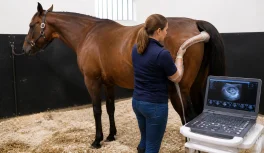
- Basic ultrasound equipment
- Gloves, insemination catheter, syringe, and extension medium for dilution
- For chilled semen: a small centrifuge and washing pipette (to concentrate the semen before insemination if it was shipped in a large volume)
- For frozen semen: a nitrogen tank, a water bath for thawing, and a timer (the thaw protocol is precise: specific temperature and duration)
At larger operations, an on-farm semen lab allows in-house collection and processing, reducing costs and increasing scheduling flexibility.
Expected Conception Rates
With good-quality semen and a well-executed protocol, per-cycle conception rates approximate:
- Fresh semen: 65% to 75%
- Chilled semen: 55% to 65%
- Frozen semen (good-freezability stallion): 45% to 60%
- Frozen semen (intermediate-freezability stallion): 30% to 45%
These are averages — they vary significantly with semen quality, team expertise, uterine health of the mare, and the protocol used. A young, healthy mare inseminated with high-quality chilled semen may achieve close to 80% per-cycle pregnancy rates; an older mare with a history of endometritis may fall below 40%.
When to Use Each Method
The choice of method depends on three main factors: proximity of the stallion, value of the cross, and urgency of outcome.
For stallions on the same property or in the same area, fresh semen is the natural choice. For stallions in another city or country, chilled semen is the standard. When the stallion is deceased, located on another continent, or when the donor mare cannot be bred (as in embryo transfer), frozen semen is the only option.
In all cases, investment in a skilled equine reproduction veterinarian and a well-planned protocol is what most determines the final outcome.