A breeding program’s fertility begins with reading the mare’s estrous cycle. The best stallion and the most expensive semen mean nothing if the breeding happens at the wrong time. Understanding the mare’s hormonal rhythm — and knowing what to look for at each phase — is the most fundamental skill in equine reproduction.
This article explains how the cycle works, what signs a breeder can observe with the naked eye, and which tools allow the ideal breeding moment to be determined with technical precision.
How the Estrous Cycle Works
A cycling adult mare has estrous cycles averaging 21 days, with normal variation from 18 to 24 days. The cycle is governed by a coordinated hormonal sequence involving the hypothalamus, pituitary gland, and ovaries.
The cycle has two main phases:
Estrus (heat): the phase when the mare accepts the stallion. It averages 5 to 7 days but can range from 3 to 10 days, particularly during seasonal transitions. During estrus, the dominant follicle grows progressively on the ovary and culminates in ovulation — typically one or two days before estrus ends.
Diestrus: the post-ovulatory phase, averaging 14 to 16 days. The corpus luteum forms at the ovulation site and produces progesterone, which suppresses new cycles and primes the endometrium for possible pregnancy. Without conception, endogenous prostaglandin destroys the corpus luteum, progesterone drops, and a new cycle begins.
One key difference from other species: in the mare, ovulation occurs at the end of estrus, not in the middle. This means the most effective breeding is the one timed to the last 24 to 48 hours of heat — not the beginning.
Seasonality and Transition Cycles
Mares are seasonally polyestrous: in temperate regions, they enter deep anestrus in winter (irregular or absent cycles) and resume full reproductive activity in spring. Between those extremes lies a transition period, during which cycles are long, irregular, and frequently anovulatory — the follicle grows but never ovulates.
This transition phase is one of the biggest challenges of an early breeding season. Mares in transition can appear to be in heat for weeks without ovulating, leading less experienced breeders to breed repeatedly and uselessly.
The transition can be managed with artificial lighting — exposing mares to 16 hours of light per day (natural plus artificial) starting 60 to 90 days before the desired breeding season begins accelerates the return to regular cycling. This is standard practice at operations with a defined breeding calendar.
Behavioral Signs of Estrus
A mare in heat communicates clearly to those who know how to observe:
Receptive posture: the mare straddled her hind legs, raises her tail, exposes her vulva, and accepts approach. This behavior — called lordosis — is the clearest sign of receptivity.
Frequent urination: the mare urinates in small amounts repeatedly, especially in the presence of a stallion or teaser.
Altered social behavior: increased restlessness, attention-seeking, reduced aggression toward the stallion and other mares.
Vulvar discharge: the presence of clear, viscous mucus at the vulva, from the estrogen-stimulated cervical secretion.
During diestrus, behavior is the opposite: the mare rejects the stallion emphatically — biting, kicking, striking — keeps her tail low, and shows high perineal muscle tone.
The Teaser Test
A teaser stallion — a vasectomized male or one of low fertility — is used to detect estrus practically and safely, without risk of unintended breeding. The procedure involves introducing the teaser to the mares and observing each mare’s behavioral response.
Mares in heat display the behaviors described above; mares in diestrus actively reject contact. The teaser test is an efficient screening tool, especially at operations with many mares.
The limitation of the behavioral approach is that it doesn’t reveal the precise timing of ovulation — it only indicates whether the mare is or isn’t in heat. For accurate timing, ultrasound monitoring is necessary.
Transrectal Ultrasound Monitoring
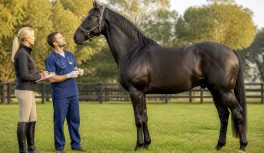
Transrectal ultrasound is the gold standard for following the mare’s estrous cycle. Using a linear transducer introduced into the rectum, the veterinarian visualizes the ovaries and uterus in real time, evaluating:
Follicular development: the dominant follicle grows progressively during estrus. When it reaches approximately 1.4 to 1.8 inches (35 to 45 mm) in diameter, ovulation is approaching. The exact ovulation size varies between mares and cycles, but rarely occurs before 35 mm.
Follicle texture: as ovulation approaches, the follicle may become slightly irregular in shape and the follicle wall may appear softer on ultrasound.
Uterine edema: during estrus, the uterus shows a characteristic edema pattern (a “sliced” appearance in longitudinal section) caused by estrogen stimulation. This pattern is a useful marker of active estrus, but decreases progressively as ovulation nears.
Based on these findings, the veterinarian determines the ideal timing for breeding or insemination — typically 24 to 36 hours before the estimated ovulation.
Ovulation Induction
For even more precise timing, ovulation can be induced pharmacologically once the dominant follicle reaches adequate size. The most common protocols are:
hCG (human chorionic gonadotropin): induces ovulation in 36 to 42 hours. Effective, especially early in the season, but may prompt antibody production after repeated use in the same cycle.
Deslorelin (a GnRH analogue): acts more physiologically and carries a lower immune-response risk. Induces ovulation in 36 to 48 hours. The preferred choice when multiple inductions are planned in the same season.
With induction, the breeding window becomes predictable: insemination can be scheduled precisely, which is essential when using chilled semen shipped from another state or country.
Estrous Cycle and Conception Rate
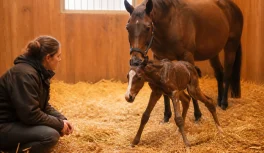
Not all cycles carry equal fertility. The first cycle after foaling (the foal heat, occurring 5 to 12 days post-partum) has a lower conception rate, especially if uterine involution is not complete. The second and third post-partum cycles typically perform better.
During the spring-to-summer transition, the first ovulatory cycles of the season also tend to have slightly lower fertility than mid-season cycles. Autumn cycles, in regions where mares are still active, tend to be more irregular.
Monitoring each mare’s individual reproductive history — recording heat dates, ovulation dates, breeding timing, and outcome — is a practice that progressively improves every management decision at a breeding operation.
Records and Reproductive Management
Keeping up-to-date reproductive records for each mare is one of the simplest, highest-impact practices in any breeding program. Records should include: heat start and end dates, follicle diameter at breeding time, confirmed ovulation date by ultrasound, date and method of breeding or insemination, and the outcome of the pregnancy check.
After a few cycles, individual patterns emerge — the mare who always ovulates at 38 mm, the one with short 19-day cycles, the one who responds better to deslorelin — and that knowledge can be used to optimize future breeding timing for each individual.