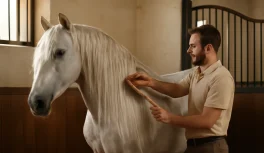
The term equine podiatry still draws blank looks outside the most specialized veterinary circles. Most people know the farrier and the veterinarian — but aren’t quite sure what an equine podiatrist does, or when their involvement changes everything.
The short answer: equine podiatry is the specialty that unites the clinical knowledge of the veterinarian with the technical skill of the farrier to treat complex conditions of the hoof and the distal limb. When the problem lies beyond routine shoeing and beyond isolated clinical treatment, the equine podiatrist steps in.
What Is Equine Podiatry?
Equine podiatry is the field dedicated to the study, diagnosis, and treatment of diseases and dysfunctions of the hoof and its associated structures — bones, tendons, ligaments, blood vessels, and soft tissues of the equine foot.
In countries with more developed equestrian traditions — particularly France, the United Kingdom, the United States, and Brazil — equine podiatry has consolidated as a subspecialty, with postgraduate training programs for veterinarians and certifications for farriers working in this area. The professional who practices it combines clinical diagnosis, imaging studies (radiography, ultrasound, MRI), and manual intervention on the hoof.
What Does an Equine Podiatrist Do That a Conventional Farrier Doesn’t?
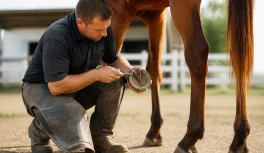
The distinction is not one of quality — it is one of scope. A skilled conventional farrier does excellent work on healthy animals or those with standard needs. The equine podiatrist works on cases in which:
- The health problem requires a combined clinical and technical intervention
- Shoeing must be guided by imaging data (radiographic angles, coffin bone position)
- The case involves complex conditions such as laminitis, advanced navicular syndrome, flexural deformities, or injury sequelae
- It is necessary to design and fabricate specialized shoes that the conventional farrier does not routinely produce
In many cases, the equine podiatry team consists of the veterinarian and the farrier working in collaboration — each contributing their specific expertise in a complementary way.
Which Conditions Require Equine Podiatry?
Chronic Laminitis
Acute laminitis can be managed by the clinical veterinarian with support from the farrier. But chronic laminitis — with coffin bone rotation, sinking, or bony remodeling — requires specialized podiatric intervention. Correctly positioning the hoof to relieve tension on the damaged laminae requires radiographs and precise calculation of the intervention angle. Errors in this context can significantly worsen the condition.
Navicular Syndrome
Advanced navicular syndrome requires not only pharmacological treatment, but carefully designed shoeing to redistribute the forces that overload the navicular bone and the deep digital flexor tendon. Egg bar shoes, heel extensions, and other specific tools must be applied based on radiographic data.
Flexural Deformities
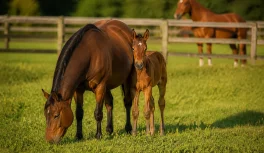
Foals born with crooked limbs or horses that develop tendon contractures over their lifetime need podiatric evaluation to determine whether the correct intervention is surgical, orthopedic (corrective shoes and extensions), or conservative. The intervention window in foals is narrow — and the wrong decision has permanent consequences.
Sequelae of Deep Wounds and Abscesses
Abscesses that reach deep structures — the deep digital flexor tendon, the synovial sheath, the coffin bone — leave sequelae requiring specialized follow-up. A hoof that suffered necrosis or was partially destroyed by infection needs to be reconstructed over several subsequent shoeing sessions, under precise professional guidance.
Chronic Hoof Quality Problems
Horses with chronically weak hoof walls, which crack frequently, fail to hold nails properly, or have excessively thin soles, may benefit from podiatric evaluation to identify the cause — whether nutritional, metabolic, genetic, or management-related — and develop a treatment plan.
What Does an Equine Podiatry Consultation Look Like?
A complete podiatric evaluation includes:
Case history: detailed clinical background — prior lameness episodes, systemic diseases, diet, work type and footing, shoeing history.
Dynamic evaluation: the horse is observed in motion — at walk and trot in a straight line and on a circle, on different surfaces. High-speed video analysis of the gait reveals asymmetries and patterns the naked eye cannot detect.
Static examination: hoof evaluation at rest — angles, lengths, balance between toe and heel, wall quality, sole quality, frog condition.
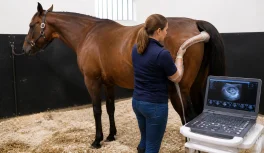
Imaging: hoof radiographs are the basic standard. In more complex cases, distal limb ultrasound and hoof MRI (available at referral centers) provide information that guides treatment with a precision impossible to achieve through physical examination alone.
Intervention plan: based on all the data, the podiatrist defines the indicated shoeing, target angles, shoe type, re-evaluation interval, and the criteria for treatment success.
How Has Equine Podiatry Evolved in Recent Years?
The field has advanced significantly with the incorporation of technology. Hoof MRI, available at specialized centers in many countries, allows visualization of internal structures that radiography does not show clearly — which has transformed the diagnosis and treatment of conditions like navicular syndrome.
Plantar pressure analysis — computerized measurement of weight distribution across each region of the hoof — has also arrived in the equine world, enabling far more precise adjustments in corrective shoeing.
When Should an Owner Seek an Equine Podiatrist?
Not every hoof problem requires a podiatry specialist — the competent farrier and clinical veterinarian resolve the vast majority of situations. But there are cases in which specialized consultation is clearly indicated:
- Lameness that persists after conventional treatment
- Diagnosis of laminitis with confirmed rotation or sinking on radiograph
- Navicular syndrome that doesn’t respond to routine shoeing
- Foal with limb deformity that worsens or fails to improve with growth
- Deep abscess or infection that has reached bony or tendinous structures
- High-value competition horse with any limb problem that has no clear cause
For high-level competition animals, preventive podiatric evaluation — even without any apparent problem — is a growing practice in countries with more developed equestrian cultures. Identifying subtle imbalances before they become injuries is an investment that can preserve months or years of a horse’s competitive career.