Anyone who breeds a Lusitano quickly learns that the breed gives a great deal — but asks a great deal in return. Not in terms of difficulty of management, but in terms of attention, consistency, and quality of care. A well-managed Lusitano can reach 30 years old in good health, competing or working productively well into the late teens. A poorly managed Lusitano develops problems that more resilient breeds would tolerate without serious consequence.
Lusitano horse care is not fundamentally different from caring for any sport horse — but there are breed-specific traits that deserve particular attention: digestive sensitivity, predisposition to certain conditions under some management practices, and the care required for the abundant mane and tail that are hallmarks of the breed.
How Should a Lusitano Be Fed?
The Lusitano is a medium-sized horse with an efficient metabolism — capable of maintaining good body condition on a more modest diet than many Warmbloods of equivalent size. This is a cost-of-care advantage, but it also requires vigilance against overweight.
Forage base: Good-quality hay is the foundation. The equine digestive system was designed for continuous forage consumption — hay should be available for at least 16 hours per day. Grass hay with good leaf-to-stem ratio, free from mold and dust, is the standard. Legume hay (alfalfa, clover) can be added in small proportions to increase protein intake for horses in high-performance work.
Concentrate: The amount depends directly on the workload. A Lusitano in light work often needs little or no concentrate beyond hay, especially if it has access to quality pasture. Horses in intensive training or competition receive a sport-specific balanced concentrate.
Critical rule: Never increase concentrate amounts abruptly. The Lusitano has a sensitive digestive system and sudden dietary changes are a documented trigger for colic.
Salt and minerals: Free-choice mineral salt block available at all times. In regions with selenium-deficient soil — common in parts of Brazil and southern Europe — specific supplementation may be needed after veterinary assessment.
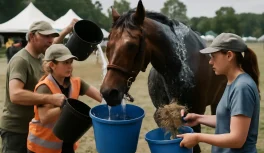
Water: Continuous access to clean, fresh water. A 1,100-pound horse in moderate work consumes 8–13 gallons (30–50 liters) of water daily. On hot days or after intensive work, consumption increases significantly.
How Should You Care for the Lusitano’s Hooves?
Lusitano hooves tend to be good quality — compact, with dense hoof wall that resists wear well. With appropriate footing and progressive adaptation, many Lusitanos work barefoot with excellent results.
For work on hard, irregular, or high-demand sport surfaces, conventional steel shoes are the standard. Alternatives include:
- Aluminum shoes: Lighter than steel, ideal for dressage horses and show performances where shoe weight can affect the elevation of movement
- Hoof boots: For barefoot horses on temporarily rough terrain
Shoeing should occur every 6–8 weeks for shod horses and every 6–10 weeks for barefoot horses in maintenance trims.
Watch for laminitis: “Easy keeper” horses — those that gain weight easily — face higher laminitis risk, especially with unrestricted access to lush pasture. The Lusitano can fall into this category. Pasture management and body weight monitoring are important preventive measures.
What Are the Most Common Health Issues in Lusitanos?
Colic: The most common cause of death in horses of any breed. The Lusitano has a sensitive digestive system, and spasmodic colic — painful intestinal contractions without real obstruction — is relatively common in the breed. Diet changes, stress, dehydration, and sudden temperature shifts are frequent triggers. Immediate veterinary treatment is always necessary.
Laminitis: Inflammation of the hoof laminae linked to high-sugar diets, obesity, or endocrine disorders such as PPID (equine Cushing’s disease) and EMS (equine metabolic syndrome). The Lusitano’s efficient metabolism predisposes it to weight gain that can lead to laminitis under poor management.
Melanoma: Gray horses are predisposed to melanoma — typically benign skin tumors developing around perineal regions, under the tail, and at the salivary glands. Most are slow-growing and benign, but some become problematic depending on location and size. Regular monitoring is recommended for gray Lusitanos over age 10.
Musculoskeletal issues: High-demand sport horses of any breed accumulate micro-injuries of use over time. The Lusitano, with frequent collection work and high joint-load movements, should have joints and tendons assessed regularly by a sport-horse veterinarian. Imaging (tendon ultrasound, radiographs) should be part of the preventive routine.
Grooming the Lusitano: Caring for Mane and Tail
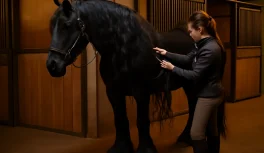
The Lusitano’s abundant, silky, naturally wavy mane and tail are among the breed’s most recognizable traits — and among those requiring the most daily grooming attention.
Brushing the mane: Use a wide-tooth comb, working through tangles gently without forcing. On heavy work days the mane can knot significantly. Some riders keep the mane braided or tied to prevent tangling. Horse-specific shampoos formulated to preserve natural coat oils maintain shine and texture.
Braided mane for competition: In dressage and formal presentations, the mane is typically braided in classic European button braids — the mane divided into sections and sewn with needle and thread matching mane color. The process takes time but produces a polished, formal presentation.
Tail care: The Lusitano’s tail grows dense and long. Regular washing with conditioner and keeping it in a tail bag for breeding farm horses on pasture preserves the tail intact. Competition horses often have the tail kept permanently in a bag to protect from friction and soiling.
Coat care: Regular grooming with a body brush and rubber curry comb to remove dead hair. The Lusitano’s coat tends toward natural shine when the horse is in good nutritional condition — a health marker every caretaker learns to recognize quickly.
Welfare and Social Needs
The Lusitano is a social and intelligent horse — and suffers in isolation. Horses kept in individual stalls without visual contact with other horses develop stereotypies (repetitive behaviors like stall weaving or crib biting) more frequently than less sensitive breeds.
Welfare recommendations:
- Stall with visual and olfactory contact with other horses
- Regular turnout — at least 4 hours daily, preferably in compatible groups
- Consistent feeding and management schedule — abrupt changes cause measurable stress
- Environmental enrichment: sturdy toys in the stall reduce boredom behaviors
A well-cared-for Lusitano with preserved health and a solid human relationship is an animal of remarkable longevity. Well-managed individuals reach 25–30 years with vitality — proof that the investment in proper care pays back across decades.