The canter is supposed to be the highlight of a ride — rhythmic, forward, alive. So when a horse won’t canter, consistently breaks to trot, or tenses up at the very thought of it, it’s easy to assume the problem is attitude. Most of the time, though, it isn’t. Refusal is often the horse’s way of saying something isn’t working — physically, biomechanically, or emotionally. And the first step is learning to listen.
Why the Canter Demands More
The canter asks more of the horse’s body than either walk or trot. It requires sustained impulsion from the hindquarters, spinal flexibility through the topline, balance across the shoulder and core, aerobic capacity, and — most of the time — the ability to carry all of that through a turn.
When any part of that chain is uncomfortable — back, hoof, saddle, joints, muscle, mouth, or even breathing — the horse will find ways to avoid it: refusing the departure, breaking early, rushing, going on the wrong lead, or going disunited.
“Won’t Canter” Can Mean Several Different Things
Before drawing conclusions, identify the pattern:
- Won’t depart at all (active refusal).
- Departs, then breaks to trot immediately (can’t sustain it).
- Departs rushing and disorganized (fleeing the effort).
- Frequently wrong lead or disunited (imbalance, stiffness, or pain).
- Avoids only one rein — for example, consistently resists the left-lead canter.
Each pattern points in a different direction.
Discomfort Signs to Watch — In the Saddle and from the Ground
A Sudden Change in Behavior
If a horse that cantered willingly starts avoiding it over the course of a week or two, pay attention. Sudden behavioral change is one of the most significant signals a horse can give.
Breaks to Trot — Every Time
A horse that keeps breaking may simply be out of condition. But it can also be pain, especially if: it always happens at the same point (a turn, a corner); it always happens on the same rein; it comes with visible tension (pinned ears, swishing tail, tight mouth); it gets worse over the session rather than improving as the horse warms up.
Rushes the Trot Before Departing
Sometimes this is anxiety or confusing aids. It can also be the horse’s attempt to launch into the canter without engaging the back and hindquarters — avoiding the parts that are uncomfortable.
Goes Stiff or Crooked, Especially on Curves
A classic sign that the body isn’t releasing the way it should. This can be stiffness or imbalance, but if it’s persistent and one-sided, it warrants investigation.
Body Language and Expression
Watch for: ears pinned hard back, tail wringing repeatedly, agitated mouth — opening, rooting, tossing the head —, short labored breathing earlier than expected, tight eyes, rigid body. Any one of these in isolation may mean very little. A repeated cluster of them means a lot.
Difficulty Only on One Side
When a horse consistently avoids one specific lead, the likelihood of an asymmetrical issue rises: hoof, joint, muscle, a saddle that slips to one side, uneven stiffness. One-sided refusal is almost always worth investigating.
General Performance Drop
Beyond the canter itself, the horse begins to: stumble more, resist lengthening, avoid turns, become irritable at grooming or girthing, show back sensitivity when touched.
Common Causes When a Horse Won’t Canter
Insufficient Conditioning
The canter demands fitness. A horse returning from a long layoff, one that’s gained weight, or one in light work may avoid it out of genuine fatigue. The clue: the horse departs but fades within a few strides, losing power quickly. The fix: short quality canter sets with rest intervals and a gradual build-up.
Saddle and Tack Fit (More Common Than Most Riders Realize)
A saddle that pinches the shoulder, bridges across the back, creates a pressure point, or unbalances the rider can turn the canter into a painful experience. Common signs: irritability at tacking up, girthiness, ear and tail behavior during the canter, uneven sweat patterns, hair ruffled or areas tender after removing the saddle. This is one of the most overlooked causes — and it warrants assessment by a qualified saddle fitter.
Back Pain or Sensitivity (Topline Issues)
The canter requires an active, elastic back. If there’s pain — muscular, vertebral, or compensatory — the horse may stiffen, rush to escape the back movement, break to trot, or refuse clearly. Clues: sensitivity when grooming, girthing, or mounting; resistance to back flexion; a “locked” or “flat” canter that never frees up.
Hoof Health and Shoeing
The hoof is the foundation. When something is sore, the horse shifts its loading pattern — and in the canter, where loading is faster and more asymmetric, that shows clearly. Clues: reluctance on hard surfaces, shortened stride, stumbling, a notable change in behavior shortly after shoeing (improvement or deterioration), resistance on turns.
Joint and Limb Issues (The “Silent” Pain)
Joint problems often surface first in the canter because the gait demands more loading and coordination. Clues: avoids a specific lead, frequently disunites, worsens with repeated work, sometimes warms out of it and sometimes doesn’t. Suspected joint pain warrants professional evaluation — there is no training workaround for an orthopedic problem.
Dental and Mouth Pain (Yes, It Affects the Canter)
Mouth pain causes resistance to contact, neck tightness, and loss of back engagement — all of which compromise the canter directly. Clues: excessive mouthing, head tossing, resistance to the bit, worsening with rein contact.
Respiratory Issues
Breathing problems can make a horse genuinely avoid sustained gaits. Clues: labored breathing earlier than expected, coughing, audible respiratory noise, general fitness decline.
Training History and Emotional Causes
Not every refusal is physical. Sometimes it’s: an insecure horse that fears the gait, anxiety that causes anticipation and rushing, contradictory aids (leg saying go, hand saying stop), or a history in which canter always preceded a harsh correction. Clue: the horse responds very differently depending on the rider and how the ask is framed, with no clear physical signs outside of ridden work.
A Welfare Checklist Before Pushing Harder
If a horse won’t canter, run through this before increasing the pressure:
1. Warm-up: at walk and trot, does the horse feel loose — or blocked? 2. Straightness: on a long line, does the horse track straight — or always drift? 3. Large circle: on a 20-meter circle, does the horse improve — or worsen? 4. One side only? Does the problem happen on both reins, or only one? 5. Without tack: does the behavior change on the longe line, without saddle or bit? 6. After work: is there back tenderness, any unevenness in the walk, discomfort when touched?
Two or three red flags is enough to step back and investigate before asking more of the horse.
What to Do in Training When Discomfort Is Suspected
Don’t “Win” the Argument
Overriding a refusal with force may produce one canter. It rarely solves the underlying issue — and it almost always damages trust.
Simplify and Observe
Instead of pushing: rhythmic trot, walk–trot transitions, large circles, and a few strides of canter (if safe) just to watch the pattern. What you observe is more useful than what you force.
Prioritize “Short and Quality”
If the horse will canter: 6–10 good strides, rest, repeat. That’s fairer than demanding minutes of a tense, blocked canter.
Use the Session to Gather Information
Where does the horse worsen? A specific turn? A particular footing? One rein? After a certain amount of time? That pattern is valuable data for whoever examines the horse.
When Signs Are Clear, Seek Professional Assessment
Veterinarian, farrier, equine dentist, saddle fitter, and a knowledgeable trainer contribute different pieces of the same puzzle. You don’t need to diagnose — you need to observe well and bring good information.
What About Laziness?
Genuine laziness exists, but it has a tell: the horse is consistent and shows no tension, no pain signs — just reduced willingness to respond. Even so, it’s worth ruling out the basics — saddle fit, hoof health, back sensitivity, conditioning level, and the clarity of the aids — before drawing that conclusion. A horse that’s genuinely comfortable almost always accepts the canter when the ask is fair and progressive, even if it isn’t the most forward horse in the barn.
Well-Being Is the Foundation of a Beautiful Canter
When a horse won’t canter, the best path is rarely more pressure — it’s listening. The canter is demanding, and refusal is often a warning signal: something is binding, hurting, tiring, or confusing the horse. Observe the signals, adjust training with intelligence, seek help when you need it, and the horse almost always comes back. The canter that grows out of genuine well-being is always rounder, lighter, and more beautiful than anything forced.
Bloco SEO
SEO Title: Why Your Horse Won’t Canter: Discomfort Signs and What to Do
Meta description (max 140 chars): When a horse refuses to canter, it’s often a message. Learn the discomfort signs, common causes, and how to handle it without force.
Suggested slug: /article/why-your-horse-wont-canter-discomfort-signs-and-what-to-do
Primary keyword: horse won’t canter
Secondary keywords: horse refuses to canter, canter discomfort signs, horse canter pain, why horse breaks canter, horse canter behavior
LSI / semantic words: horse back pain canter, saddle fit problems, equine dental pain, horse hoof canter, horse behavioral changes, equine welfare, training refusal horse, horse body language
Suggested internal links: Common Canter Mistakes and How to Fix Every One; 6 Arena Exercises for a Rounder, More Balanced Canter
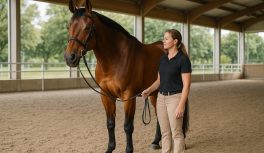
Image suggestion: A rider or trainer attentively observing a horse in an arena on a loose rein, calm atmosphere suggesting assessment rather than training pressure. Alt text: “Rider observing a horse’s behavior in an arena, watching for signs of discomfort before asking for the canter”
WordPress category: Health (ID: 81)