Two eyes. Two different visual systems. Horse monocular and binocular vision aren’t just two modes of the same process — they’re functionally distinct systems that cover different zones, serve different purposes, and produce behaviors that confuse horse people until the underlying visual biology is understood.
From how a horse evaluates a jump to why it reacts differently to the same object on its left versus right side, these two systems are at work in nearly every behavioral pattern that matters in handling, riding, and training.
What is monocular vision in horses?
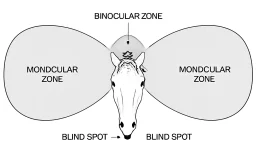
Monocular vision refers to visual processing in which each eye operates independently, covering its own zone without overlapping the other eye’s field. The horse’s monocular zones dominate its total visual coverage.
Each eye covers approximately 190 degrees independently. In these lateral monocular zones:
- Motion detection is exceptional: the rod photoreceptors that populate the peripheral retina flag any movement in the lateral field immediately, even subtle motion at the far edges of the visual range
- Depth perception is limited: without two overlapping images to triangulate, the brain can’t calculate precise distance using stereoscopic vision. The horse relies on monocular depth cues instead, with lower accuracy
- Visual information stays associated with that eye: data captured by the left eye is processed primarily by the right hemisphere, and vice versa — and this doesn’t automatically transfer to the other side
The monocular zones are the horse’s wide-area surveillance system: maximum coverage, continuous monitoring, extreme sensitivity to change. What they sacrifice in precision they compensate with breadth.
What is binocular vision in horses?
Binocular vision occurs where the fields of both eyes overlap simultaneously — a zone directly in front of the horse where the brain receives two slightly different perspectives and uses that difference to calculate depth. This is genuine stereoscopic vision.
In horses, the binocular zone spans approximately 55 to 65 degrees directly ahead. It’s narrow by human standards — humans have about 120 degrees of binocular overlap — but it’s where the horse:
- Judges the height and distance of a jump before committing to takeoff
- Evaluates the terrain immediately in front of its hooves
- Assesses how far away an object is when approaching it directly
The binocular zone compensates for its narrowness with precision: within that 60-degree forward band, the horse has genuine depth calculation.
Why is the horse’s binocular zone narrower than a human’s?
This traces directly to the predator-prey evolutionary split.
Predators — wolves, big cats, bears — evolved forward-facing eyes positioned close together to maximize binocular overlap and depth precision, critical for calculating strike distance during a pursuit or pounce. Human vision, with approximately 120 degrees of binocular overlap, shares this predator configuration.
Prey animals evolved the opposite trade-off: lateral eye placement that maximizes panoramic surveillance, reducing binocular overlap but enabling near-360-degree environmental monitoring. For the horse, detecting that something moved 150 degrees to the side matters more than knowing exactly how far away it is. Survival math favored coverage over precision.
How does a horse estimate distance in the monocular zone?
In the lateral monocular zones, horses use the same monocular depth cues that allow a two-dimensional photograph to convey a sense of depth:
- Relative size: larger objects are assumed to be closer
- Field position: lower objects in the visual field tend to be nearer
- Motion parallax: as the horse moves its head, nearby objects appear to shift faster than distant ones
- Occlusion: an object partially blocking another is interpreted as being in front of it
These cues provide usable but lower-precision depth estimates — enough for navigating familiar terrain, but less reliable for judging the exact distance of a novel moving object encountered at an angle.
How does head position change what the horse sees?
Because the horse has no centrally fixed fovea (as humans do), the direction of the binocular zone changes entirely with head position. This is one of the most practically significant aspects of equine vision — and one of the most consistently overlooked in training contexts.
Head raised high: binocular zone points toward the horizon. Typical of alert or threat-scanning posture; the horse is assessing distant space.
Head at natural angle (neck gently arched): binocular zone points slightly forward and down. The horse is monitoring nearby terrain and the immediate approach path ahead.
Head lowered to grazing level: binocular zone points toward the ground immediately in front of the hooves. The horse is reading what’s underfoot.
When riders maintain a horse’s head in constant deep flexion, they’re redirecting the binocular zone downward — away from the distances that matter most for navigation and assessment. The horse doesn’t lose depth perception, but it’s aimed at the wrong range. In jumping specifically: horses need to raise their heads sufficiently in the approach to an obstacle to bring it into the binocular zone for assessment. Horses whose head carriage is restricted below this functional threshold arrive at the takeoff point with incomplete spatial information.
Why does the same object spook a horse on one side but not the other?
This is one of the most frequently observed and least-explained behavioral patterns in horsemanship. The answer lies in the independence of monocular visual processing.
When a horse evaluates a novel object through its right eye, that visual data is processed primarily by the left hemisphere. The horse may approach, sniff, and accept the object on that side. But if the same object then appears on the left side, the right hemisphere encounters it — and has no stored record of the previous evaluation. It’s meeting the object for the first time.
This phenomenon — lateralization of brain function in horses — has been confirmed in research settings. The behavioral implication is direct: assessment through one eye does not automatically apply to the other side.
For trainers and handlers, this means introducing any new equipment, environment, or stimulus from both sides — not as redundancy, but as neurological necessity. Each side of the horse needs its own exposure and evaluation before the animal can be considered genuinely familiar with something.
Do horses have a dominant eye?
Many horses show lateral preferences: a tendency to initiate the canter on one lead, to turn toward a specific side under stress, or to work more fluidly in one direction of a circle. These preferences reflect the same underlying lateralization — the two hemispheres process sensory input and organize behavioral output somewhat differently. Skilled trainers identify these tendencies and build competence progressively on the less-preferred side, rather than demanding immediate symmetry.
Monocular and binocular vision in jumping: the full sequence
The jumping approach makes the interplay of both systems concrete and observable.
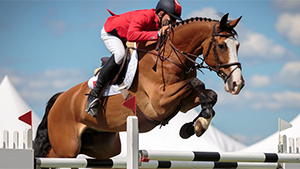
Several strides out from the fence, the horse raises its head to direct the binocular zone toward the obstacle. It collects the depth information it needs: height, distance, approach angle. In the final 2 to 3 strides, the jump passes into the frontal blind spot below the muzzle. At that point, the horse is committed and executing — on data collected during the binocular assessment window, with nothing left to see.
Well-trained jumpers perform this sequence automatically and confidently. Horses whose head position was restricted during the binocular assessment phase arrive at takeoff with incomplete spatial data — which manifests as chipping in, hesitation, added strides, or knocked poles. The problem isn’t the horse’s eye. It’s that the eye was pointed in the wrong direction at the moment that mattered.