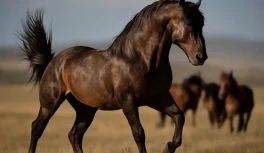
The horse is grazing quietly. A plastic bag catches the wind forty feet away. In under a second, the horse locks up, head high, nostrils wide — and a moment later may be in full flight. To an observer without context, the reaction looks wildly out of proportion. To someone who understands equine visual biology, it’s the predictable output of a system that was never designed to wait and confirm.
Understanding why horses spook is the foundation of safe handling, effective training, and a working relationship that doesn’t feel like an ongoing negotiation with unpredictability.
Why horses spook: the evolutionary answer
The spook reflex is not a personality quirk or a management failure. It is a survival program selected for over millions of years.
Horses evolved in open grassland environments alongside predators capable of explosive attacks with minimal warning. In that context, the nervous system that survived was the one that erred toward caution. A horse that waited to confirm whether a movement was actually dangerous before responding was often the horse that didn’t escape in time. A horse that reacted to any unexpected stimulus — and was wrong ninety-nine times out of a hundred — was the horse that lived.
The math of prey-animal survival favors the over-reactor. Every domestic horse alive today is descended from that animal.
Domestication has layered training and habituation on top of this program. It hasn’t erased it. What familiarity and consistent handling do is raise the activation threshold for specific stimuli in specific contexts. The program still runs. The trigger level adjusts.
How monocular vision creates the spook trigger
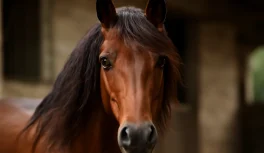
The largest portion of the horse’s visual field is covered by monocular vision — each eye operating independently, with each covering roughly 190 degrees. In these lateral zones, the horse detects motion with exceptional sensitivity. What it does not have is reliable depth perception.
When an object appears in the monocular zone — especially if it’s moving — the horse receives a specific and incomplete piece of information: something is moving here, but I can’t tell precisely what it is, how large it is, or how far away it is.
A human with binocular frontal vision sees a plastic bag forty feet away and immediately assesses it as small, distant, and inoffensive. A horse perceiving the same bag through lateral monocular vision receives: moving object, uncertain size, uncertain distance. The visual system flags it as requiring a response before any further analysis is possible.
That response is alert-and-prepare-to-flee — not because the horse has decided the bag is dangerous, but because the visual system has identified a situation that exceeds its confidence threshold. The alarm fires before the cortex can evaluate.
Why moving objects trigger horses more than static ones
The rod photoreceptors that populate the monocular zones are tuned for change detection — differences in light intensity over time, which is the signature of motion. These cells don’t differentiate color or fine shape. They register: did something move?
A strange object standing still in a field may be evaluated and ignored. The same object swaying, rustling, or inflating catches the attention immediately. The plastic bag anchored to a fence post is less alarming than the same bag billowing in the wind. The banner at rest is less triggering than the banner snapping in a gust.
Motion is the trigger. The lateral visual system was built to find it — and it does, reliably.
Why do horses sometimes spook at the same thing repeatedly?
Habituation to a specific stimulus is context-specific. A horse that has established “flag in the outdoor arena on calm days = safe” has not learned “flags in general = safe.” Encounter that same flag from a new angle, in an unfamiliar location, or paired with an unexpected sound, and the horse may react again.
This isn’t stubbornness or poor memory. It’s the specificity of associative learning: the horse encodes the particular combination of stimulus, context, and sensory experience — not an abstract category.
Light transitions and the unexpected spook
One of the most common and underappreciated spook triggers is the light-transition effect. The horse’s eye adapts more slowly to rapid luminance changes than the human eye does.
When a horse moves from a bright area into shade, or from a dim space into bright sunlight, there’s a transition window during which visual acuity is temporarily reduced. Objects that appear during this window — or that are revealed as the eye finishes adjusting — may register as appearing suddenly, with no visual precursor.
This creates a category of spooks that look completely random: the horse that has passed the same barrel a hundred times suddenly veers sideways as it moves under a shadowed overhang. From the horse’s perspective, the barrel wasn’t there — and then it was. That’s exactly the kind of sudden materialization the lateral detection system is hardwired to respond to.
Habituation: raising the threshold without removing the reflex
The most effective approach to horses that spook frequently is systematic habituation — controlled, progressive exposure to triggering stimuli until they’re reclassified as non-threatening.
This works because the nervous system updates its threat catalog over time. A stimulus that repeatedly produces no negative consequence gets filed as “not dangerous” and the response threshold rises substantially. The key variables:
- Start below the horse’s reaction threshold: introduce a lower-intensity version of the trigger first — smaller, slower, further away, less movement
- Progress only when the horse shows genuine calm: advancing to a more intense stimulus level before the horse has settled reinforces vigilance, not relaxation
- Allow voluntary investigation: when safe, letting the horse approach and sniff a scary object significantly accelerates reclassification
- Don’t punish the spook itself: the spook is a reflex, not a choice. Punishment increases arousal and can strengthen the negative association with the stimulus
The opposite process — sensitization — occurs when repeated exposures increase rather than decrease anxiety. Horses that are repeatedly startled by a stimulus without resolution don’t build tolerance; they build anticipatory anxiety. The environmental trigger becomes permanently loaded.
The rider’s role in the spook response
Horses are highly attuned to the physiological state of the humans they work with. A rider who tenses in anticipation of a known spook zone is providing the horse with a clear signal: something here makes my leader nervous.
This is not a metaphor. Horses register changes in heart rate, muscle tension, and breathing pattern in the people on or near them. A rider who tightens at the approach of a familiar trigger is transmitting confirmation that something worth monitoring is nearby — which primes the horse’s response, often creating the reaction the rider was trying to prevent.
The practical response is not to pretend that triggers don’t exist. It’s to train the rider’s own physiological regulation alongside equestrian skills — developing the ability to breathe through and release tension at known trigger points, so the horse receives a signal of calm rather than alarm.
The posterior blind spot and the most intense spooks
The most explosive and least-predictable spooks typically involve the posterior blind spot — the zone directly behind the tail where the horse has zero visual input. When a stimulus appears suddenly in that zone without auditory warning, the horse has received no precursor signals through any visual channel.
The response bypasses evaluation entirely. The horse doesn’t assess what triggered the spook — it executes an immediate exit. This is the fastest and most powerful version of the flight reflex, and also the one most likely to result in injury to handlers who are nearby.
Consistent awareness of the posterior blind spot, and the habit of announcing presence before entering it, prevents most incidents of this kind.