The horse that wins over anyone who loves performance and partnership
If you’ve ever felt goosebumps watching a horse “fly” at the trot, hitched only to a sulky that seems to sketch the wind, you’ve felt the magic of the American trotter. Born for speed and honed for consistency, it has everything horse lovers look for: attitude, stamina, a steady mind, and a real willingness to cooperate.
More than a racetrack sprinter, the American Trotter (the trotting branch of the Standardbred) is a versatile partner—quick to learn, up for challenges, and easy to retrain off the track, from leisure riding to distance events and ranch work.
History and origins of the American Trotter
The story of the American trotter is intertwined with the rise of harness racing in the United States. Its roots reach back to the late 18th century, when the Thoroughbred Messenger (imported in 1788) left descendants with a marked aptitude for the trot. From there came selective crosses with mares of varied origins—Canadian Pacer, Norfolk Trotter, Morgan—aimed at speed, hardiness, and a pure, roomy trot.
The turning point was Hambletonian 10 (Rysdyk’s Hambletonian, 1849), which set the genetic foundation of the Standardbred. In 1879 the name Standardbred became official: to qualify for the Stud Book, a horse had to cover 1 mile in 2 minutes 30 seconds—the “standard.” With continued improvement, that benchmark dropped to around 1 minute 50 seconds in the following decades, cementing the breed’s reputation for both speed and remarkable regularity.
Since then, the Standardbred has two performance types: trotters (diagonal gait) and pacers (lateral gait). The American Trotter is the line specialized in the trot, selected and trained to keep the gait clean even at top speed.
Physical and behavioral traits
The American trotter has a build made for high-level trotting:
- Height: roughly 4 ft 11 in to 5 ft 7 in (about 1.50–1.70 m).
- Weight: about 795–990 lbs (around 360–450 kg).
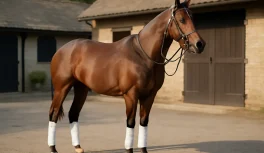
- Type: athletic, slightly longer than a Thoroughbred, with a useful back and powerful hindquarters that drive the movement.
- Head & neck: straight profile, broad forehead, slightly arched, well-set neck—for stability and control.
- Shoulders/chest: sloped and broad, favoring long strides and good oxygen intake.
- Limbs: solid bone, clean tendons, correct angles to absorb concussion at speed.
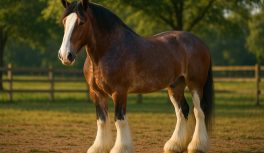
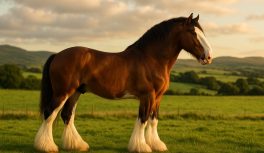
- Coat colors: most commonly bay, black, brown, and chestnut—though all colors are accepted.
Temperament-wise, it’s balanced, sharp, and cooperative. The racetrack life favors cool-headed horses—focused in noisy, bright, crowded environments—with strong mental recovery. They learn quickly, respond well to clear routines, and accept conditioning, which helps a lot when retraining them for new under-saddle jobs after the track.
Gaits: the trot is elastic, pure, and steady, with minimal tendency to “break” when training is consistent. Even at racing speed, the diagonal coordination holds with impressive rhythm—that’s the signature of the trotting branch.
Typical aptitudes and uses
American Trotter in harness racing
The breed’s main stage is the harness track. There, its ability to sustain a fast trot over long distances shines. Training blends cardiovascular conditioning, specific strength, and mental routines to preserve gait purity during bursts (the break, the stretch run, overtakes). In U.S. racing, trotter and pacer events are run separately, reinforcing the functional differences between the two types.
Transitioning to the saddle (after racing)
A major virtue of the breed is its versatility off the track. Many retired American Trotters are re-educated for riding, becoming excellent trail and leisure horses, doing well in entry-level endurance, ranch work, recreational driving, and even introductory dressage. Their roomy trot and collaborative temperament make the process easier.
Sporting and recreational driving
Beyond the racetrack, single or pair driving—over scenic routes or combined tests—finds in the American Trotter a reliable engine: rhythm, courage, and economy of motion.
A family horse
Its cool head and metronomic rhythm make it a good candidate for equine-assisted activities and for beginners under instruction. In a family setting, it’s usually gentle and generous when handled correctly and given a well-managed transition out of racing routines.
Interesting facts
- Two “languages” in the Standardbred: trotter (diagonal) and pacer (lateral). Pacers often use hobbles; trotters generally don’t—their coordination is neuromuscular and reinforced through training.
- Historic times mentioned: in trotting, Prakas covered 1 mile in 1:53; in pacing, Niatross clocked 1:49 (quoted as world records in the source material).
- Gait genetics: excellence in trotting and ambling has been linked to a mutation in the DMRT3 gene, which affects spinal circuits involved in gait coordination.
- Cultural use: Amish communities often use Standardbreds for buggy pulling; the breed also appears in shows and has improved other populations thanks to its speed and toughness.
Myths about the breed
- “Trotters aren’t good under saddle.” Myth. With a retraining program, many become excellent trail and leisure mounts and even handle entry-level competitions well.
- “They’re hot because they’re racehorses.” Myth. Selection favors mental stability; track environments demand cool focus, not explosive temperaments.
- “They only shine on the track.” Myth. Versatility is a strong suit: driving, light endurance, ranch work, equine therapy—common post-career paths.
- “All trotters have flimsy conformation.” Myth. The American Trotter is known for solid bone and practical functionality, built for intense, regular training.
- “Trotters can’t canter well.” Partly false. While training emphasizes the trot, many show a balanced canter when ridden and schooled.
An athlete born to be a partner
The American trotter proves that performance and gentleness can go hand in hand. On the track, it showcases the science of a perfect trot; away from it, the art of partnership. Whether you dream of harness-racing adrenaline or want a safe, willing companion for trails, driving, or basic schooling, the American Trotter delivers stamina, intelligence, and an athlete’s heart—three ingredients that make any path lighter and more beautiful.